

Barcelona has become the epicenter of real estate regulation in Spain. Since March 2024, the Catalan capital strictly applies rent limitation measures after being officially declared a stressed residential market zone (zona de mercado residencial tensionado). This declaration, with an initial validity of three years, has completely transformed the rules of the game.
If your goal is to acquire a home to live in, the impact is limited. However, if you are considering buying a flat in Barcelona for investment purposes, the situation changes radically. You can no longer calculate your financial returns based on the prices you observe on real estate portals. It is essential to understand the legal and financial implications before taking any step.
How does the stressed zone affect buying a flat in Barcelona?
For a buyer, the first clarification is of vital importance: the declaration of a stressed zone does not limit the sale price of free-market housing. Buyer and seller can fully and freely agree on the acquisition price of the property. If you find a flat that fits your needs for 500.000 €, you can buy it for that amount without the law preventing it.
The regulation comes directly into play when you decide to put that home on the long-term rental market. It is here where the law limits the maximum rent you can demand from the tenant. Therefore, we must clearly distinguish the purpose of the acquisition:
- Purchase for personal use: The impact of the stressed zone is residual, limited to contextual aspects of the local market.
- Purchase as an investment: The regulations directly condition the income the asset will generate and, therefore, its real net profitability. It is essential to perform a due diligence on the property before committing capital.

The rental history: why the previous rent is your limit
One of the most common mistakes among investors is believing that acquiring a property "resets" its rental history. This is not the case. In stressed zones, the limitations are linked directly to the property, not the owner.
If the flat you are going to acquire has been rented as a primary residence in the last five years, the new rental agreement cannot exceed the last rent of the previous contract, once the legally applicable update has been applied.
Let's imagine a very common practical case:
- Purchase price of the flat: 450.000 €
- Rents of similar properties advertised in the area: 1.700 €/month
- Last actual rent of the previous contract (updated): 1.250 €/month
If you buy this property to rent it out, the legal limit you can demand will be 1.250 €/month, not the 1.700 €/month you see on online platforms. This discrepancy can ruin any business plan if not detected in time. For this reason, requesting the rental history from the seller before signing the deposit agreement (arras) is a mandatory step.

What happens if the flat has not been rented recently
What happens if the property has been vacant or inhabited by its own owners during the last five years? In this scenario, as there is no recent reference rent, the previous contract rule cannot be applied.
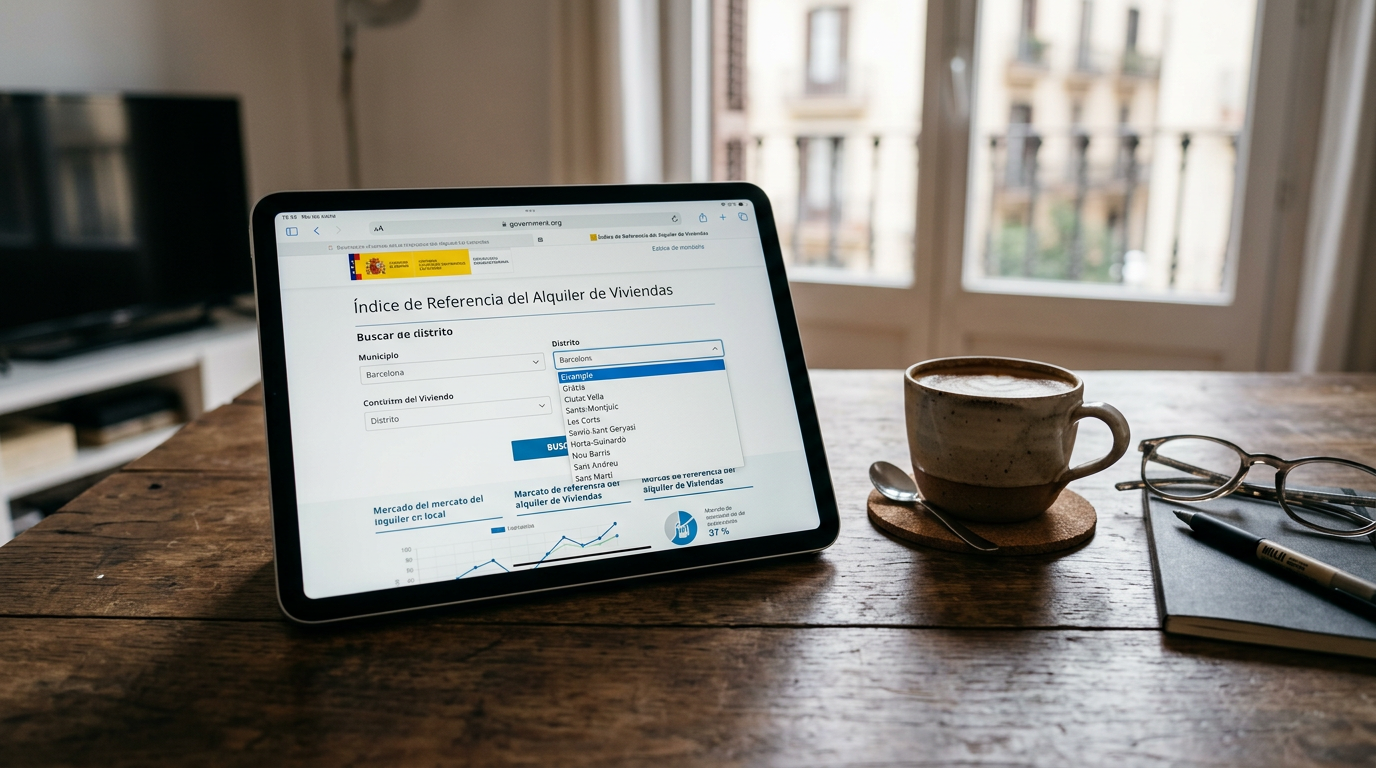
However, this does not grant you absolute freedom to set the rent. In the absence of contracts in the last five years, the rental price is entirely subject to the state Índice de Referencia de Precios de Alquiler (State Rental Price Reference Index). You must consult the range assigned by the system to the specific characteristics of your property (location, surface area, state of preservation, year of construction, etc.) and you cannot exceed the upper limit of that range.
Knowing what it means for Barcelona to be a stressed area (zona tensionada) will help you anticipate whether your property will be subject to these strict price ranges or if there is any room for negotiation.
The impact of being a large property owner (gran tenedor) in Catalonia
If you already have several properties in your investment portfolio, you must pay special attention to your legal status. In Catalonia, the declaration of a stressed zone (zona tensionada) reduces the threshold to be considered a large property owner (gran tenedor) to the ownership of five or more urban residential properties located in these areas.
If you hold the status of a large property owner (gran tenedor), the limitations are even more restrictive. When you rent out a property (even if it has a rental history in the last five years), the price of the new contract will be capped by the lower of these two figures:
- The rent of the previous contract, duly updated.
- The maximum limit set by the state reference price index.
Therefore, if you buy an apartment where the previous rent was €1,650/month, but the state index sets a maximum of €1,450/month for that property, as a large property owner (gran tenedor) you can only charge €1,450/month. It is essential to check if you qualify as a large property owner (gran tenedor) before adding a new asset to your portfolio in Catalonia.
Exceptions: when can the rent be increased by 10%?
The Spanish Urban Leases Act (LAU - Ley de Arrendamientos Urbanos) contemplates specific cases in which it is possible to increase the rent by up to 10% above the limit of the previous contract. These cases are exceptional and must be perfectly documented:
- Refurbishment works: Executed within the two years prior to the signing of the new lease agreement.
- Energy efficiency improvements: Leading to non-renewable primary energy savings of at least 30%, duly certified.
- Accessibility improvements: Installation of elevators, ramps, or other elements that guarantee universal mobility in the building or property.
- Long-term contracts: When the lease agreement is signed for a minimum period of ten years, or extensions are agreed upon that allow the tenant to remain uninterruptedly for that period.
Do not automatically assume this increase in your business plan; the conditions are very strict, and any error in the documentary justification can lead to legal claims from the tenant.
Risks of buying an already rented apartment or renting by rooms
A common alternative for many investors is buying an already rented property. This operation offers the advantage of generating a return from day one, but introduces significant legal risks in stressed areas (zonas tensionadas).
Firstly, the sale does not terminate the current lease agreement, meaning you subrogate to the rights and obligations of the previous owner. In addition, you must consider the extraordinary extensions provided for by the LAU (Spanish Urban Leasing Act) in these areas. A tenant in a stressed housing market area can request an extraordinary annual extension of the contract for a maximum of three additional years under the same conditions. Do not plan your investment assuming that the tenant will leave upon the expiration of the original contract.
On the other hand, the temptation to bypass these limitations by resorting to room-by-room rentals faces increasingly restrictive regional regulations. In Catalonia, the legislation establishes that the sum of the rents agreed upon in the different room contracts of the same property cannot exceed the maximum applicable rent if the property were rented as a single unit.
Essential documentation before signing the deposit agreement (arras)
To mitigate risks and ensure you are making a solid investment, it is vital to request a series of key documents from the seller before making any payment or signing the deposit agreement (arras). Your checklist must include:
- The current lease agreements or those entered into in the last five years.
- Proof of rent payments and the updates applied.
- Documentation regarding any expenses legally passed on to the tenant (such as the IBI (property tax) or the rubbish tax).
- The valid certificate of occupancy (cédula de habitabilidad) and the energy performance certificate.
- The updated Nota Simple from the Land Registry to rule out charges or easements.
- The Building Technical Inspection (ITE) and the minutes of the most recent homeowners' association meetings to anticipate future extraordinary assessments (derramas).
Before closing any transaction, the most advisable course of action is to have rigorous advice on buying a flat in Barcelona, ensuring that a professional thoroughly analyses all this documentation.
The real impact on the figures: a practical example
Suppose you are analysing a flat in Barcelona with a sale price of 400.000 €. Looking at rental portals, you see identical properties advertised for 1.600 € per month. With this superficial data, you might make the following estimate:
- Estimated annual income: 19.200 €
- Gross yield on purchase price: 4,80 %
However, after requesting the relevant documentation, you discover that the flat was rented until six months ago for a rent of 1.200 € per month. Since this is the maximum rent applicable by law, the real figures of your investment change drastically:
- Real annual income: 14.400 €
- Real gross yield on purchase price: 3,60 %
From this gross yield, you will have to deduct the IBI, community fees, non-payment insurance, property maintenance, and the corresponding taxes. This is a clear example of how failing to conduct proper due diligence can turn an excellent investment into an unprofitable business. Knowing these variables will allow you to calculate the profitability of a flat in Barcelona with absolute precision and legal certainty.
Conclusion
Buying a property in Barcelona today requires more rigor than ever. If your goal is to purchase a home to live in, the standard precautions regarding encumbrances and state of repair remain the priority. However, for investors, the declaration of a stressed market area (zona tensionada) adds an unavoidable layer of legal complexity.
Do not rely on theoretical yields based on asking prices. Find out the previous rent, simulate the state index, evaluate your profile as a property holder, and make sure you know what to check before buying. Only a rigorous and professional analysis will allow you to buy with full guarantees and protect your capital in Barcelona's dynamic market.