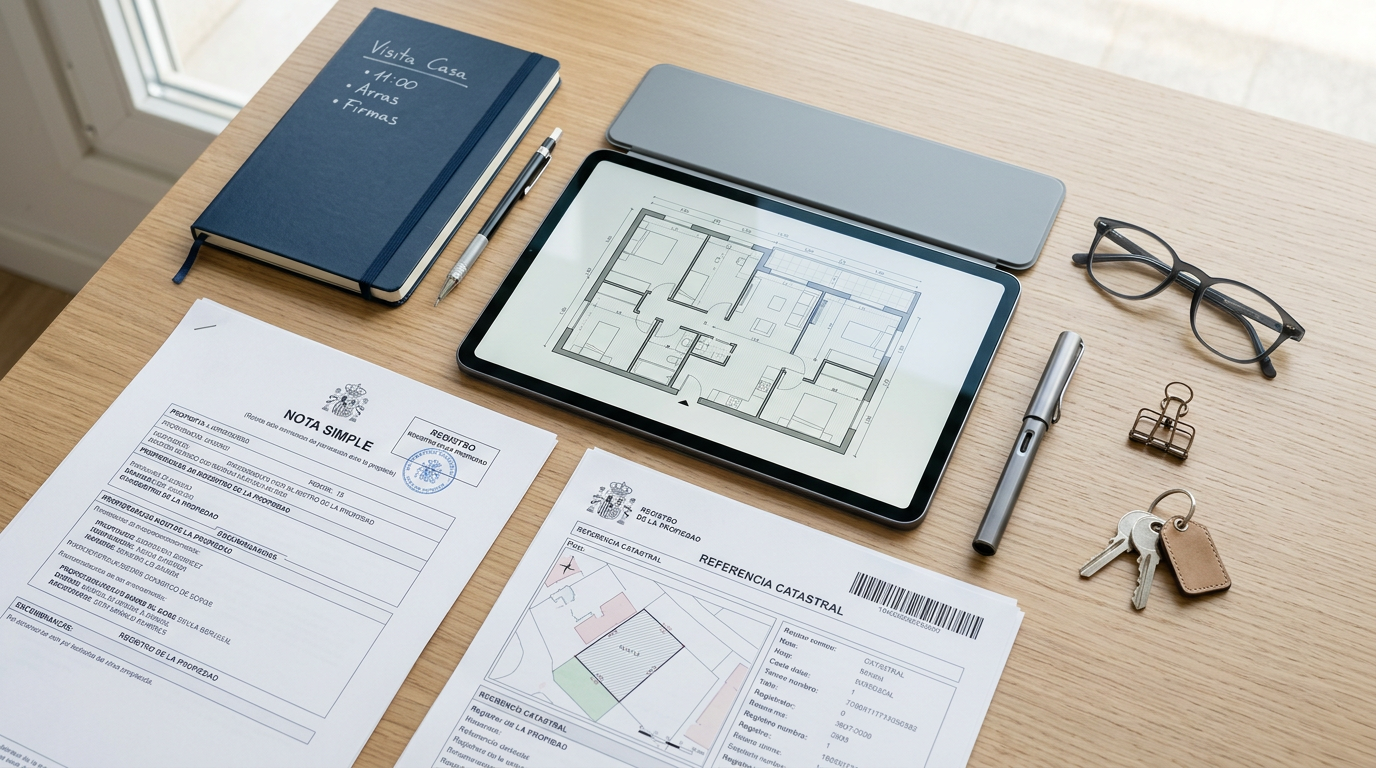
Buying a home is one of the most important financial decisions in life. However, it does not only consist of checking its price, visiting the property, and getting a mortgage. Before signing any document that commits you, such as a reservation or a deposit contract (contrato de arras), it is crucial to know all the legal and technical details of the property.
Who is the real owner? Are there hidden charges? Is the terrace you like so much legal? Are there approved extraordinary expenses (derramas) in the community that you will have to pay? A real estate due diligence is the research process that answers these and other questions, allowing you to make an informed and safe decision.
What is real estate due diligence and what is it for?
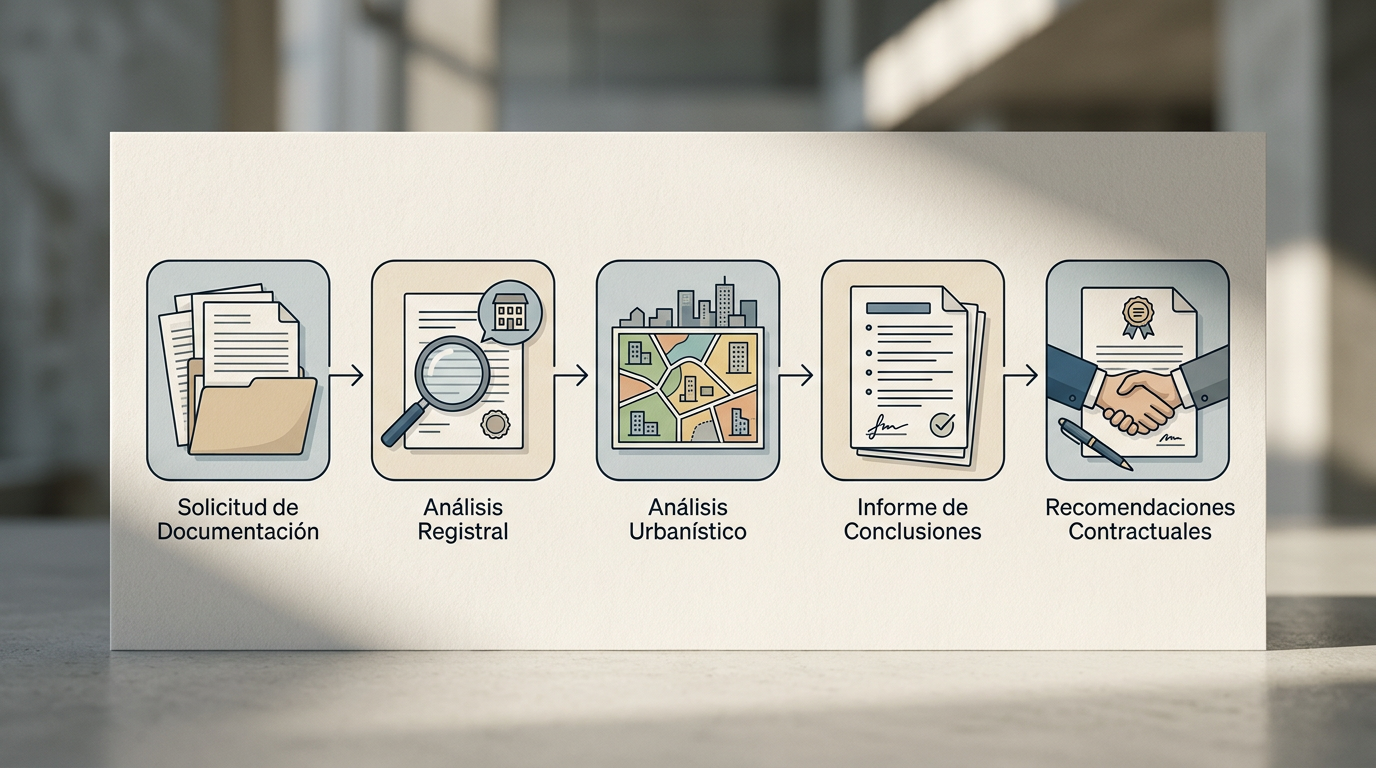
A real estate due diligence is an exhaustive audit or investigation into the legal and documentary status of a property that is carried out before the purchase. Its objective is to identify and evaluate any risk or circumstance that could affect the property, its use, its value, or future costs for the buyer.
The purpose is not simply to collect documents, but to interpret them, connect the possible problems detected, and determine how they should be resolved or reflected in the purchase contract.
Although the term "due diligence" does not refer to a single legally regulated document, its scope is adapted to each property. A second-hand apartment does not require the same checks as a house with extensions or a protected housing (VPO). Institutions such as la Generalitat de Cataluña highlight the importance of reviewing the previous legal status of the property, demonstrating that this analysis should not be limited to the moment of the deed.
Is it mandatory?
No, there is no legal obligation to hire a due diligence to buy a home. However, the fact that it is not mandatory does not mean it is not necessary.
The buyer assumes important obligations from the signing of a simple reservation. For this reason, the Consejo General del Notariado recommends getting thoroughly informed before signing or handing over money. Performing this review allows you to negotiate, demand corrections, or even decide not to proceed with the purchase when you are still in time.
When should it be performed?
The ideal time to start a due diligence is just after finding the desired home and before handing over any significant amount of money. The optimal thing is to review the documentation before signing arras. If you must pay a deposit to reserve, the document should condition the continuity of the operation to the satisfactory result of this legal review. Leaving everything for the day of the deed is a mistake; although the notary performs checks, their intervention is at the end of the process, when you have already assumed firm economic commitments.

What does a real estate due diligence review?
A complete and professional review goes much further than requesting a nota simple (land registry certificate). It cross-analyzes multiple sources of information to build a faithful image of the reality of the property, which includes what to check before buying a home.
1. Ownership and capacity to sell
The first question is: who is selling and can they do it? The nota simple from the Registro de la Propiedad and the deeds are reviewed to confirm the identity of all owners, the existence of usufructs, the need for notary powers of attorney, or special authorizations (in cases of inheritances, companies, etc.).
2. Liens and registry limitations
Does the house have "backpacks"? A review of registry charges is carried out to analyze all those registered:
- Mortgages and foreclosures.
- Usufructs or termination clauses (condiciones resolutorias).
- Easements (right of way, light, etc.).
- Prohibitions to dispose.
- Tax liens or VPO (protected housing) limitations.
The due diligence explains what each charge means, how it can be cancelled, and what should be regulated in the contract to protect you.
3. Correspondence between Registry, Catastro, and reality
The house you have visited must be the same one that appears in the documents. Information on surface area, use, distribution, and boundaries is compared between the physical reality, the Registro de la Propiedad, and the Sede Electrónica del Catastro. A discrepancy can hide illegal works and affect the appraisal, financing, or future renovation projects.
4. Urban planning situation
Is the full renovation legal? Can the terrace be enclosed? This analysis checks building permits, possible undeclared changes of use, urban discipline files, or architectural protections. It is key in penthouses, ground floors with patios, single-family houses, and premises converted into housing.
5. Habitation certificate and technical documentation
In communities like Catalonia, the cédula de habitabilidad (habitation certificate) is essential. Its existence, validity, and correspondence with the property are verified. The energy efficiency certificate is also reviewed. The lack of a document does not always prevent the purchase, but you need to know why it is missing and who must obtain it.
6. ITE and building status
When buying an apartment, you acquire a part of the common elements. It is fundamental to analyze the ITE of the building (Technical Building Inspection) to know the state of the structure, facade, and roof. Passing the ITE does not mean there are no serious deficiencies or expensive repairs pending execution.
7. Community of owners and derramas
The certificate of being up to date with payments is not enough. The latest community minutes, budgets, and statutes are reviewed. The minutes can reveal future problems, such as the study to change the elevator or repair the facade, which are not yet an approved derrama (extraordinary assessment) but will involve a significant expense for you.
8. Occupancy and leases
Who lives in the property? It is verified if it is occupied by the seller, a relative, a tenant, or if it is empty. If there is a rental contract, it is fundamental to analyze its conditions, as you might have to respect it.
9. Reservation and arras contract
The due diligence does not end with the analysis of the property; it culminates in its correct contractual drafting. If a problem is detected, the contrato de arras or reservation must reflect the solution: what the seller must do, in what timeframe, and what happens if they do not comply. It is vital to know how to review a reservation or an arras.
10. Financing and total cost
If you need a mortgage, the contract must protect you. Clauses on financing (suspensive condition), realistic deadlines to obtain it, and the consequences of a low appraisal are reviewed. The total cost of the operation is analyzed, including taxes (ITP, IVA), expenses, and possible future derramas.
Main problems that a due diligence can detect
A well-done investigation can bring to light situations that will save you thousands of euros and many headaches:
- That the seller is not the sole owner and a co-heir's signature is missing.
- That there is a foreclosure about to be executed.
- That the terrace or the storage room being sold to you are not for private use or do not even belong to the property.
- That the property is listed as commercial premises in the Registry and not as housing.
- That the extra room was built without a license and there is a demolition order.
- That the ITE of the building is unfavorable and forces a millionaire rehabilitation.
- That the community has approved a derrama of €10,000 per owner that the seller "forgot" to mention.
- Que la vivienda está alquilada con un contrato de renta antigua (old rent control contract).
- That the arras contract you were going to sign does not allow you to recover your money if the bank denies you the mortgage.
Have you found a home and don't know if the documentation is correct? We analyze the registry, urban planning, and community situation before you sign or hand over money.
What does a legal due diligence not replace?
It is important to understand that a legal and documentary review does not replace a technical inspection. A lawyer can detect that a work does not have a license, but it is an architect who must assess if there are cracks, dampness, or structural problems.
Nor should it be confused with an appraisal (tasación), whose objective is to determine a value for the market or for a mortgage guarantee, but without entering into the analysis of community minutes or arras contract clauses. Both the technical report and the appraisal are complementary to the legal due diligence.
When is due diligence especially recommended?
Although it is always advisable, due diligence becomes essential in operations with certain particularities:
- Old homes or in buildings without rehabilitation.
- Properties with extensions, terraces, patios, or annexes.
- Penthouses and ground floors.
- Properties coming from an inheritance.
- Properties that have been fully renovated.
- Premises converted into housing.
- Protected housing (VPO/VPP).
- When the seller acts through a notary power of attorney.
- If the purchase depends on obtaining financing.
- If the agency or the seller rushes you to sign.
Frequently Asked Questions about Real Estate Due Diligence
Is it the same as requesting a nota simple?
No. The nota simple is just one of the many documents reviewed in a due diligence, which also analyzes Catastro, urban planning, community, ITE, contracts, and more.
Doesn't the real estate agency already do this review?
The agency collects documentation and mediates in the operation, but its function is not to perform an independent and exclusive legal audit in the best interest of the buyer. Their incentives are aligned with closing the sale.
When should I order it?
Ideally before signing the contrato de arras. If you have already signed it, it should be done as soon as possible and always before the public deed to be able to react in time.
Does it guarantee that I will never have a problem?
It drastically reduces foreseeable risks based on available documentation and information. It cannot 100% guarantee the non-existence of undeclared hidden defects or problems not recorded in documents, but it is the best tool to minimize them.
Conclusion
A real estate due diligence is your best insurance for a peaceful purchase. Its value is not only in finding problems, but in offering you a complete and truthful image of what you are buying, allowing you to negotiate better conditions or withdraw from a bad operation before it is too late.
At INMODOCS we analyze all the documentation of the home, identify risks, and advise you on how to reflect it in the contract. Most problems are easier and cheaper to solve before signing. Know the risks of the housing and the conditions that should be incorporated into the contract. Before buying, know exactly the property and the obligations you are assuming.

Before signing the deposit
If you are considering buying in Barcelona, read the full guide: Buying a flat in Barcelona without surprises.
This content is of a general informative nature and does not replace professional legal or technical advice adapted to a specific operation.