

Before buying a property in Spain, it is fundamental to conduct an exhaustive analysis of its legal and registry situation. It is not enough for the flat to fit what you are looking for or for the price to be attractive; you must reliably verify who the actual owner is and if there are mortgages, embargoes, usufructs or other limitations that could frustrate the transaction.
This review should always be carried out before handing over any significant amount of money. Waiting until the day of signing the deed before a notary can be too late if you have previously signed a contrato de arras (deposit agreement) that does not regulate in detail how detected charges should be managed. In this sense, performing correct checks before buying a home is the smartest step to secure your investment.
Furthermore, it is worth knowing that not all charges have the same level of gravity or the same consequences. While a mortgage is usually cancelled simultaneously with the transfer without major complication, a judicial embargo, a prohibition to dispose or an execution procedure can completely prevent the sale. Below, we explain in detail how to check property charges, what the most common encumbrances mean and how to act upon them.
What is a charge on a property?
A charge is a right, limitation or encumbrance recorded on a property that restricts the powers of its owner or, failing that, grants preferential rights of collection or use to third parties (such as banks, public administrations or individuals).
Among the most common charges that can be found registered are:
- Mortgages: They guarantee a bank loan.
- Embargoes: Decreed by judges or the public administration (such as Hacienda or Social Security) due to unpaid debts.
- Usufructs and rights of use: Grant a third party the right to enjoy the property.
- Easements: Rights of way or views in favor of adjacent properties.
- Resolutory conditions: Guarantees for deferred payment of previous transfers.
- Prohibitions to dispose: Legal or judicial restrictions that prevent the sale of the asset.
- Tax Liens: Marginal notes that link the property to the payment of taxes from past transfers.
According to the Colegio de Registradores, the information from the Property Registry is the only one that allows knowing with certainty the ownership and limitations affecting a property. The existence of charges does not necessarily mean you should discard the sale, but it does require determining their scope, whether their cancellation is viable and who will assume the involved costs.
1. Request an updated nota simple
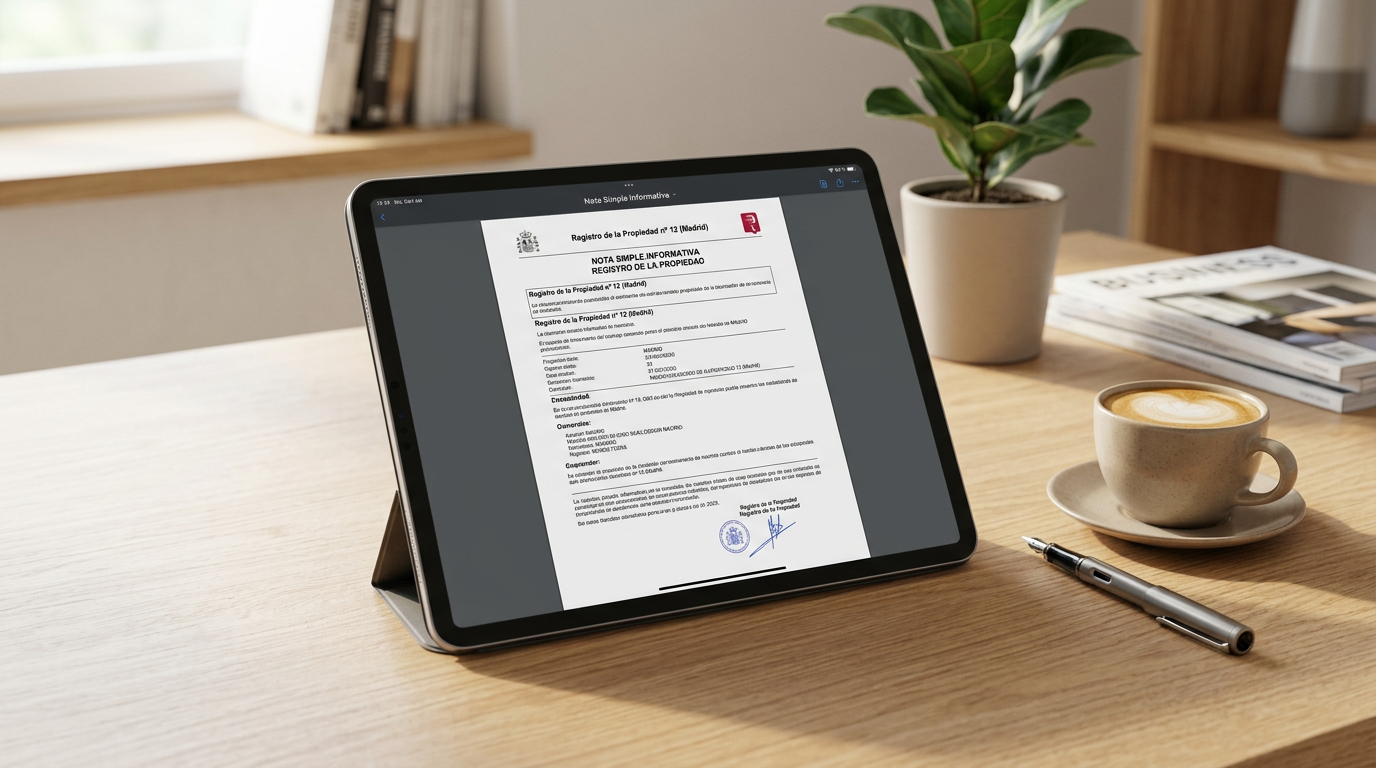
The main and essential document to check property charges is the nota simple informativa from the Property Registry. It is a public document that summarizes the legal status of the property.
The nota simple contains vital information divided into several sections:
- Identification and description of the property: Useful and built surface area, boundaries and technical distribution.
- Ownership: Name of the current owner or owners and their share of participation (for example, if it is sold 100% or if it belongs to several co-owners or heirs).
- Charges: Detail of all mortgages, embargoes or other current encumbrances on the property.
To obtain it, you can request it online on the official website of the Colegio de Registradores de España. It is a priority that this document be very recent (from the last few days). A nota simple obtained months ago is useless, as the owner could have received an embargo notation or established a new charge in that interval of time.
Likewise, before committing funds, it is prudent to request the documentation before signing deposit agreement to verify that everything matches the seller's statements.
2. Check that the note corresponds to the property
A surprisingly common mistake is to assume that the nota simple read corresponds exactly to the physical property you have visited. Before assessing the charges, perform the following cross-checks:
- Exact match of the postal address, floor, door and registry property number.
- Verify the described cadastral reference. If you detect inconsistencies in the surfaces or divisions, you should analyze what happens if you need to compare Registry and Catastro to correct possible discrepancies.
- Check the annexes: garage spaces and storage rooms are usually independent registry properties. Therefore, you will need to request and analyze a specific nota simple for each of them, as they could have their own charges separate from the home.

3. What to do if a mortgage appears
Finding a registered mortgage is the most common charge and should not scare you. However, it requires a methodical organization for its correct liquidation.
It is fundamental to know that the amount of "mortgage liability" that appears in the nota simple does not reflect the actual debt remaining for the seller to pay. That value is the maximum for which the property is liable to the bank. To know the exact amount pending, the seller must provide a certificate of outstanding debt balance issued by their financial institution.
From there, there are three formulas to proceed with the sale:
Prior economic and registry cancellation
The seller uses their own funds to settle the debt with the bank and goes to the notary to sign the mortgage cancellation deed before selling the house to you. This is the ideal scenario for the buyer, although it is not always viable if the seller depends on the money from your purchase to pay the bank.
Simultaneous cancellation at the time of signing
This is the most common method. At the moment of signing the purchase deed, the buyer appears with two bank checks (or urgent Bank of Spain transfers): one destined for the seller's entity to cancel the pending loan, and another with the remaining balance for the seller. Additionally, a provision of funds is retained to cover the registry cancellation costs of said mortgage.
Mortgage subrogation
The buyer decides to "assume" the existing mortgage, becoming the new debtor under the same conditions. For this to happen, the seller's bank must analyze the buyer's solvency profile and expressly authorize the operation.
Remember that, as explained by the Banco de España, for a paid mortgage to legally disappear from the map, the cancellation must be carried out in the Property Registry, a procedure that many owners forget to perform after paying their last installment.
4. What it means if an embargo exists
An embargo indicates that a court or a public entity (such as the Agencia Tributaria or the city council) has decreed a lien on the property to guarantee the collection of a debt from the current owner.
If you find an embargo noted in the nota simple, you must take extreme precautions. Before signing anything, it is mandatory to know:
- Which body or court has ordered the embargo.
- The official procedure number and the amount claimed (including interest and costs).
- Obtain an official debt liquidation document and a commitment to lift the embargo issued by the creditor.
Buying a property with an active embargo without ensuring the retention of funds to cancel it directly at the moment of signing would transfer the responsibility to answer for those debts with the property itself to you. For safety, it is recommended to have a comprehensive real estate due diligence to protect these complex operations.
5. Usufructs, rights of use and purchase options
If a life or temporary usufruct is reflected in the nota simple, it means that the seller holds the "bare ownership" (nuda propiedad), but another person (the usufructuary) has the legal right to use the property or rent it for their own benefit.
For the purchase to be carried out free of this limitation, the usufructuary must appear in the public purchase deed to sell or renounce their usufruct right. Otherwise, you would acquire a property where you could not legally move in.
The same applies to purchase option rights previously granted to third parties: if they are current and registered, the beneficiary has absolute priority to acquire the property within the agreed deadlines.
6. Easements and resolutory conditions
Easements (such as rights of way, light or aqueduct) are rarely cancelled, since they are part of the physical and neighborhood configuration of the building. You simply need to know them and evaluate if they interfere with the use you intend for the property.
In contrast, the resolutory condition is a warning of danger. It indicates that a previous seller deferred part of the payment for the house and that, if this was not completed, the former owner can demand to recover the house. You must demand that the payment letter be provided and the condition be cancelled in the registry before formalizing your acquisition.
7. Prohibitions to dispose and preferential acquisition rights
A prohibition to dispose is an absolute block on the ability to sell recorded in the Property Registry. It usually derives from criminal proceedings, bankruptcy or specific clauses in family donations.
If the nota simple of the property shows a current prohibition to dispose, the Registrar will refuse to register the property in your name. The operation cannot proceed under any circumstances until said prohibition is lifted by the relevant authority.
8. Tax and urban planning encumbrances
Tax liens (afecciones fiscales) are very common marginal notes indicating that the property is subject to the final payment of taxes from previous transfers during a usual period of five years. Although they do not normally prevent the sale, it is advisable to check that the seller correctly settled their previous obligations.
Regarding urban planning encumbrances (afecciones urbanísticas), these may indicate that the land is subject to pending development costs or city council reparceling plans that could lead to significant future levies for the new owner.
9. Charges that do not clearly appear in the nota simple
The Property Registry is paramount, but not everything is listed there. There are debts linked to the property that you must check in person or through documentation:
- Debts with the Community of Owners: You must demand a certificate issued by the property manager certifying that the property is up to date with the payment of all ordinary fees and extraordinary levies.
- Property Tax (IBI): Be sure to request the payment receipts for this municipal tax corresponding to the last four years.
- Rental contracts or tenants: Rental agreements are not always registered in the Registry, but they remain valid by law. It is vital to confirm that the property is delivered vacant and free of occupants.
What the deposit agreement should indicate to protect you
Faced with any slight doubt about the registry status of the property, the contrato de arras becomes your greatest legal shield. Do not limit yourself to signing standard internet templates; it is essential to review the deposit conditions so that the final wording specifies precisely:
- The seller's explicit commitment to transfer the property completely free of charges, encumbrances, tenants and occupants.
- The obligation to provide zero balance certificates and process economic cancellations at the time of signing.
- The right to terminate the contract (with the corresponding double return of the deposit) if the seller fails to documentally clear complex charges (such as embargoes or prohibitions) before the agreed deadline for signing the deed.
Quick checklist to check charges on a property
Before placing your signature on any reservation or deposit document, make sure to check off the following steps:
- Request a nota simple less than 10 days old.
- Verify the identity appearing in the Registry of all co-owners.
- Request a zero debt certificate or pending balance of the active mortgage.
- Check that there are no preventive notations of current embargoes.
- Verify that there are no usufructs restricting full ownership.
- Check the community certificate signed by the board secretary.
- Request the last paid IBI receipt from the seller.
Frequently Asked Questions
How can I know if a property is free of charges?
The primary way is to request the nota simple informativa from the Property Registry. Additionally, you should gather non-debt certificates from the community of owners and the last paid local IBI receipts.
Can a property with an active mortgage be bought?
Yes, it is perfectly common. The crucial thing is to organize the retention of funds to economically cancel said loan at the same moment the purchase is signed before the notary.
Do embargoes disappear if the seller says they have already paid?
No. Even if the material debt has been settled, the embargo will continue to weigh on the property in the Registry until the corresponding judicial or administrative cancellation order is presented at the registry office.
Does the nota simple indicate how much money the seller has left to pay?
No. The nota simple only shows the initial volume of mortgage liability for which the property is responsible. The real and updated balance is only known by requesting a pending debt certificate issued by the creditor bank.
Conclusion
Checking the charges of a property requires going beyond a superficial reading of the nota simple. Each registry notation, marginal note or tax lien hides legal implications that can burden your financial and heritage security for years.
While settling a previous mortgage loan is a standardized procedure, dealing with unresolved embargoes, prohibitions to dispose or easements requires a meticulous strategic analysis.
At INMODOCS, we exhaustively analyze the nota simple, ownership titles, cadastral documentation and community certificates of your future home before you commit a single euro. We transparently explain the detected charges and draft the necessary guarantee clauses in your contract so that you perform a completely safe property purchase. Checking property charges professionally is the only way to avoid inherited debts.

Before signing the deposit
If you are considering buying in Barcelona, read the full guide: Buying a flat in Barcelona without surprises.