
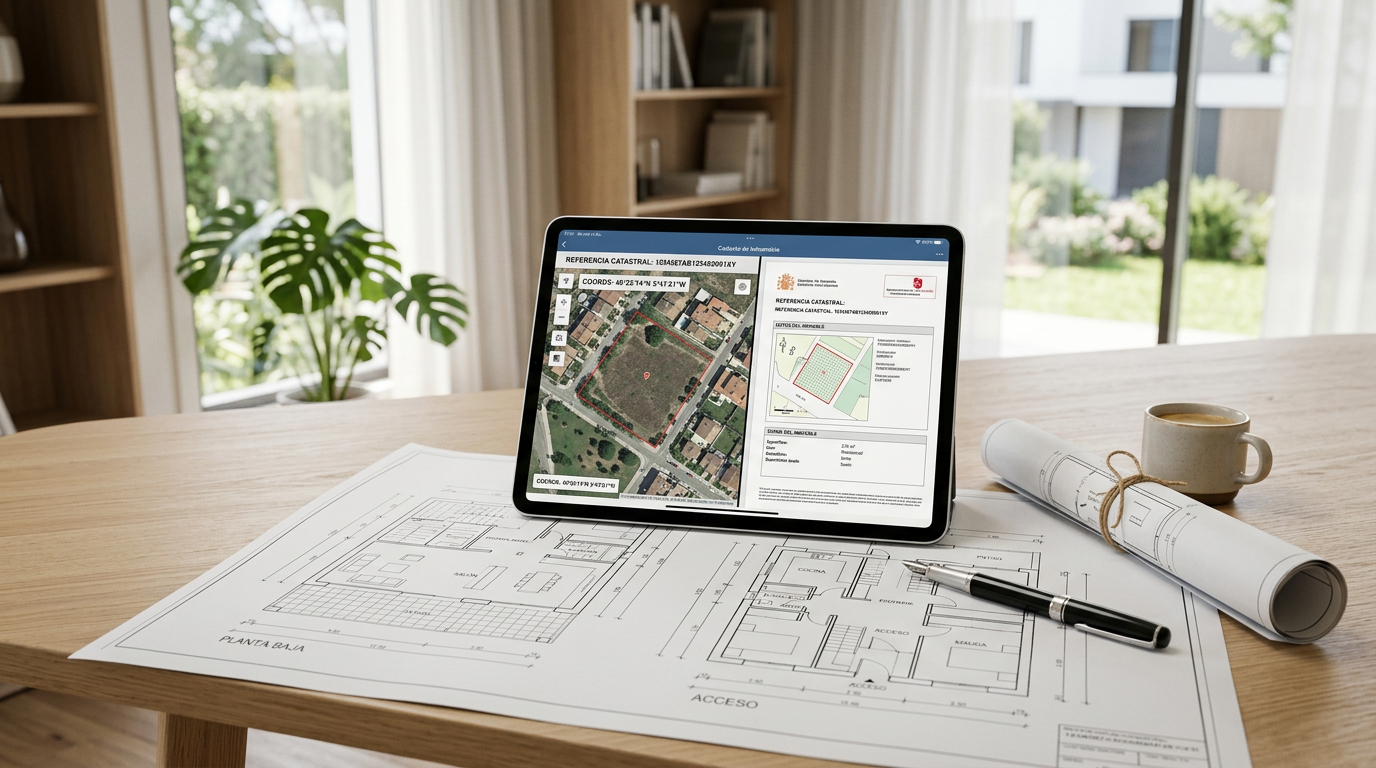
It is extremely common to find a home advertised with a certain area, listed in the Catastro (Cadastre) with a different one and, to add further confusion, have yet a different measurement in the nota simple from the Registro de la Propiedad (Property Registry).
For example, it is not unusual to see a property advertised with 95 m², which in the Catastro Electronic Office appears with 88 m² and whose registry file indicates only 76 m².
These differences do not automatically mean that the sale should be ruled out. They may originate from different calculation methodologies, the inclusion of community areas, or the presence of registry descriptions that are decades old. However, they sometimes reveal problems that require immediate attention, such as the illegal enclosure of a terrace, the unregulated incorporation of storage rooms or patios, or new construction extensions without a license.
When registry and cadastre do not coincide, it is not enough to arbitrarily choose the figure that is most advantageous. It is essential to carry out a series of checks before buying a home to identify the physical, cadastral, and mortgage reality and secure your investment without risks.
What is the difference between Registry and Cadastre?
Although both bodies collect information on real estate, it is fundamental to understand that the Registro de la Propiedad and the Catastro Inmobiliario are completely independent institutions with different purposes.
- The Registro de la Propiedad: It is a public institution under the Ministry of Justice whose main purpose is to guarantee legal certainty. The Registry provides public certification of who the legitimate owner of a home is and details the existence of liens, mortgages, foreclosures, or use limitations. To be fully protected, it is crucial to review the nota simple of the property before making any payment.
- The Catastro: It is a mandatory administrative registry under the Ministry of Finance. Its primary function is fiscal and tax-related. It is the tool used to geographically locate a property, determine its exact built area using cartographic bases, assign the reference catastral (cadastral reference), and calculate the valor de referencia (reference value), which directly influences taxes such as IBI, ITP, or Inheritance and Gift Tax.
The following table helps to understand the role of each of these offices regarding a discrepancy:
| Feature | Registro de la Propiedad | Catastro Inmobiliario |
|---|---|---|
| Main Objective | Legal certainty and protection of property rights. | Fiscal, tax management, and administrative delimitation. |
| Registration | Voluntary (though recommended and essential for mortgages). | Mandatory and automatic by law. |
| Publicity Effect | Presumption of legal accuracy (what is registered is final). | Merely descriptive and instrumental information. |
| Methodology | Historically based on deeds and written oral declarations. | Digital measurement on aerial cartography and technical plans. |

Why can different surface areas appear?
The reasons why a property presents variations in capacity or meters on paper are divided into several common scenarios:
1. Different measurement criteria
A recurring error lies in comparing meters without discriminating their typology. It is not the same:
- Superficie útil (Net internal area): The livable space remaining inside the exterior walls of the property.
- Superficie construida (Gross floor area): Includes the entire perimeter contour, partitions, ventilation ducts, and 50% of shared dividing walls.
- Superficie construida con elementos comunes: The private built area plus the proportional share of hallways, entrances, stairs, and common areas.
While the Catastro usually records the built area reflecting common elements, Registry notas simples may only record the private built area or even the historical net area in old residential zones.
2. Obsolete registry descriptions
In Spain, thousands of properties have original deeds drafted 40 or 50 years ago. At that time, measurements were often made by eye-ball estimates or rudimentarily on imprecise plans. If there has been no recent sale or update process, that archaic description persists in the Registry, even if the physical reality of the home is different.
3. Non-legalized renovations, enclosures, and extensions
This is the most dangerous scenario for a buyer. It happens when the previous owner has undertaken major works without processing the municipal building license or formalizing the deed of declaration of new construction (obra nueva). Closing a terrace to add it to the living room, converting an attic or basement into rooms, or adding a floor to villas are usually incorporated automatically into the Catastro via Ministry of Finance aerial photos to collect taxes, but remain outside the protection of the Registry for lack of urban planning legality.
What does it mean for a property to be coordinated with the Cadastre?
Since the entry into force of Ley 13/2015 for the reform of the Ley Hipotecaria and the recast text of the Ley del Catastro, a coordination system between both entities was introduced.
When the Registry and the Cadastre manage to coordinate technically, the georeferenced graphic representation of the property is incorporated into the registry entry, usually based on cadastral cartography. Once the registrar records this representation, the law presumes that the property has the exact location and geographic limits reflected in said graphic plan.
If the nota simple indicates that the property is not graphically coordinated with the Catastro, we face a technical vulnerability that, while not preventing the purchase of the flat, does introduce uncertainty about the delimitation of boundaries, especially critical in rural land, plots, or detached houses.
The excess of area (exceso de cabida) and its regularization limits
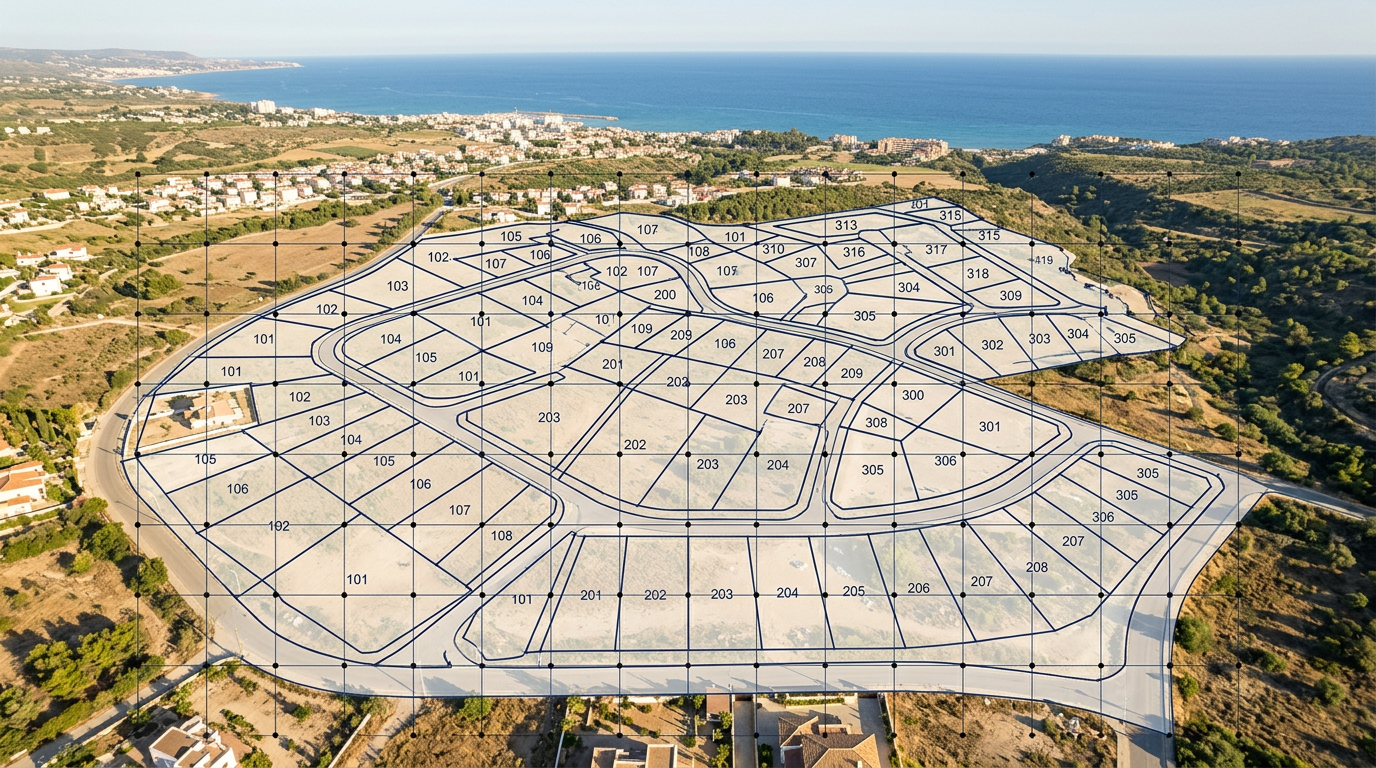
An exceso de cabida occurs when the actual area of the property is greater than the figure recorded in the Registro de la Propiedad. It is not equivalent to having irregularly annexed a neighbor's land or a common patio: it is, by definition, a rectification to reflect the real meters that the original property always had.
Mortgage regulations distinguish several scenarios for regularizing the meters:
- Difference of less than 5%: If the area increase does not exceed 5% of the area recorded in the Registry, it can be rectified by a direct statement from the parties in the new sale deed, assuming no doubts arise about the real identity of the property.
- Difference of up to 10%: If the excess is less than 10%, the property registrar can rectify the area using a Certificación Catastral Descriptiva y Gráfica, requiring full geographic agreement between the property described in the Cadastre and the one being transferred.
- Differences exceeding 10%: In these scenarios, the interested party must promote an area rectification file (notarial procedure set out in Article 201 of the Ley Hipotecaria), which requires formal notification to adjoining neighbors so they may claim if they consider their properties are being encroached upon.
Can you buy if there is a discrepancy in surface areas?
The answer is yes, but with extreme caution. It is a priority that you analyze with specialized professionals whether it is a simple instrumental lag or if you are facing a serious urban planning irregularity.
Attention! The fact that a physical alteration or expansion appears on the Catastro file does not mean it is legal. The Catastro captures physical realities for tax purposes, without verifying at all the existence of building licenses or authorizations from the community of owners.
When to go ahead with the purchase:
- The discrepancy is exclusively theoretical due to the use of different area terms (net vs. built area).
- The mortgage appraisal validates the operation by verifying that the property complies with regulations.
- The surface variation is so small that it falls within the 5% or 10% limits for ordinary correction.
When to stop the operation or demand clarification:
- A relevant part of the flat (for example, a terrace or a full penthouse) turns out to actually be a common area owned by the building.
- An expansion made without any municipal license is detected and the City Council's action to restore legality has not expired.
- The bank appraiser refuses to consider the undeclared meters, significantly reducing the appraisal value and, therefore, the mortgage capital you will be granted.
- The seller vaguely shifts all cadastral regularization to the buyer without proportionally adjusting the property price.
Critical clauses to include in the deposit agreement (contrato de arras)
If you have decided to acquire a property that carries registry or Catastro discrepancies, the contract should not be limited to generic mentions of “cuerpo cierto” (as is). You must protect your savings by ensuring you have the necessary documentation before signing deposit agreement.
Specific clauses in the arras must delimit in detail:
- Explicit confirmation of the three areas: real physical, cadastral, and registry.
- Designation of the party assuming the notary costs, technical measurement, and registry fees necessary for regularization.
- A contractual resolution clause in case the excess of area exceeds 10% or the bank conditions the mortgage on an appraisal that differs significantly from the price set in the agreement, allowing you to fully recover the amounts paid as a deposit.
Frequently Asked Questions
Which prevails in a conflict, the Registry or the Cadastre?
It depends on what is being decided. The Registro de la Propiedad prevails over the Cadastre in aspects of legal title and ownership. However, if the matter revolves around cartographic location and identification of official geographic limits, the coordinated graphic representation of the Catastro carries a presumption of legal truth once the procedure is completed.
Can a mortgage appraisal plummet if there are m² discrepancies?
Absolutely yes. Approved appraisers can only value the duly accredited area that enjoys legal registry and urban planning protection. If a flat physically has 105 m² but 25 m² come from an unregistered enclosure or one lacking authorizations, the appraiser could value the flat exclusively based on the 80 m² legally registered.
Is it dangerous to buy a home not officially coordinated with the Cadastre?
It is not a direct impediment to sale. Thousands of deeds are signed daily without being graphically coordinated. However, for detached houses or self-builds, not having this geographic synchronization opens the door to potential litigation and discrepancies with the plots of adjoining neighbors.
Before signing the deposit
If you are considering buying in Barcelona, read the full guide: Buying a flat in Barcelona without surprises.

Conclusion: Minimize technical and legal risks
When buying your future home becomes a labyrinth where the Registry and Cadastre do not match, prevention and exhaustive legal analysis are your best allies. Before signing a deposit agreement or taking out a mortgage, you must understand that every square meter has immediate consequences on the real value of your purchase, your subsequent taxation, and the costs of your deeds.
At INMODOCS we act as expert consultants and perform a thorough real estate due diligence before taking any step. We handle analyzing a discrepancy between Registry and Cadastre, rigorously examining the legality of terraces or extensions, and certifying that you will not pay an excessive amount for meters that legally do not belong to the home.
Check the status of your future home before committing your savings.