

Buying a home is one of the most important financial decisions of your life. However, in Catalonia, if the seller is a company with a significant real estate portfolio, the process can become significantly complicated administratively. Before going to the notary, there is a critical check you must not skip: does the Generalitat have the right of first refusal and withdrawal (tanteo y retracto) over the property?
Since 2025 and with the regulations fully in force in 2026, the Catalan legal framework grants the Administration the right to preferentially acquire certain homes in specific transactions. If you are thinking of buying an apartment in Barcelona or another Catalan town from a large owner, understanding how the right of first refusal (tanteo) for large property owners in Catalonia works is essential to avoid losing your reservation or seeing your transaction frustrated at the last minute.
What is the Generalitat's right of first refusal and withdrawal (tanteo y retracto)?
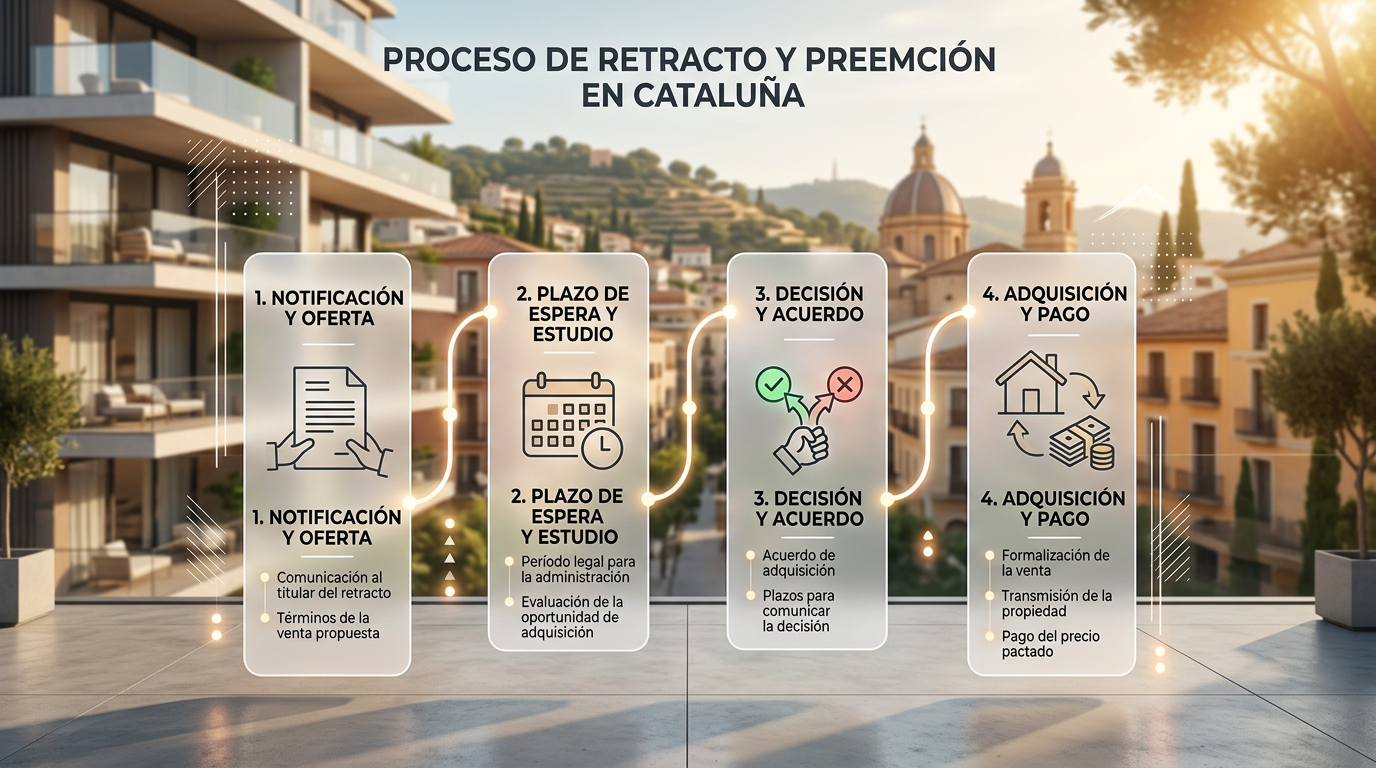
The right of first refusal (tanteo) is a right of preferential acquisition held by the public administration (in this case, the Catalan Housing Agency - Agència de l'Habitatge de Catalunya). In practice, it means that, before formalizing the sale of a property that meets certain requirements, the seller has the legal obligation to notify the Generalitat of their intention to sell, detailing the price of the transaction, the terms of the sale, the state of conservation of the apartment, and its occupancy status.
Once notified, the Generalitat has a legal period to decide whether to match the private buyer's offer and acquire the home to add it to its public housing stock. If it decides to exercise its right, it steps exactly into your position as a buyer and keeps the property, legitimately excluding you from the transaction.
Conversely, the right of withdrawal (retracto) is the flip side of the coin: it operates after the sale has been completed. If a company sells a property subject to this regime without prior notification to the Administration, concealing actual conditions, or before the tanteo period expires, the Generalitat can 'retract' the sale. This means it will undo your acquisition, pay the deeded price, and award the property to itself—a disastrous scenario for any good-faith buyer who has already paid taxes and notary fees. That is why it is vital to review ownership and the acquisition title with absolute rigor.
When does the right of first refusal (tanteo) for large property owners exist in Catalonia?
Not all real estate transactions in Catalan territory are subject to this administrative control. For the right of first refusal (tanteo) under this specific modality to be triggered, three determining factors must converge simultaneously:
- Location of the property: The home must be located within an area officially declared as a stressed residential market area.
- Seller profile: The current owner must meet the definition of a legal entity large property owner (gran tenedor) subject to the corresponding regime. That is, it affects companies, funds, or financial institutions, not automatically natural persons (who are regulated by other specific tanteo rules). Do not forget to check if the seller is a large property owner before taking any firm steps.
- Nature of the property: It must be a property intended for residential use (housing).

Stressed zones: how does it affect Barcelona and other municipalities?
The geographical factor is key for the tanteo gran tenedor Cataluña (right of first refusal for large property holders in Catalonia). If you are going to buy an apartment in Barcelona in a stressed zone, you should know that the Catalan capital and a large part of its metropolitan area have this status of a stressed housing market.
Before formalizing any pre-agreement, it is imperative to check if the property is in a stressed zone. If the municipality is on the official list and the seller is a legal entity owning multiple properties, the right of first refusal (tanteo) file before the Agencia de la Vivienda de Cataluña is a mandatory procedure before deeds can be signed.
The Registro de Grandes Tenedores and its transitional regime
The Generalitat has the Registro de Grandes Tenedores de vivienda (Registry of Large Housing Holders), an body reporting to the Agencia de la Vivienda de Cataluña where legal entities reaching this threshold must declare their status and real estate portfolio.
Given that the final regulations for this registry may be in the development or transitional stages, the law imposes a very strict preventive mechanism: when a legal entity wants to sell a property in a stressed zone, it must formally declare whether or not it holds the status of a gran tenedor (large holder). In the event of denying this status, the agency (gestora) or the notary public itself will require them to provide a registry certificate proving the number of properties in their name throughout Spain to incorporate it into the public deed. This is one of the reasons why knowing what documentation to request before the earnest money contract (arras) will make the difference between a safe purchase and an administrative ordeal.
The procedure: deadlines and the response of the Agencia de la Vivienda
From the moment the gran tenedor seller makes the formal notification to the Agencia de la Vivienda de Cataluña detailing the sale and purchase offer, the Administration has a maximum period of two months to respond.
- If the Administration issues an express waiver resolution, or if those two months elapse without a decision (administrative silence equivalent to a waiver), the buyer and seller are free to formalize the sale in a public deed under the exact notified conditions.
- If the Generalitat decides to exercise the right of first refusal (tanteo), the private sale is cancelled and the Administration is subrogated to the contract, acquiring the property.
This two-month period (which may be extended if a technical or physical inspection of the property is required) directly impacts the financial conditions of your purchase. You must ensure that the validity of your mortgage offer or your appraisal does not expire during this administrative wait.
What exceptions exist to this right of first refusal?
Although the rule is strict, there are some exceptions where the tanteo does not materialize or from which one can be excluded:
- New construction or major renovation (gran rehabilitación): Certain transfers carried out during the first year after obtaining the certificate of occupancy (cédula de habitabilidad) may be exempt from this process.
- Qualified individual buyer: There is a very specific case in which the Generalitat waives its right of first refusal (tanteo) if the ultimate buyer is an individual registered in the Register of applicants for subsidized housing (Registro de solicitantes de vivienda protegida), undertakes to classify the apartment as subsidized housing (vivienda protegida) within one month, and designates it as their primary and permanent residence for a minimum of ten years. However, violating this commitment post-purchase would enable the Administration to exercise a late right of redemption (retracto tardío).
How to adapt the deposit agreement (contrato de arras) to avoid risks
If you detect that the property is subject to this regulation, do not use a standard deposit agreement (contrato de arras) under any circumstances. You must draft specific clauses to protect your money as follows:
- Conditions precedent (Condición suspensiva): The deposit agreement must be strictly conditional upon the Generalitat expressly waiving, or waiving by administrative silence, its right of first refusal (tanteo).
- Refund of funds: It must be perfectly clear that, should the Generalitat exercise its right of first refusal (tanteo), the seller will refund 100% of the amounts delivered as a deposit fully and without penalties, exempting the seller from the penalty of returning double the deposit (as this is an unforeseen event by legal mandate).
- Generous deadlines: It is vital to adapt the deposit agreement to the transaction stipulating a generous completion deadline (minimum of 90 days) to cover the two-month administrative process and the subsequent notary signing.
Essential documentation for your due diligence
To guarantee that you are buying safely and will not inherit a right of redemption (retracto) issue in the future, demand the following documents before signing any commitment:
- Updated title search (Nota simple registral) (to verify charges and transfer history).
- Seller's title deed (Título de propiedad) (to verify how they acquired the property; for example, if it stems from a foreclosure or a deed in lieu of foreclosure (dación en pago), as these scenarios can also trigger the Catalan right of first refusal (tanteo), even if the seller is not a large property holder (gran tenedor)).
- Sworn declaration of the status of large property holder (gran tenedor) of the legal entity seller and its corresponding registry certificate.
- Stamped copy of the transfer notification sent to the Catalan Housing Agency (Agencia de la Vivienda de Cataluña).
- Formal resolution of waiver of the right of first refusal (tanteo) or, failing that, proof of the date of receipt of the notification to calculate the two-month expiration period.
Common mistakes when buying from a large property owner
The lack of specialized legal advice often leads to critical mistakes:
- Believing it only affects social housing: Many buyers mistakenly assume that the right of first refusal (tanteo) only exists for officially protected housing (VPO). The regime of tanteo for large property holders (gran tenedor) in stressed areas affects free-market housing.
- Ignoring the origin of the apartment: If the current seller (for example, an individual) previously bought the apartment from a bank through a foreclosure without properly notifying the Generalitat at the time, the right of withdrawal (retracto) could still be latent on the property.
- Modifying the price after notification: If you notify a sale price to the Administration and then at the notary's office you decide to lower it or agree on other conditions, the previous notification loses all validity and exposes the transaction to an immediate retracto.
Frequently Asked Questions (FAQ)
What happens if I buy the property without the seller having notified the Generalitat?
The transfer will have been carried out irregularly. The Generalitat may exercise its right of retracto within the periods provided by law, keeping your home at the same price you paid, forcing you to undo the transaction with the consequent loss of time, management expenses, and potential legal disputes to recover your investment.
If the seller is a bank, does the right of first refusal apply?
Most likely. Banks and their real estate subsidiaries usually clearly hold the status of a legal entity gran tenedor. Furthermore, properties originating from foreclosures or deeds in lieu of foreclosure (dación en pago) have their own specific case of tanteo in Catalonia, regardless of whether the seller currently maintains the status of a gran tenedor.
Can the Generalitat physically inspect the property before deciding?
Yes. Regulations allow technicians from the Agencia de la Vivienda de Cataluña to access the property to check its state of conservation and habitability. If this inspection is requested, the deadlines to resolve the tanteo may be temporarily suspended until the visit is carried out.
Conclusion
Buying an apartment that belongs to a company or financial entity in a stressed area of Catalonia requires a meticulous preventive legal analysis. The real danger of this regulation does not lie in the Generalitat deciding to exercise its preferential acquisition right, but in discovering that the property was subject to this regime once you have already handed over thousands of euros in a poorly drafted deposit agreement (arras) that is difficult to recover.
At INMODOCS we exhaustively analyze your real estate transaction, verify the seller's status, manage the documentary due diligence for the tanteo, and draft your arras contracts with customized deadlines and protection clauses. Secure your purchase and prevent administrative bureaucracy from putting your savings at risk.