
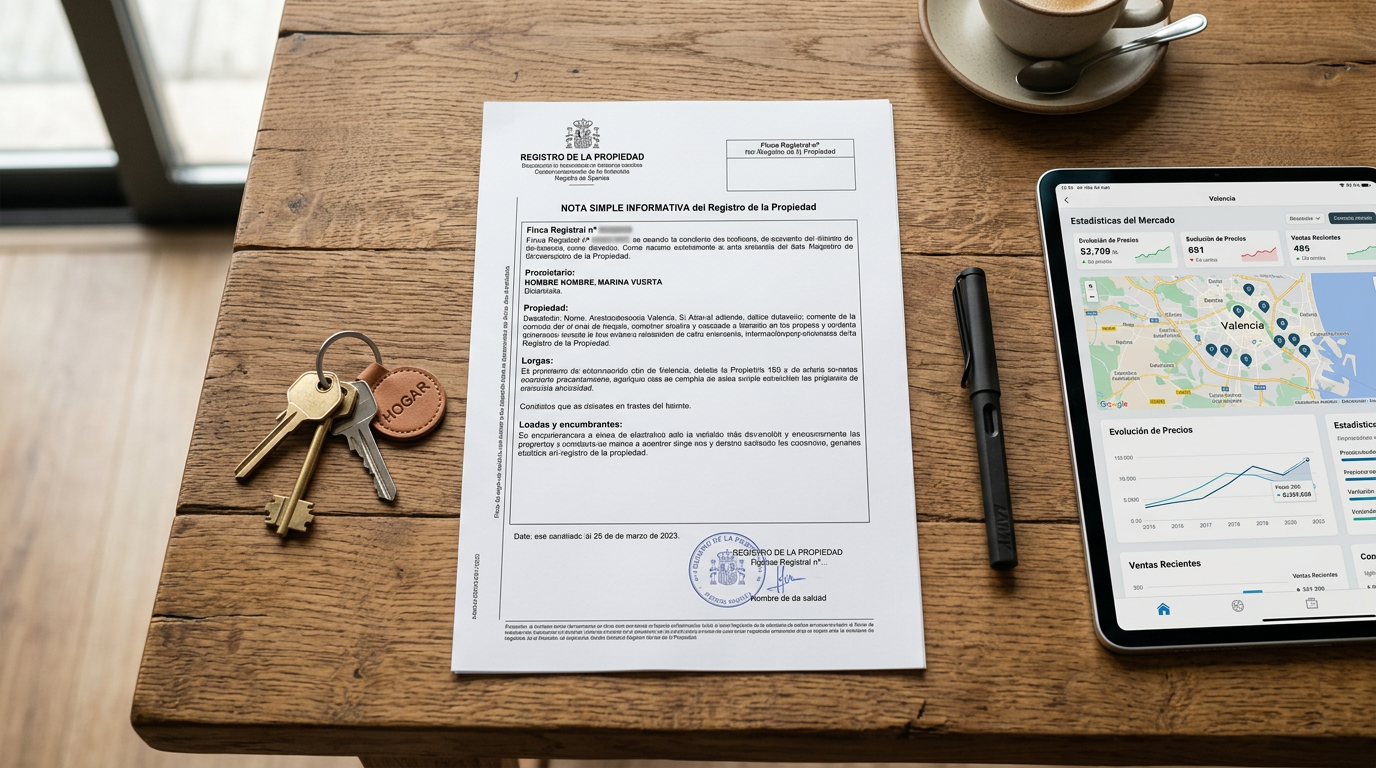
You have requested a nota simple for a property and found yourself with several pages full of registry data, complex entries, share percentages, mortgages, and marginal notes. At first glance, it can be difficult to decipher whether the document is in order or if it contains any legal circumstances that put your investment at risk.
To understand a nota simple without getting lost in legal jargon, we must structure its analysis into three large blocks:
- The property description (the physical and registry reality of the property).
- Ownership (who is selling and under what legal right they are doing so).
- Charges and limitations (debts, encumbrances, or prohibitions on the property).
However, to buy with complete peace of mind, a superficial look is not enough. You must examine the actual surface areas, linked annexes, the difference between bare ownership (nuda propiedad) and usufruct (usufructo), as well as documents pending registration. In this guide, we explain step-by-step how to interpret each section and what warning signs to watch out for.
What information does a nota simple contain?
The nota simple is an abridged document of a purely informative nature, issued by the Registro de la Propiedad (Property Registry) where the property is registered.
As detailed by the Colegio de Registradores, both the nota simple and the registry certification (certificación registral) contain the description, ownership, and charges of the property. However, the key difference lies in the fact that the nota simple has informative and easy public disclosure value, while the certification is the only means that officially and under the registrar's public faith certifies the content of the Registry books.
For the preliminary analysis of buying a home, having a recent nota simple is usually sufficient. If you need to start the purchase process, the ideal approach is to request a nota simple updated to avoid surprises with outdated information.
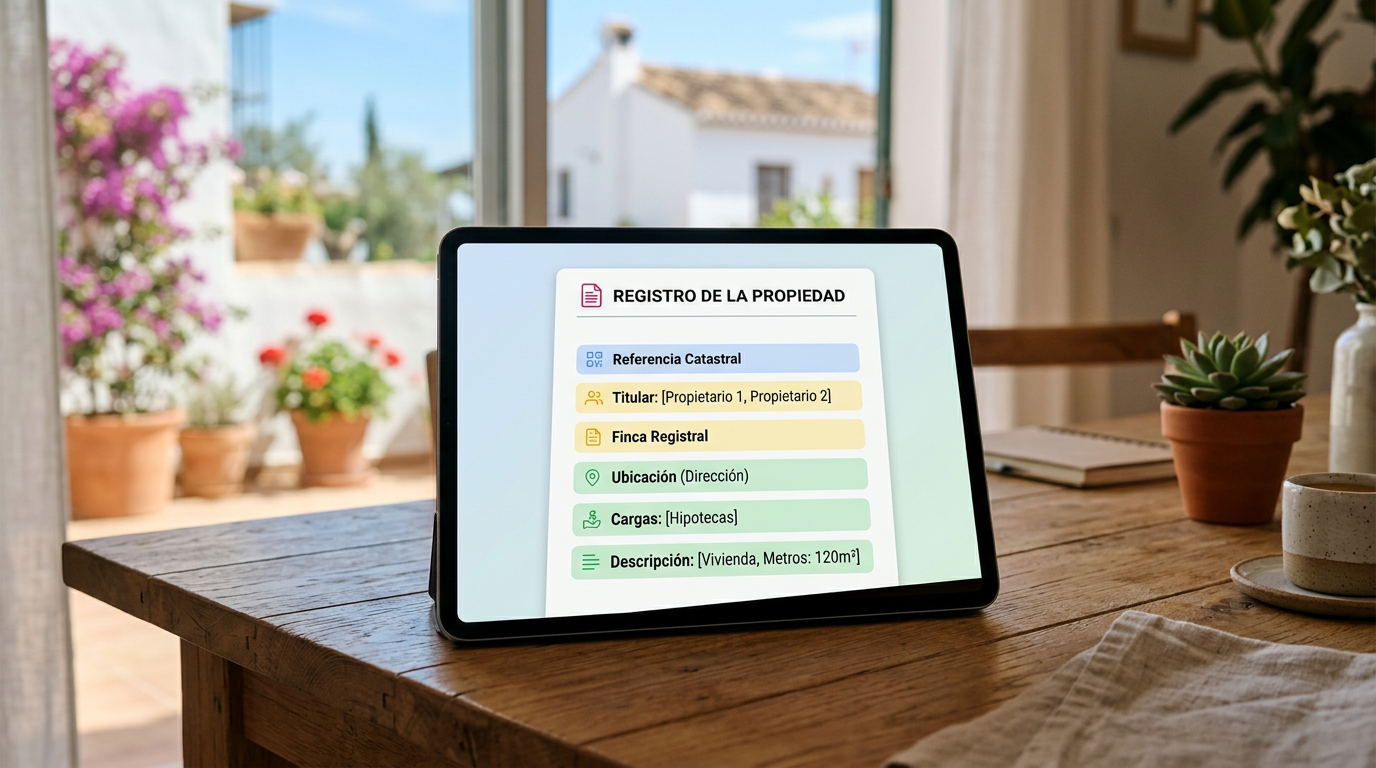
1. Registry details and date of issue
The header of the nota simple is crucial for determining the validity of the document. In this initial section you must check:
- Name and number of the issuing Registro de la Propiedad.
- Exact date and time of issue: The Registry operates in strict order of presentation. A certificate older than a month may not reflect a preventive embargo or a mortgage registered yesterday.
- Property registry number (número de finca): The unique identifier of that property in that specific registry.
- Unique Registry Code (CRU): A 15-digit national code equivalent to the property's "DNI" (national ID).
- Volume (tomo), book (libro), folio, and entry (inscripción): Traditional archiving data that facilitate locating the history of the property.
The registry information must be completely up to date at key moments: before signing the earnest money contract (contrato de arras) and on the very day before signing the deed of sale (escritura de compraventa).
2. Property description and physical details
This section covers the legal identity of the home. Here, the Registry describes in writing what the property is like, although it does not always match the physical reality to the millimeter.
Nature of the property: home, commercial premises, or office?
The nota simple must classify the property according to its registered use: home, commercial premises (local comercial), office, garage, storage room, or rustic land (finca rústica).
It is common to find studios or commercial premises advertised as homes. If in the registry it appears as a "premises" (local), you would be buying a property without a certificate of occupancy (cédula de habitabilidad), which will affect both your ability to get a mortgage and the legality of residing in it. The commercial designation of the seller or estate agency has no value compared to what the Registry dictates.
Address, floor, and door
In older properties, the postal address may differ from the current street name due to changes in the municipal street map. It is also common to see designations like "mezzanine" (entresuelo), "main floor" (principal), or "door A" which physically correspond to a first floor or second door. While minor discrepancies are common, they must be verified by cross-referencing boundary and ownership data.
Registry vs. Cadastral surface area
This is one of the areas where most misinterpretations occur. The nota simple may express the usable surface area (superficie útil) or the built surface area (superficie construida, with or without common elements). If you notice that the square meters in the deeds differ significantly from what you see on the ground or what the Catastro (Cadastral Registry) indicates, we suggest comparing Registry and Catastro to identify the source of the discrepancy (for example, an undeclared renovation or an illegal terrace enclosure).
Boundaries, share quotas, and annexes
- Boundaries (linderos): They indicate what borders the home at its four cardinal points (the landing, the street, the adjacent property, or the inner courtyard).
- Share quota (cuota de participación): The percentage of ownership that the home has over the common elements of the building. It is used to calculate your contribution to community fees and special assessments (derramas).
- Annexes (anejos): Spaces such as the parking space or storage room that are inseparably linked to the home. If they do not appear as annexes in the nota simple, it means they are independent registered properties and must have their own nota simple with their corresponding charges.
3. Ownership: Who is the true owner?
This section answers the most important question: Does the seller have the legal right to transfer the property to you?
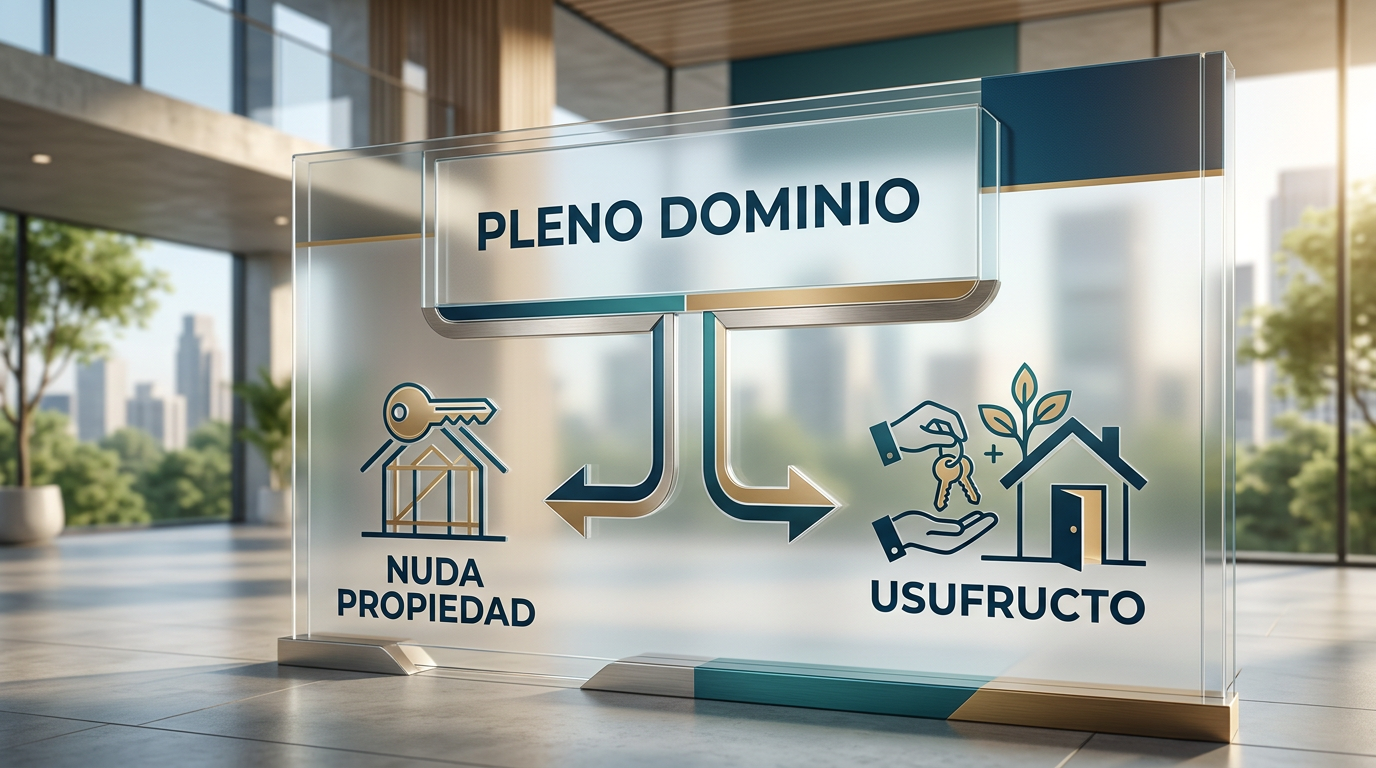
Full ownership vs. bare ownership and usufruct
Property ownership can be split:
- Full ownership (pleno dominio): The owner holds 100% of the property and the right of use.
- Bare ownership (nuda propiedad): The owner holds the legal title of the asset but cannot use it.
- Usufruct (usufructo): The usufructuary has the right of use and enjoyment (for example, living in the apartment or renting it out) for life or for a specified period.
If you buy a home where the usufruct belongs to an elderly person and the bare ownership to their children, all of them must sign the sale for you to acquire full ownership free of charges.
Ownership percentages and titles of acquisition
The nota simple details the percentages (e.g., a married couple at 50% as community property, or three siblings at 33.3% after an inheritance). Make sure all co-owners agree and will sign the contract. Additionally, the document shows the title of acquisition (sale, inheritance, donation, etc.). If the flat comes from a recent inheritance, it is vital to check that all inheritance taxes have been settled to prevent the Treasury (Hacienda) from claiming against the new buyer.
4. Charges, liens, and limitations of the home
Charges are third-party rights that limit the use or disposal of the home. It is essential to check if the flat has charges before handing over any money.
Registered mortgage and its real balance
The presence of a mortgage is the most common charge. The nota simple will show the maximum mortgage liability agreed with the bank. However, this amount does not represent the seller's current debt. The actual outstanding balance must be proven with a zero-debt balance certificate issued by the seller's bank on the very day the deed is signed.
Paid mortgage but not cancelled in the registry
Often, the seller claims that their mortgage is "already paid." If it still appears on the nota simple, it is because the financial payment was made but not the registry cancellation (cancelación registral). To remove it from the Property Registry, it is necessary to execute a public deed of cancellation signed by the bank and present it to the Registry. To understand the differences in these processes, it is advisable to check the guide on what to do when charges appear.
Seizures and marginal notes of foreclosure
An embargo (seizure) indicates that a court or public administration (such as Hacienda or Social Security) has preventively placed a lien on the property due to owner debts. If a marginal note of foreclosure (nota marginal de ejecución) also appears, it means the creditor has already started the auction process for the property. Buying an apartment in this situation requires rigorous legal control to ensure that the purchase money is sent directly to cancel the embargo in court before registering your ownership.
Usufructs, resolutive conditions, and easements
- Resolutive condition (condición resolutoria): Guarantees that if the previous buyer does not finish paying a deferred price, the property reverts to the original seller.
- Easements (servidumbres): Encumbrances that oblige allowing the passage of utilities, views, or pathways in favor of neighboring properties.
- Tax liabilities (afecciones fiscales): Marginal notes indicating that the property is liable for the payment of taxes from previous transfers for a period of 5 years. Generally, if the self-assessment was done correctly at the time, they do not represent a real problem, but it is wise to check that they are close to expiring.
5. Documents pending registration
At the end of the nota simple, a crucial section usually appears: "Pending dispatch" (Pendientes de despacho) or "Active entry seatings" (Asientos de presentación vigentes).
If there is any document listed in this section, it means someone has recently submitted a deed, a foreclosure, or a lawsuit that the Registrar is still evaluating. The principle of registry priority determines that whatever enters the Registry first takes precedence. Therefore, never sign an earnest money agreement or a purchase contract if there are documents pending registration without knowing exactly what they are, as they could completely change the ownership or charges of the property.
6. What does 'free of charges' actually mean?
When a nota simple indicates that a property is "free of charges" (libre de cargas), it strictly means that there are no encumbrances registered in the Property Registry. However, it does not guarantee 100% that the transaction is free of external risks.
The nota simple does not show:
- Debts to the community of owners (unpaid community fees or special assessments).
- The payment status of the Real Estate Tax (IBI - Impuesto sobre Bienes Inmuebles).
- Active rental contracts that are not registered (which the buyer must respect by law in many cases).
- Urban planning violations or open disciplinary files by the city council.
- The actual technical building status (ITE - Inspección Técnica de Edificios / IEE - Informe de Evaluación de Edificios).
For this reason, gathering and studying all the documentation before signing earnest money agreements (such as IBI receipts, community meeting minutes, and debt certificates) is the only safe way to avoid assuming other people's debts.
Warning signs when reviewing the nota simple
Pay special attention if you detect any of these situations during your reading:
- Mismatched ownership: The name of the person acting as the seller does not match the registered owner.
- Incomplete percentages: The seller only owns an undivided share of the full ownership.
- Presence of disposal prohibitions (prohibiciones de disponer): Judicial or administrative resolutions that legally prevent the sale of the property.
- Non-conforming use: The property is classified as an office, storage room, or commercial premises instead of a residential home.
- Existence of active foreclosure proceedings (ejecuciones hipotecarias).
If you identify any of these points, expert advice is essential. Conducting a comprehensive real estate due diligence before committing your savings will prevent you from signing a blind earnest money contract.
Frequently Asked Questions (FAQ)
How can I know if the seller is the sole owner?
You must go to the "Ownership" (Titularidad) section and verify if the seller holds 100% of the full ownership (pleno dominio). If smaller percentages appear, or figures such as bare ownership and usufruct, more people are involved in the ownership.
How long is a nota simple valid for?
Legally it does not have an expiration date, but in practice, it becomes outdated very quickly. For a secure transaction, it is recommended that the nota simple is no more than 10 to 15 days old.
Does the nota simple certify the town planning legality of the property?
No. The Registry publishes private rights and charges, but not the legality of the construction or whether the property is subject to municipal urban discipline proceedings. This must be consulted directly at the corresponding town hall.
Before signing the deposit
If you are considering buying in Barcelona, read the full guide: Buying a flat in Barcelona without surprises.

Conclusion
Understanding a nota simple is much more than checking that the seller's name is correct and verifying that the charges section has no alarming debts. It requires a technical and meticulous reading of each paragraph, cross-referencing the registry data with the Catastro, the Town Hall, and the community of owners itself.
If you have questions about tax liabilities, embargo annotations, or preferential acquisition rights appearing in your document, at INMODOCS we offer our expert service to review the ownership and charges of the home rigorously, protecting your money and guaranteeing a 100% secure transaction.
Disclaimer: This article offers general information to guide property buyers and does not constitute personalized legal advice for specific transactions.