
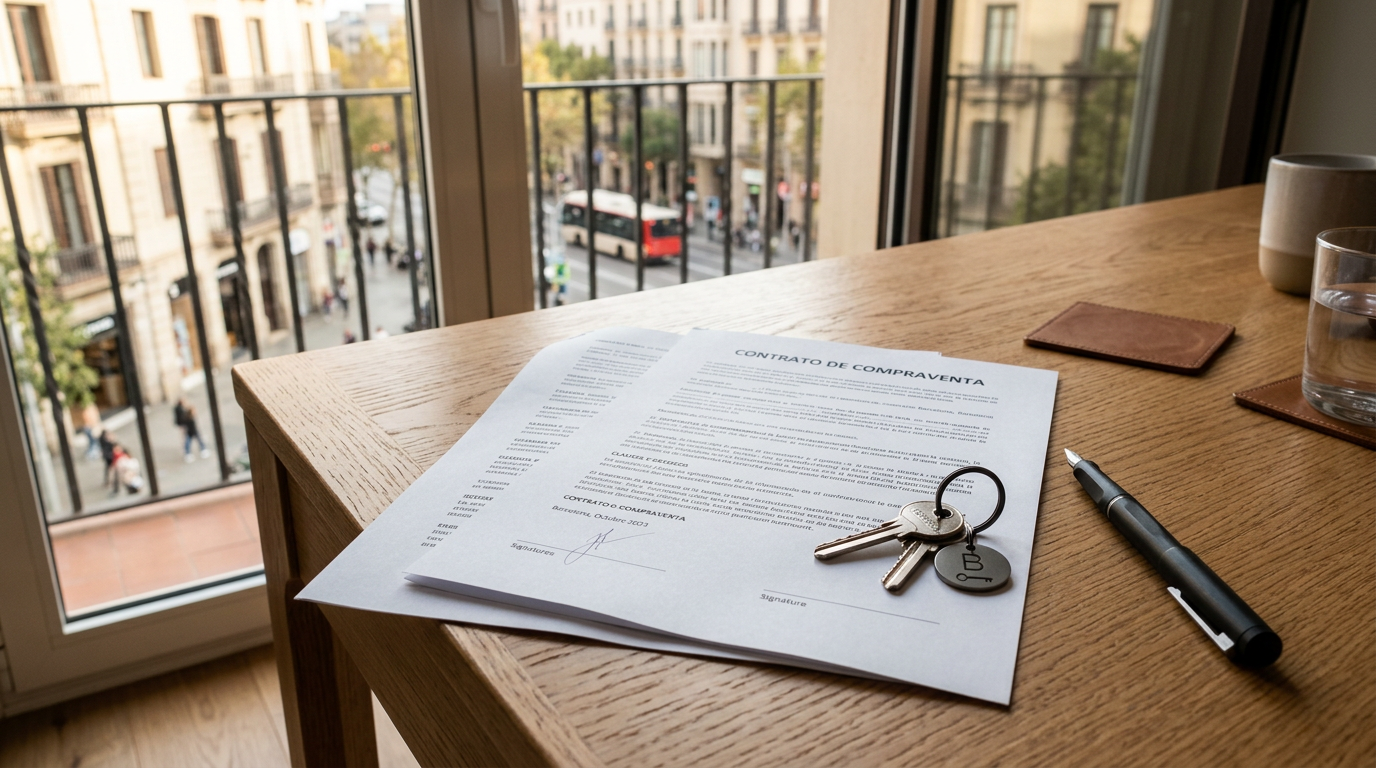
An earnest money agreement (contrato de arras) is a private agreement that the buyer and the seller sign before executing the public deed of sale. It identifies the property, the price, the amount paid, the deadline for signing the deed, and the conditions that must be met to safely complete the transaction.
Although it is common practice in the real estate market, the earnest money agreement is not legally mandatory. However, from the moment it is signed, it becomes a valid and binding document for both parties. Therefore, it should never be treated as a simple reservation form to temporarily remove the property from the market.
Using an earnest money agreement (contrato de arras) model in Barcelona is an excellent tool to structure the basis of the agreement. However, copying a generic document without adapting it can leave critical aspects unregulated, such as bank financing, registry charges, the Building Technical Inspection (ITE), extraordinary community levies (derramas), the validity of the occupancy certificate (cédula de habitabilidad), or the delivery of the property free of occupants.
In this guide, we analyze in detail which clauses are indispensable if you are going to buy or sell an apartment in Catalonia.
What is an earnest money agreement (contrato de arras)?
It is a preliminary contract or private agreement prior to the public deed, where the parties set the essential conditions of the future sale, and the buyer delivers an amount of money (usually 10% of the purchase price) as a deposit and guarantee.
Its content is what actually determines:
- Whether the buyer or the seller can withdraw from the sale.
- What happens if the bank does not grant the mortgage.
- Who assumes the costs of cancelling previous charges.
- What technical and legal documentation the seller is strictly required to provide.
- Who pays the community levies (derramas) approved by the homeowners' association.
- On what exact date and under what habitability conditions the property will be delivered.
It is vital to understand the difference between reservation and earnest money (diferencia entre reserva y arras) before disbursing any amount, as each document carries very different legal implications.
Is any earnest money agreement model suitable in Catalonia?
The short answer is no.
A standard internet model offers a basic structure, but it lacks the flexibility to cover the physical and legal peculiarities of each property. In the legal framework of Catalonia, this is even more critical because the Código Civil de Cataluña (Civil Code of Catalonia) governs, which has its own sale regulation that is very different from that of the Spanish common Civil Code.
It does not require the same clauses or the same level of protection:
- A property free of charges versus one that is mortgaged or has liens.
- A social housing property (VPO).
- A property originating from an unregistered inheritance.
- An old building obliged to undergo the Technical Inspection (ITE) with pending deficiencies.
- A sale conditioned on the bank approving the mortgage.
The Código Civil de Cataluña imposes a rigorous prior duty of disclosure on the seller regarding the relevant characteristics of the property. Therefore, the contract must always be custom-drafted after having collected and analyzed the documentation you must review beforehand.
Arras confirmatorias (confirmatory earnest money) vs. Arras penitenciales (penitential earnest money) in Catalonia
The clause defining the type and nature of the earnest money (arras) is, without a doubt, the most important in the document.
Confirmatory earnest money (arras confirmatorias)
In Catalan civil law, unless the contract specifies otherwise, the amount delivered by the buyer is presumed to be received as confirmatory earnest money (arras confirmatorias).
This means that they act as a down payment on the final price and confirm the existence of the purchase and sale agreement irreversibly. Neither party can unilaterally back out of the contract by forfeiting or returning the money. If one party defaults, the other may seek specific performance of the sale through the courts or the termination of the contract with the corresponding compensation for damages.
Penitential earnest money (arras penitenciales)
For them to allow free withdrawal, they must be expressly agreed upon as such. Regulated in artículo 621-8 del Código Civil de Cataluña (Catalan Civil Code), penitential earnest money allows the contract to be terminated as follows:
- If the buyer withdraws, they forfeit the amount delivered.
- If the seller withdraws, they must return double the amount received.
To avoid litigation, the document must unequivocally reflect the penitential agreement. It is not enough to label the document title as "Contrato de Arras". To delve deeper into its application and consequences, we recommend consulting our detailed article on the difference between confirmatory and penitential earnest money.
Essential structure and clauses of an earnest money contract (contrato de arras)
For an earnest money contract template in Barcelona to be robust and protect your investment, it must consist of the following well-developed sections:
1. Precise identification of the parties and the property
The full name, DNI/NIE, address, and the capacity in which each signatory appears (in their own name, through a power of attorney, or as the administrator of a company) must be recorded.
Likewise, the property must be described using the exact land registry details (property number (número de finca), volume (tomo), book (libro), folio (folio), and the Unique Registry Code - CRU) and the cadastral reference, in addition to detailing whether it includes inseparable annexes such as parking spaces or storage rooms.
2. Price, payment methods, and nature of the earnest money
The total acquisition price will be detailed, explicitly indicating that the earnest money (arras) is deducted from this amount at the time of signing the public deed (escritura). The destination bank account number and the method by which the remaining funds will be transferred on the day of signing before the notary public will also be reflected.
3. Deadline for deed signing and the financing clause
Establishing a realistic deadline for formalizing the public sale is fundamental. In Catalonia, if the purchase is conditional on obtaining bank financing, artículo 621-49 del Código Civil de Cataluña offers special default protection.
However, to avoid disputes, it is essential to include a custom-drafted financing clause specifying:
- The exact amount of the loan requested.
- The buyer's maximum deadlines for submitting formal rejections from the bank.
- The obligation to fully refund the earnest money in the event that the mortgage is denied through no negligence of the buyer.
4. Cancellation of charges, ITE and urban planning status
Before signing, it is a priority to know how to check the charges on the flat through an updated nota simple (land registry filing). The contrato de arras (earnest money contract) must expressly oblige the seller to deliver the property free of any mortgage, lien, tax charge, or limitation, with the seller assuming all financial and registry cancellation costs.
Similarly, the technical condition of the building must be regulated. If the property is required to pass the Technical Building Inspection (ITE), the corresponding certificate of aptitude must be attached. If deficiencies are detected, it must be agreed who will bear the cost of the corrective works.
5. Distribution of derramas and community fees
Community derramas (extraordinary assessments) are often a source of dispute. The usual rule in Catalonia dictates that extraordinary derramas approved prior to the signing of the contrato de arras correspond to the seller, while those approved subsequently fall on the buyer. However, we suggest you read more about how to regulate derramas in the earnest money contract to safeguard this clause in a fair manner.
6. Cédula de habitabilidad and energy efficiency certificate
In Barcelona, it is an indispensable legal requirement for executing the deed to deliver the valid cédula de habitabilidad (occupancy certificate) and the energy certificate. The contrato de arras must provide for the seller's obligation to process and provide them with sufficient time before the signing at the notary.

Example of an illustrative header
PENITENTIAL EARNEST MONEY CONTRACT

In Barcelona, on [Day] [Month] [Year].

REUNIDOS

Of the one part, Mr./Ms. [Full Name], holder of DNI/NIE [Number], residing at [Address], hereinafter, the "Selling Party".

Of the other part, Mr./Ms. [Full Name], holder of DNI/NIE [Number], residing at [Address], hereinafter, the "Buying Party".

Both parties mutually acknowledge each other's sufficient legal capacity to execute this document, and to this end:

MANIFIESTAN

I.- That the Selling Party is the owner in fee simple of registered property number [Property Number], registered in the Land Registry of Barcelona No. [Number] (*Registro de la Propiedad de Barcelona*), which corresponds to the dwelling located at [Full Address, Floor and Door], with Cadastral Reference [Code].

II.- That the Buying Party is interested in acquiring the aforementioned property, and therefore both parties agree to formalize this PENITENTIAL EARNEST MONEY CONTRACT subject to the following clauses...
Important Notice: This header is merely an illustrative example of the initial structure. A secure contract requires the detailed drafting and review of all subsequent clauses based on the registry status of the property.
Risk clauses you should avoid or examine with a magnifying glass
When reviewing a draft or a template of an earnest money contract (contrato de arras), be wary and seek immediate advice if you come across phrases such as the following:
- "The buyer knows and accepts the current planning and physical status of the property, waiving any future claims." (This may conceal urban planning illegalities or serious hidden defects).
- "Obtaining financing is the sole responsibility of the buying party, and the lack thereof shall not affect the validity of the contract." (This overrides the protection of the Catalan Civil Code (Código Civil catalán), preventing you from recovering your money if your mortgage is denied).
- "All extraordinary community levies (derramas) issued after the signing of this document, whether approved or not, shall be borne by the buyer." (This would force you to pay for expensive works approved by the seller before the property is actually yours).
Specificities in Barcelona: Earnest money between individuals and notarial deposit
An earnest money contract can be signed privately between individuals, without the need for real estate agency mediation. It remains a fully binding document as long as it is signed by all legitimate registered owners.
However, Catalan law provides an advanced security option: the notarial deposit of the earnest money (arras).
According to legislation in Catalonia, if penitential earnest money (arras penitenciales) is agreed upon for a maximum period of six months, the parties can agree to deposit it before a notary. This deposit can be recorded in the Property Registry (Registro de la Propiedad), so that the property itself is directly encumbered to guarantee the return of the amounts in case of withdrawal by the seller. This is highly recommended when the amounts delivered are very high or if there are reasonable doubts regarding the seller's solvency.
Common mistakes when using a generic template
- Ignoring the local legal framework: Using an earnest money contract template based on the common Civil Code (Código Civil - applicable in Madrid, for example) instead of the Civil Code of Catalonia (Código Civil de Cataluña).
- Not checking the Nota Simple before signing: Discovering liens, foreclosures, or charges that are difficult to cancel once the earnest money has already been transferred.
- Setting unrealistic deadlines: Granting completion deadlines that are too short (for example, 30 days) which do not leave enough time for the appraisal, bank risk analysis, and compliance with the notarial transparency deadlines (FEIN).
Frequently Asked Questions (FAQ)
Is it mandatory to sign an earnest money contract to buy an apartment?
No, it is not legally mandatory. However, it is the most effective and widely used tool to ensure that neither party backs out of the transaction during the mortgage preparation and deed signing process.
What percentage of the purchase price is usually paid as a deposit?
There is no legal minimum, but market custom places the earnest money (arras) at around 10% of the total agreed price for the property.
What happens if the seller backs out of a penitential earnest money agreement?
If penitential earnest money (arras penitenciales) has been explicitly agreed upon under article 621-8 of Catalonia, the seller will be required to return double (twice) the amount you transferred.
Before signing the deposit
If you are considering buying in Barcelona, read the full guide: Buying a flat in Barcelona without surprises.

Conclusion: Sign with total security
A deposit agreement (contrato de arras) template in Barcelona is a highly useful starting point, but it must never replace a professional analysis and adaptation of the legal transaction. For your purchase to be successfully completed at the notary, each clause must address the actual risks of the property in question.
At INMODOCS, we take care of generating and reviewing a deposit agreement template meticulously tailored to the documentation of your future home, ensuring the full protection of your savings against any unforeseen event. Do not take unnecessary risks in one of the most important financial decisions of your life.