

One of the most frequent and unpleasant surprises after purchasing a property is receiving an extraordinary fee from the building administration. Whether it is to renovate the facade, repair a roof with leaks, install a new elevator, or rectify serious deficiencies detected in the ITE (Inspección Técnica del Edificio / Technical Building Inspection), these unforeseen costs can disrupt any financial budget.
When works were approved in a general meeting of owners prior to the signing of the deed, but the receipts are issued afterwards, the great dispute inevitably arises: who pays the special levy (derrama) when buying or selling a home?
In Catalonia, the resolution of this conflict is not limited simply to looking at the approval date of the agreement. Factors such as the payment schedule set by the board, the information contained in the community debt certificate and, as a priority, what has been negotiated and signed in the earnest money agreement (arras) will play a crucial role. To proceed with total security, it is essential to carry out certain checks before buying a home.
What is a community special levy and why is it generated?
A special levy (derrama) is an extraordinary financial contribution that the community of owners collectively approves when the annual ordinary budget or the accumulated legal reserve fund is insufficient to cover a certain expense.
Generally, these exceptional disbursements are intended for actions such as:
- Renovating facades, balconies, or ornamental elements.
- Waterproofing roofs, terraces, or light-wells.
- Installing from scratch or replacing elevator machinery.
- Removing architectural barriers in the lobby.
- Rectifying foundation or structural failures derived from the Technical Building Inspection (ITE).
- Renovating the drainage downpipe network or common lighting.
Under the regulatory framework of Catalan Civil Law, owners are obliged to contribute financially in proportion to their participation quota (property coefficient), unless the statutes or a unanimous extraordinary agreement provide for another distribution.
Who pays a special levy when the flat is sold? The legal framework in Catalonia
To clarify who legally assumes these extraordinary costs in Catalan territory, we must clearly differentiate between two independent legal levels:
- The external relationship with the community of owners: Who is legally obliged to make the disbursement to the administrator.
- The internal relationship between the seller and the buyer: What both parties have contractually agreed upon.
Regarding the community, the person obliged to pay the installments is always the person who is the registered owner of the property at the precise moment the installment of the special levy becomes due and mandatory for collection.
However, at an internal contractual level, buyer and seller have full freedom to agree on how the total cost of that special levy is distributed. In fact, it is recommended to regulate these conditions in detail in the documentation before signing the earnest money agreement, avoiding subsequent litigation and claims.

Key scenarios according to the approval and maturity schedule
Not all special levies are structured the same way. While some are paid via a single immediate payment, others are split into convenient monthly installments that can extend for years. This leads to three different regulatory scenarios:
1. Special levy approved and due before the sale
If the meeting of owners approved the special levy and the payment installments became effectively due before the signing of the deed of sale at the notary, that amount is a direct debt of the seller. The seller must ensure they are up to date with the payment of all these sums already due.
Before final signing, the buyer has the right and duty to verify this and, if debts persist, demand that they be settled beforehand or proceed with a financial retention on the purchase price before a notary.
2. Special levy approved before the sale with installments falling due after
This scenario is the main seed of legal conflicts.
Suppose that in February a facade project valued at €12,000 per neighbor is unanimously approved, split into 12 consecutive monthly installments of €1,000 each. The deed of sale is formalized at the end of June. In this case:
- The installments from February to June have already expired and legally correspond to the seller.
- The installments from July to January of the following year will formally expire when the buyer already possesses the keys and the title of ownership, so the estate management will charge the receipts directly to their bank account.
To prevent the buyer from assuming this unforeseen extra cost, a clause must be expressly included in the earnest money agreement where the seller assumes the totality of the special levy because it was approved in a meeting prior to the signing. If not included, the new owner will be imperatively forced to pay such future maturities to the community.
3. Special levy approved after the date of sale
If the board meets and formally approves the works and their corresponding payment installments on a date later than the granting of the public deed, the full cost will fall on the buyer.
However, there is a nuance of utmost importance according to the Civil Code of Catalonia regarding the legal duty of pre-contractual information in good faith. If it is proven that the seller knew of the imminent urgency of a critical repair (e.g., official requirements from the city council, previous community minutes in which the work was already intensely discussed, or budgets commissioned under suspicion of collapse) and deliberately concealed it so as not to harm the sale, the buyer could take action for hidden defects (vicios ocultos) or breach of said duty.
| Special Levy Scenario | Obliged to the Community | Contractual Obligor (By default without special agreement) |
|---|---|---|
| Approved and due before the sale | Seller | Seller |
| Approved before the sale; subsequent maturity | Buyer | Buyer |
| Approved and arising after the sale | Buyer | Buyer |
The Community Debt Certificate in Catalonia
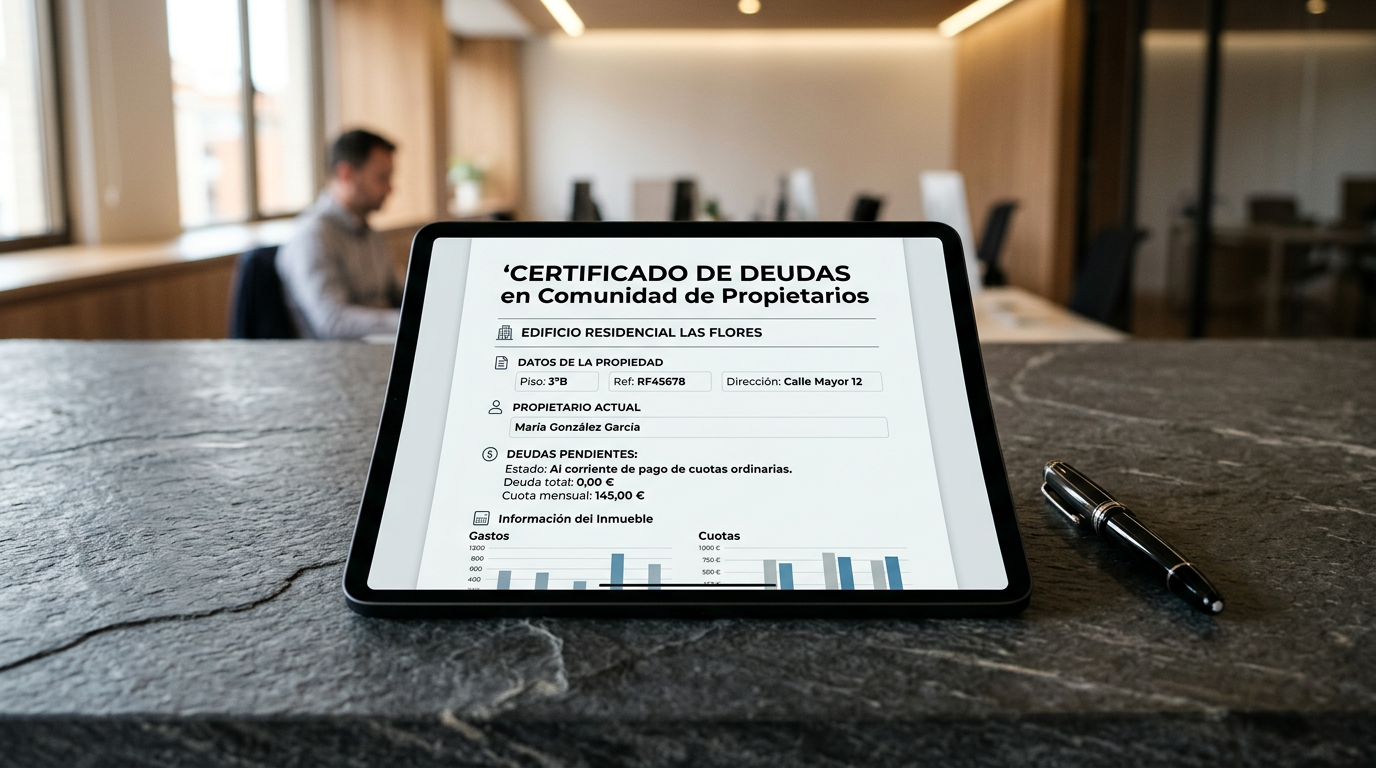
In Catalonia, civil legislation requires that when a property is transferred for consideration, the transferring party must expressly declare that they are up to date with the payment of ordinary and extraordinary common expenses, as well as contributions to the reserve fund.
To validate this declaration, the seller must mandatory provide a certificate on the status of their community debts, issued by the person acting as secretary of the board with the approval of the president.
This essential document must clarify:
- The debts accumulated and due to date.
- The installments pending maturity associated with common expenses already formally approved in minutes.
Why a "zero debt certificate" may not be enough?
It is common to settle for a simple heading stating that the property "lacks debtor balances as of today." However, this wording may hide special levies whose effective demand starts a few weeks later. It is imperative that the buyer demands a breakdown in the certificate of whether there are extraordinary expenses already planned in minutes pending accrual. To avoid falling into these administrative traps, it is advisable to check the charges and debts of the property with technical assistance.
Real Encumbrance for community debts
Catalan civil law in its article 553-5 of the Civil Code of Catalonia provides special protection for communities of owners through the legal figure of afección real (real encumbrance).
This determines that the transferred property answers directly to the co-ownership, as a real guarantee, for the amounts pending payment (both ordinary and special levies) originated by the transferor during:
- The current calendar year in which the transmission occurs.
- The four immediately preceding calendar years, counted backwards from the first day of January of that period.
In practice, if the seller disappears leaving unpaid special levies within this time frame, the community of owners can initiate legal proceedings against the new owner and auction the property in the worst-case scenario to recover the amounts. Therefore, legally waiving the presentation of the community debt certificate in the deed (a possibility allowed if the buyer voluntarily exonerates the seller) constitutes an alarming legal temerity.
Practical Example 1: Split facade special levy
To eloquently visualize the impact of a deficient contractual clause, let's analyze the timeline of the following example:
- February 15: The board approves structural and facade repair for a total of €12,000 per home, setting installments of €1,000 per month between March and February of the following year.
- June 30: The notarial signing of the sale of the property takes place.
- If there are no additional agreements: The monthly installments for March, April, May, and June (€4,000) are paid by the seller. However, starting from the July installment, the community will validly claim the remaining €8,000 from the buyer.
- If there is a precise clause in the arras: By agreeing that the seller assumes the totality of the community works started or approved during their tenure, the buying party can withhold the pending €8,000 from the total purchase price during the notarial act, depositing them or delivering them directly to the administrator.
The Technical Building Inspection (ITE) and hidden special levies
A constant source of hidden liabilities is found in the general constructive state of the building. A community of owners may not have approved any economic sum yet because it does not have a final closed budget, but it may be obliged to urgently rehabilitate the property having received a Technical Building Inspection (ITE) with an unfavorable rating (serious or very serious deficiencies).
Before committing your savings in the earnest money agreement, it is essential to request the technical report of the building and check the ITE of the building. If the report indicates significant damage that the community will mandatory have to undertake in the immediate future, that information constitutes a material value that should redirect price negotiations or determine the drafting of specific contingency clauses.
How to regulate special levies in the earnest money agreement and the deed
A contract drafted with ambiguities such as "pending community expenses will be at the expense of the seller" can lead to prolonged battles of legal interpretation.
To successfully shield your financial interests, the clause intended to regulate building charges must clearly describe:
- Literal identification: The exact date the meeting of owners was held where the approval of the works was decided.
- Description of the project: Precise detail of the object of the works (repair of downpipes, renovation of elements, etc.).
- Definitive balances: The total cost assigned to the property, what has already been amortized, and the exact installments that remain.
- Payment guarantee: How the transaction will be executed. The ideal way will always consist of calculating the total pending capital and withholding it from the sale value of the flat at the notary to proceed to the direct payment in favor of the community.
Carrying out a complete real estate due diligence on the property is the only safe procedure to avoid inheriting millionaire debts or getting involved in unwanted lawsuits.
Frequently Asked Questions (FAQ)
Does the seller always pay a special levy approved before the sale?
Not necessarily. Before the community of owners, the primary person obliged to pay installments following the sale is the new owner. For the seller to pay it, it must be expressly agreed in writing in private documents and in the notarial deed itself.
Must the administrator detail a future special levy in the certificate?
Yes. In accordance with the civil legislation of Catalonia, the community liquidation document must clearly indicate which extraordinary installments have already been approved in a meeting but are pending maturity in the established schedule.
Can I buy a flat if it has a pending multi-million special levy?
Of course. It is a perfectly legitimate practice. The crucial thing is to accurately quantify that future debtor balance and incorporate it into the negotiation table, either by deducting it directly from the property price or by instrumenting a fund retention system before the notary.
What happens if the board decides to approve a budget increase after the purchase?
In the event that the seller had agreed to assume the original special levy, the appearance of a subsequent budget increase usually generates friction. If the increase responds to an unforeseen extension of the works that were already initially approved, it could be claimed that it should be adjusted by agreement. For this reason, the contract must establish in detail which party assumes the budget deviations of the project.
Before signing the deposit
If you are considering buying in Barcelona, read the full guide: Buying a flat in Barcelona without surprises.
Conclusion: Buy safely by analyzing the community
Determining who pays extraordinary debts when processing a property transfer in Catalonia requires rigorous control of dates, specific horizontal property regulations, and exact analysis of community minutes. It is not enough to stick to a provisional zero balance certificate; it is necessary to actively investigate the documentary and administrative trail of the property.
At INMODOCS we act proactively by performing a full analysis of the building's situation, the status of debts, and all minutes before you make any payment in earnest money. In addition, we draft and supervise the corresponding contractual safeguard clauses so that you know exactly the financial obligations that correspond to you.
Don't take a wrong step. If you need to verify the status of the building you are going to buy, you can trust our team to analyze the minutes before buying.