
When buying a home in Spain, it is common to focus on the property price, mortgage negotiations, and the corresponding taxes (such as ITP (Property Transfer Tax) or IVA (VAT)). However, there are other running costs linked to the property that must be settled with total clarity between the buyer and the seller to avoid unpleasant surprises after signing the deed.
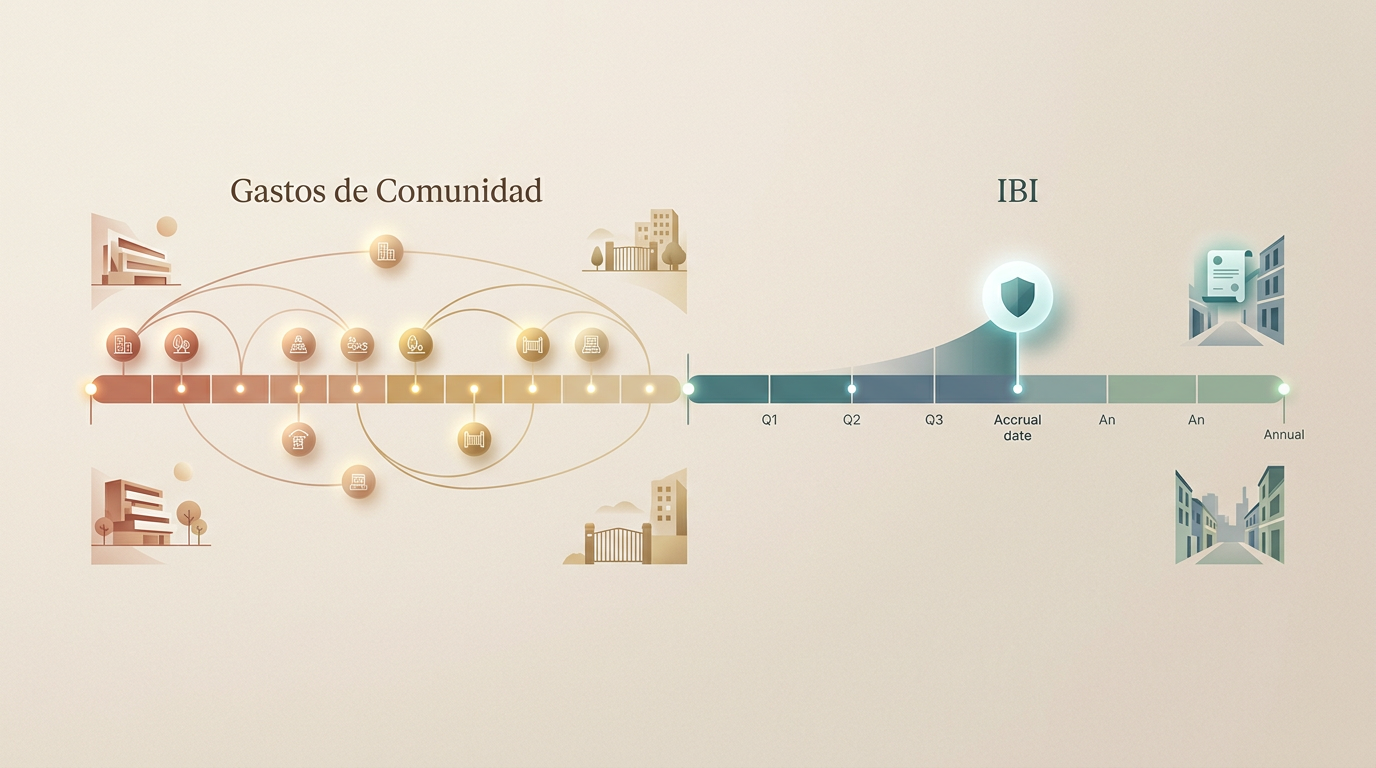
Two of the most common recurring expenses that generate the most doubts are community fees (gastos de comunidad) and the Impuesto sobre Bienes Inmuebles (IBI). Although at first glance they may seem similar due to their periodic nature, the reality is that the law treats them very differently.
While the IBI is governed by local tax regulations and takes a fixed annual accrual date as a reference, community fees depend on the Ley de Propiedad Horizontal (Horizontal Property Law) (and specific civil regimes such as the Código Civil de Cataluña) and are divided into ordinary, extraordinary, and reserve fund contributions.
Before signing a contrato de arras (deposit agreement), a verbal statement assuring that "everything is paid" is not enough. It is vital to know exactly what expenses exist, when they are due, and who will assume each of them after the sale. Below, we analyze the distribution of both concepts in detail.
Who pays the community fees when selling a flat?
Property owners are obliged to contribute to the common expenses of the building according to their share quota or in accordance with the specific rules established in the community bylaws. This category includes concepts such as ordinary fees, extraordinary levies (derramas), contributions to the reserve fund, and other specific expenses approved in the homeowners' meetings.
When a property is sold, it is essential to differentiate between outstanding debts that have already accumulated (which legally belong to the seller) and the bills that will be issued from the moment the buyer becomes the new owner.
Outstanding community debts belong to the seller
The seller is personally liable for any debts owed to the community at the time of transferring the property. However, to protect homeowners' associations, the law establishes a real guarantee: the statutory charge on the property (afección real).
In Catalonia, for example, the Código Civil de Cataluña stipulates that the property is legally bound to the payment of outstanding community debts corresponding to the elapsed part of the current year and the four immediately preceding calendar years (under the state's common Código Civil, this period is three years plus the current year).
This means that if you buy a property with outstanding community debts and the seller does not pay them, the homeowners' association can claim them directly against the property, affecting you as the new owner. To avoid this serious detriment, it is mandatory to request the community debt certificate (certificado de deudas de la comunidad) before signing the public deed.
What should the community certificate state?
A very common mistake is to accept a generic certificate that simply states that the seller is "up to date with payments" for outstanding fees. A complete certificate, especially under Catalan regulations, must transparently break down:
- Outstanding debts payable to date.
- Budgeted and approved ordinary expenses that have not yet fallen due.
- Special assessments (derramas) or extraordinary expenses already approved by the homeowners' association (junta de propietarios) but not yet due.
- The status of contributions to the property's reserve fund.
Let us imagine that the homeowners' association has approved a major facade renovation worth 300,000 euros. The property in question is responsible for 12,000 euros of the special assessment. If the seller has already paid 4,000 euros and it has been agreed to pay the remainder in monthly installments after the sale, a basic certificate will state that it is "up to date", omitting that the buyer will have to assume the remaining monthly installments of 8,000 euros. Therefore, obtaining a detailed certificate is the only safe method to assess the financial reality of the building and negotiate a price adjustment if necessary.
Who pays the community fees after signing the deed?
Once the sale is formalized and the public deed is signed, the buyer assumes the status of co-owner. From that moment on, they are obliged to pay the new ordinary community fees as they fall due.
However, buyer and seller are completely free to agree to a different split privately. For example, they can agree that the seller assumes the entirety of an extraordinary assessment that has already been approved for improvement works on the building, even if some of the receipts are issued after the purchase. For this agreement to be fully valid and enforceable between the parties, it must be perfectly drafted in the earnest money contract (contrato de arras) or in the deed.
The destination of the reserve fund when transferring the property
The reserve fund of a homeowners' association is an accumulated deposit to meet future conservation works or emergencies in the building. Many sellers mistakenly assume that, when selling the apartment, they have the right to claim the return of their proportional share of this fund.
However, the law strictly establishes that contributions to the reserve fund belong to the homeowners' association and are inseparably linked to the property. The seller has no right to demand its refund, meaning the accumulated fund balance is automatically transferred for the benefit of the new purchaser.

Who pays the IBI (Property Tax) when a property is sold?
The Impuesto sobre Bienes Inmuebles (IBI) is an annual municipal tax levied on the ownership of real rights over any real estate. Unlike community fees, its legal functioning regarding sale transactions is structured around a key date: January 1st.
With respect to the corresponding City Hall, the taxpayer for the tax is the person who owns the property on the first day of the calendar year. Therefore, if you sell a property on September 2nd, the taxpayer liable to the municipality remains the seller, given that they were the owner on January 1st of that same year.
The apportionment of the IBI: the jurisprudence of the Supreme Court
The fact that the seller is the sole party liable to the local administration does not mean they must obligatorily bear the full cost of the tax for the entire year. The Tribunal Supremo (Supreme Court), through a landmark ruling, determined that the seller who pays the IBI (Impuesto sobre Bienes Inmuebles / Property Tax) for a tax year has the right to pass on to the buyer the proportional share of the tax corresponding to the period of the year in which the buyer owns the property, unless there is an express agreement to the contrary.
In this way, two areas of relationship are clearly distinguished:
- Tax relationship (with the Ayuntamiento / Town Hall): The party liable for payment remains exclusively the person who owned the property on January 1st.
- Private relationship (buyer and seller): Unless otherwise expressly agreed in the contract, the annual cost of the tax is prorated daily from the date the deed (escritura) is signed.
Practical example of IBI apportionment
To visualize this clearly, let us analyze the following scenario:
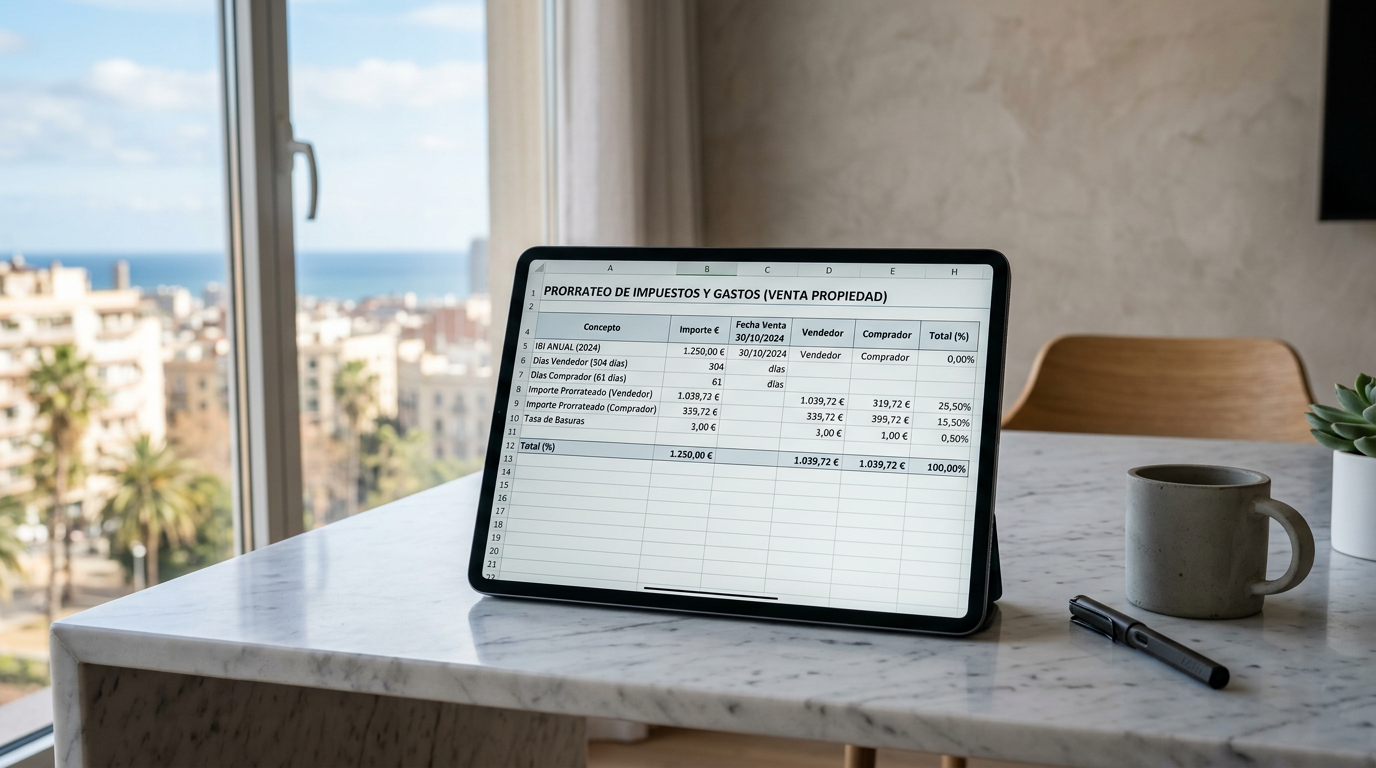
- Annual IBI amount: 730 euros (equivalent to 2 euros per day).
- Date of signing the deed: October 1st.
- Seller's period (from January 1st to September 30th): 273 days.
- Buyer's period (from October 1st to December 31st): 92 days.
If the proportional daily apportionment rule is applied, the seller is responsible for 546 euros and the buyer for 184 euros. Typically, this settlement of accounts is resolved directly during the signing before the notary, by deducting the seller's proportional share from the final price to be paid by the buyer.
Comparison: Key differences between IBI and Community Fees
To clarify the nature of both financial concepts, the following table schematically shows the main differences to keep in mind in any sale and purchase transaction:
| Concept | Community Fees | Impuesto sobre Bienes Inmuebles (IBI) |
|---|---|---|
| Origin | Ordinary fees and agreements of the Board of Owners (Junta de Propietarios). | Municipal tax accrued annually by the Town Hall (Ayuntamiento). |
| General Rule | The seller is liable for outstanding debts; the buyer assumes those after the signing of the deed. | The taxpayer (sujeto pasivo) is the owner as of January 1st of the year of the sale. |
| Apportionment | Monthly fees are not generally apportioned, unless expressly agreed. | It is generally apportioned by days of ownership, unless otherwise agreed. |
| Lien on the Property (Afección de la Finca) | The property is liable for debts of the current year and the 3 or 4 previous years. | The property is subsidiarily liable for the payment of outstanding tax periods. |
| Verification Document | Certificate issued by the Community Administrator/Secretary. | Proof of payment for the last tax years and cadastral query. |
What to check and how to regulate these expenses in the earnest money agreement (arras)
To ensure a secure purchase and avoid subsequent litigation, it is highly recommended to collect and analyze all relevant documentation before proceeding to sign the earnest money agreement (contrato de arras). Make sure to request the following documentation from the seller:
- Last receipt of paid IBI (Impuesto sobre Bienes Inmuebles - property tax): To check the exact annual amount and verify that the cadastral reference fully matches the property.
- Community debt certificate: Recently issued by the property manager, which includes current debts and approved expenses pending maturity.
- Minutes of the latest homeowners' association meetings: A key document to check if there are future community works or major special assessments (derramas) being discussed but not yet formalized.
- Annual budget and ITE (Inspección Técnica de Edificios - Technical Building Inspection) report: If the building is of a certain age, knowing the status of the Technical Building Inspection is key, as a negative rating will force costly special assessments (derramas) in the short term.
The wording of the earnest money contract (contrato de arras)
Do not rely on overly generic formulas such as the classic phrase "the property will be delivered free of charges, liens, and tenants, and up to date with expenses and taxes." This statement can be ambiguous when it comes to settling approved special assessments (derramas) pending payment or calculating the daily apportionment of the current IBI. It is highly recommended to draft a specific and detailed clause in the earnest money contract to regulate expenses clearly:
"The selling party declares to be up to date with the payment of all ordinary and extraordinary community expenses accrued to date, as well as the Real Estate Tax (IBI). The seller undertakes to provide, at the time of signing the public deed of sale, the corresponding community debt certificate with no outstanding balances. Furthermore, the parties expressly agree that the IBI amount for the current year shall be prorated between buyer and seller by calendar days in proportion to the time that each of them holds ownership of the property during the current financial year, proceeding to make the appropriate compensation in the final settlement at the notary public."
Frequently asked questions about the community of owners and IBI in the sale and purchase
Who pays the community fees for the specific month in which the sale is signed?
Unless otherwise agreed in the earnest money contract (contrato de arras), the person responsible for paying the monthly receipt issued by the community administration is whoever holds ownership of the property on the due date of the fee according to community rules. However, the parties can freely agree to prorate that specific month by actual days of occupancy.
Is it legal to waive the presentation of the community debt certificate in the public deed?
The applicable regulations in Catalonia and the rest of Spain require the seller to present this certificate to the notary. However, the law allows the buyer to expressly release the seller from this obligation. From a legal certainty perspective, it is highly discouraged for the buyer to accept this waiver, as they would assume the risk of having to face prior community debts of thousands of euros that they were unaware of.
What IBI debts from previous years can be claimed from me when buying a flat?
Tax law stipulates that real estate properties remain directly liable (afectos de forma real) for the payment of outstanding taxes levied on their ownership, in this case the IBI (Impuesto sobre Bienes Inmuebles). The Town Hall can subsidiarily claim unprescribed tax bills from the last four years from the new acquirer if the previous owner is insolvent. Therefore, it is crucial to verify the status of the tax bills from previous fiscal years before buying.
What happens if the IBI bill for the current year has not yet been issued?
If the sale takes place in the first months of the year, before the town hall issues and collects the annual IBI bill, immediate payment cannot be made at the notary's office. In these cases, the cost is usually estimated based on the previous year's bill and a withholding of that amount from the sale price is agreed upon, or else a written commitment is made to carry out the appropriate settlement and compensation at the time the tax is finally charged to the seller.
Conclusion
Community fees and the IBI in a sale and purchase transaction require meticulous and differentiated attention. An incomplete analysis of the financial situation of the homeowners' association (comunidad de propietarios) or the tax status of the property can lead to unforeseen financial liabilities for the buyer right after having made the most important financial outlay of their life.
Before signing any deposit agreement (contrato de arras) or committing yourself financially, it is essential that you carry out a complete review before buying. Knowing the existing debts, approved extraordinary assessments (derramas), the status of the IBI, and the apportionment agreements will give you the peace of mind of making a completely secure investment.
At INMODOCS, we analyze in detail all the legal, technical, and financial documentation of the property (including community certificates, minutes of the homeowners' association meetings, IBI bills, and cadastre debts) to guarantee that your transaction is free of risks and unpleasant surprises. Secure your real estate investment and rely on professionals who look exclusively after your buying interests.

Before signing the deposit
If you are considering buying in Barcelona, read the full guide: Buying a flat in Barcelona without surprises.