
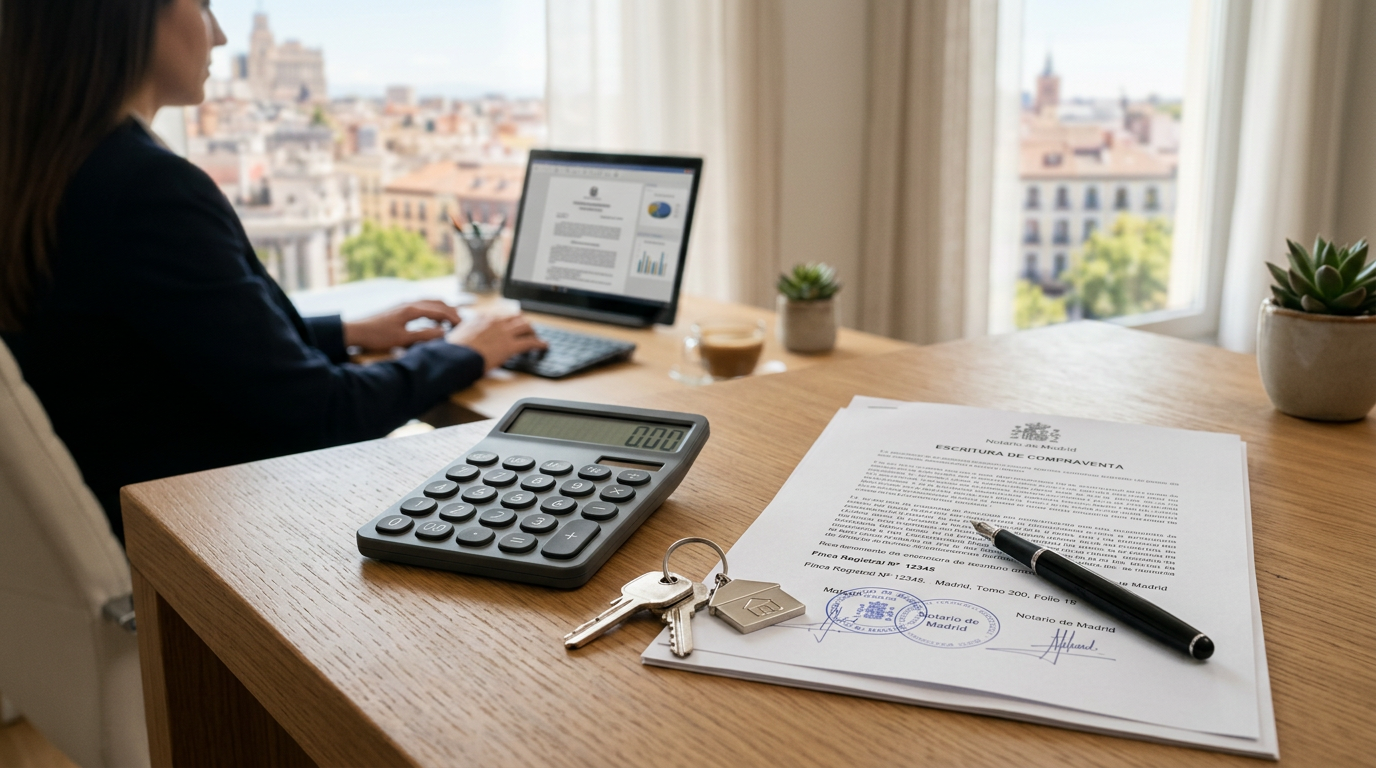
Buying a home is one of the most important financial decisions of your life. However, the process can become complicated if you encounter an owner who pays taxes outside of Spain. If you are thinking of buying a property from a non-resident seller, you should know that this transaction is not exactly the same as a conventional sale. In fact, the law imposes direct tax obligations on you that, if not met, can end up costing you very dearly.
In this article, we explain in detail what the 3% withholding is, how it is managed through the Spanish Tax Agency (Hacienda), and what other tax and legal risks you must shield yourself against before signing the deed.
Is being a foreigner the same as being a tax non-resident?
Often, the mistake of associating nationality with tax residence is made. However, these are completely different concepts. A British or French citizen can live permanently in Spain, pay their taxes here, and be a full tax resident. Conversely, a Spanish national may reside abroad for work or personal reasons and be considered a tax non-resident in our country.
What is relevant for the Spanish Tax Agency (AEAT) when determining whether you must withhold part of the price is where the seller pays taxes. The Non-Resident Income Tax (IRNR) Regulations establish that the seller must prove their residence in Spain by means of a tax residence certificate issued by the AEAT itself.
It is not enough for the seller to show you a Spanish NIE, have a national bank account, or claim that they live here informally. If they do not provide the current official certificate, you must act under the premise that they are a non-resident to avoid penalties.

What does the 3% withholding on a non-resident seller consist of?
The famous 3% withholding is not a tax that you must pay out of your own pocket as an extra cost of the purchase process. It is, in reality, a portion of the agreed price of the property that is not delivered to the seller at the time of signing. Instead, the buyer retains it temporarily with the legal obligation to deposit it directly with the public treasury (Hacienda).
Let's look at a practical example to easily understand it:
- Agreed purchase price: €500,000
- Mandatory withholding (3%): €15,000
- Net amount delivered to the seller at the notary's office: €485,000
- Amount that the buyer deposits with Hacienda: €15,000
This withholding functions as a payment on account of the final tax that the non-resident seller will have to settle for the capital gain derived from the transfer. If the resulting final tax is less than those €15,000, the seller may request a refund of the excess from Hacienda. If it is higher, they will have to pay the difference. In any case, that final calculation is the seller's business, but as the buyer, it is your responsibility to ensure that the initial withholding is strictly applied.

How and when to submit the modelo 211
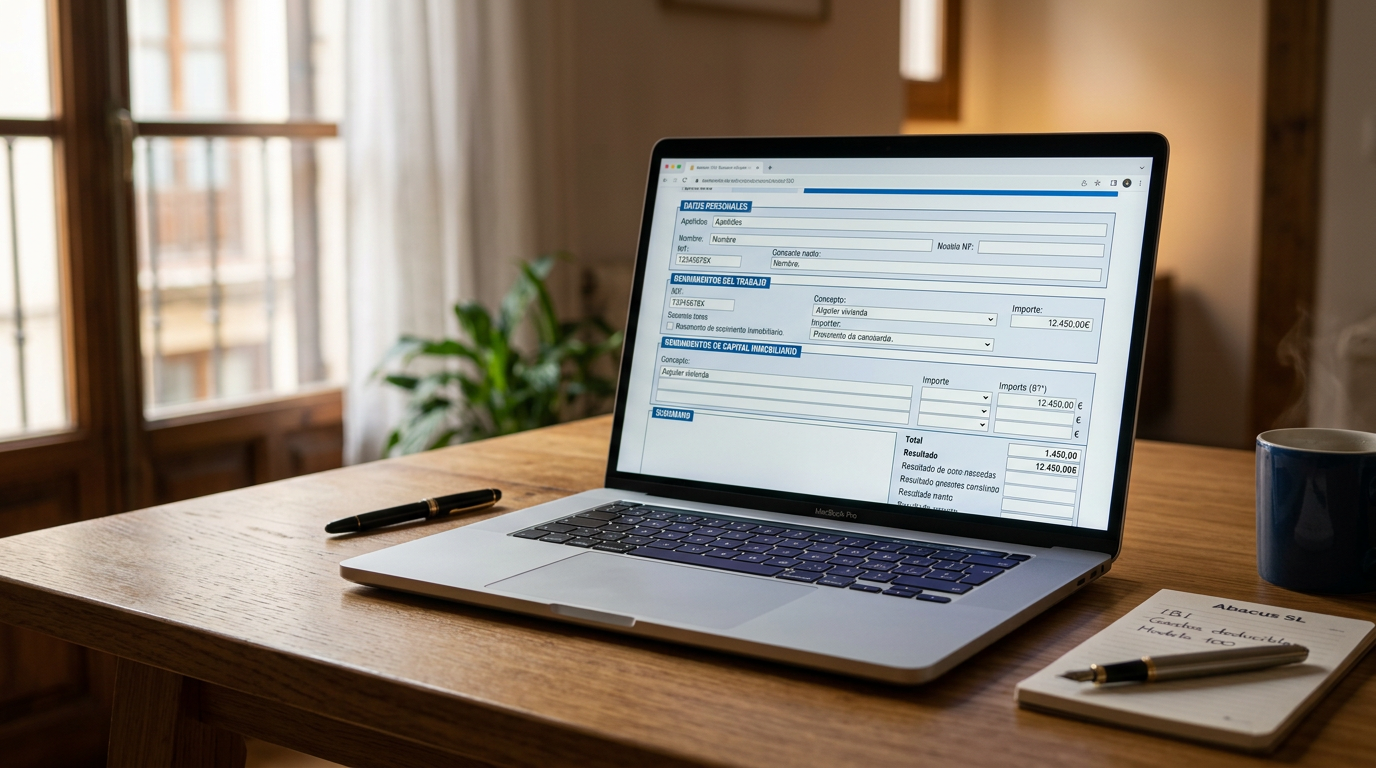
To make this deposit into the public coffers correctly, you must file and pay the modelo 211 of the Spanish Tax Agency (AEAT).
- Who must submit it? The buyer (or buyers, in proportion to their acquisition share).
- What is the deadline? Exactly one month starting from the date of execution of the public deed of sale.
- What must you do after payment? Once paid, you must mandatorily deliver the corresponding copy of Modelo 211 to the non-resident seller. This document will be their only official proof to demonstrate to the AEAT (Spanish Tax Agency) that the withholding has already been applied and to process their subsequent capital gains tax return.
If you are planning to buy in Barcelona from abroad or purchase a property from an owner residing abroad, it is crucial that your legal team coordinates the filing of this tax form flawlessly.
The big risk for the buyer: what happens if you do not withhold?
Never accept proposals such as: "Pay me the full sale price and I will take care of paying my taxes in my country". Accepting this constitutes one of the greatest legal dangers of the transaction.
The Ley del IRNR (Non-Resident Income Tax Law) is categoric in this regard: if the buyer does not apply or pay the 3% withholding, the acquired property remains liable for the payment of the tax debt. This means that if the seller leaves Spain without settling their tax, Hacienda (Spanish Tax Authority) will not go looking for them abroad, but will instead seize or claim the debt directly against your newly purchased home. Therefore, the withholding is not a negotiable option, but your greatest legal guarantee.
Co-ownership and inheritances: what happens if there are multiple sellers?
A frequent scenario is finding properties that belong to several people, such as divorced couples, co-owners of an inheritance, or investment partners. In these situations, the tax residency of each seller must be analyzed individually.
If a €500,000 property belongs 50% to a resident in Spain and 50% to a non-tax resident, the 3% withholding will only apply to the portion of the price corresponding to the non-resident seller:
- Resident's share (€250,000): No 3% withholding is applied.
- Non-resident's share (€250,000): 3% is withheld, which means €7,500.
- Total withholding to be paid with Modelo 211: €7,500.
This scenario requires drafting the public deed and issuing the bank checks or wire transfers with millimetric precision to avoid rejections from the Agencia Tributaria.
The hidden danger: the non-resident's plusvalía municipal (municipal capital gains tax)
In addition to the 3% state withholding, there is a second tax issue that often goes unnoticed until it is too late: the Impuesto sobre el Incremento de Valor de los Terrenos de Naturaleza Urbana, popularly known as plusvalía municipal.
In a typical transaction between residents, this local tax is the responsibility of the seller. However, the Ley Reguladora de las Haciendas Locales (Local Tax Law) introduces an exception of enormous importance: when the seller is a non-resident individual in Spain, the buyer automatically acquires the status of substitute taxpayer (sustituto del contribuyente).
This means that the local administration will demand payment from you if the seller does not do so voluntarily. If you are going to buy in Catalonia, knowing the taxes on a property purchase in Catalonia will help you anticipate this and other costs. To avoid unpleasant surprises, the expert recommendation is to calculate the municipal capital gains tax (plusvalía municipal) before the day of signing at the notary, agree to retain that amount from the total price, and have the buyer themselves take care of settling it directly with the town hall.
Practical aspects: powers of attorney, earnest money agreements (arras), and the form of payment
The operation of these complex transactions requires an exhaustive prior analysis that must begin at the moment of drafting and regulating payments in the earnest money agreement (arras). Do not leave important decisions for the day of the notary signing.
1. Control of powers of representation
It is very common for the non-resident seller not to physically travel to Spain to sign the deed and instead delegate to a legal representative. In this case, it is mandatory to thoroughly analyze the power of attorney provided:
- It must have the Hague Apostille (or diplomatic legalization) if it was granted before a foreign notary.
- It must have a certified translation (traducción jurada) into Spanish if it is written in another language.
- It must include explicit and valid powers to sell the specific property, set the price, agree on withholdings, and receive payments on behalf of the owner.
2. Coordination of payment flows
The distribution of money at the notary office is often like a delicate puzzle, especially if the seller has an outstanding mortgage on the property. It is vital to coordinate and transparently reflect all these items in the deed:
- Amount destined for the cancellation of the seller's mortgage (direct payment to the creditor bank).
- Amount withheld for the 3% (Model 211).
- Amount withheld for the payment of the municipal capital gains tax (plusvalía municipal).
- Final net balance transferred to the seller.
The sum of all these items must match the agreed purchase price with total accuracy. For this entire mechanism to work smoothly, it is a priority to rigorously check mortgages and other liens before proceeding with the reservation.
Why is a complete due diligence still vital?
The international taxation of a transaction is a highly relevant technical layer, but it should not make you forget basic physical and real estate checks. Carrying out a thorough legal review before buying (due diligence) is the only mechanism that guarantees the property is free of urban planning liabilities, hidden community debts, outstanding extraordinary assessments (derramas), habitability issues, or tenants without a legal contract.
Checking the property registry filing (nota simple), the cadastral status, the payment of the Property Tax (Impuesto sobre Bienes Inmuebles - IBI), the status of the Building Technical Inspection (Inspección Técnica de Edificios - ITE), and the minutes of the homeowners' association meetings must always accompany the tax analysis of the non-resident seller.
Conclusion
Buying a property from a non-resident tax seller in Spain is a safe and feasible transaction as long as the appropriate precautionary measures are taken. Strict compliance with the 3% withholding tax through Modelo 211, the correct estimation of the plusvalía municipal (municipal capital gains tax) to avoid becoming jointly liable, and the validation of foreign powers of attorney are three non-negotiable pillars to safeguard your investment.
At INMODOCS, we are experts in coordinating these types of complex transactions, analyzing all registry and tax documentation prior to signing to guarantee that you enjoy your new home with complete peace of mind and without unpleasant surprises in your mailbox.
Before signing the deposit
If you are considering buying in Barcelona, read the full guide: Buying a flat in Barcelona without surprises.