

If you want to buy a flat in Barcelona and you are looking at real estate listings, it is very likely that you already have a figure in mind for the down payment. However, having only 20% of the property price is not enough. To avoid unpleasant last-minute surprises, it is essential to accurately calculate the additional costs of the transaction.
In addition to the selling price, you must budget for taxes, notary fees, Property Registry expenses, the cost of the appraisal, and other necessary professional services. In the case of a second-hand property, the Impuesto sobre Transmisiones Patrimoniales (ITP - Property Transfer Tax) represents the most significant outlay after the acquisition itself. Since mid-2025, Catalonia has applied a progressive scale to this tax, which makes it necessary to fine-tune the estimated total budget.
Before taking any firm step or signing a deposit agreement (contrato de arras), you must be clear on two figures: the total real cost of the purchase and the amount of personal funds you need to contribute from your pocket.
What are the expenses of buying a flat in Barcelona?
In the second-hand housing market in Catalonia, the buyer must face a series of mandatory and recommended expenses. The main concepts you must include in your financial plan are:
- The Impuesto sobre Transmisiones Patrimoniales (ITP).
- Notary fees for the public deed.
- Registration costs in the Property Registry.
- The official appraisal of the property (if you apply for a mortgage).
- A possible loan opening fee.
- Legal and technical advice costs prior to signing.
According to the Civil Code of Catalonia, unless agreed otherwise, the costs of executing the public deed and those subsequent to the transfer correspond to the buyer. Since these are not fixed percentages across all concepts, it is vital to break them down one by one.
The Impuesto sobre Transmisiones Patrimoniales (ITP) in Catalonia
The ITP is, by far, the highest additional expense when buying a second-hand home. In Catalonia, the general rate is calculated using a progressive bracket system:
- Up to €600,000 of tax base: 10% is applied.
- Between €600,000 and €900,000: 11% is applied on that bracket.
- Between €900,000 and €1,500,000: 12% is applied on that bracket.
- Above €1,500,000: 13% is applied on the excess.
For example, for a €300,000 flat, you will pay a flat 10%, meaning €30,000. If you buy for €500,000, the tax will amount to €50,000. However, if the property costs €750,000, the calculation by brackets results in €76,500 (€60,000 corresponding to the first bracket of €600,000 and €16,500 corresponding to 11% of the remaining €150,000).
A critical detail: Hacienda (the tax authority) does not always calculate this tax based on the price agreed in the purchase agreement. It is essential to consult the reference value officially determined by the Catastro (Cadastre), because if this value is higher than the sale price, the ITP tax base will be that cadastral reference value and not what you pay to the seller.
Reduced ITP rates: when can you benefit?
Fortunately, not all buyers have to pay the general rate of ITP (Property Transfer Tax). Catalonia offers various tax benefits that reduce this tax to 5% for the purchase of a primary residence, provided that strict age, income, and family situation requirements are met.
The following are entitled to this reduced rate of 5%:
- Young people aged 35 or under (subject to a taxable base and income limit).
- Members of large families or single-parent families.
- Individuals with a degree of disability equal to or greater than 33%.
- Victims of gender-based violence.
Knowing these benefits will allow you to calculate purchase taxes accurately and save thousands of euros that you can allocate towards renovations or the property's down payment.
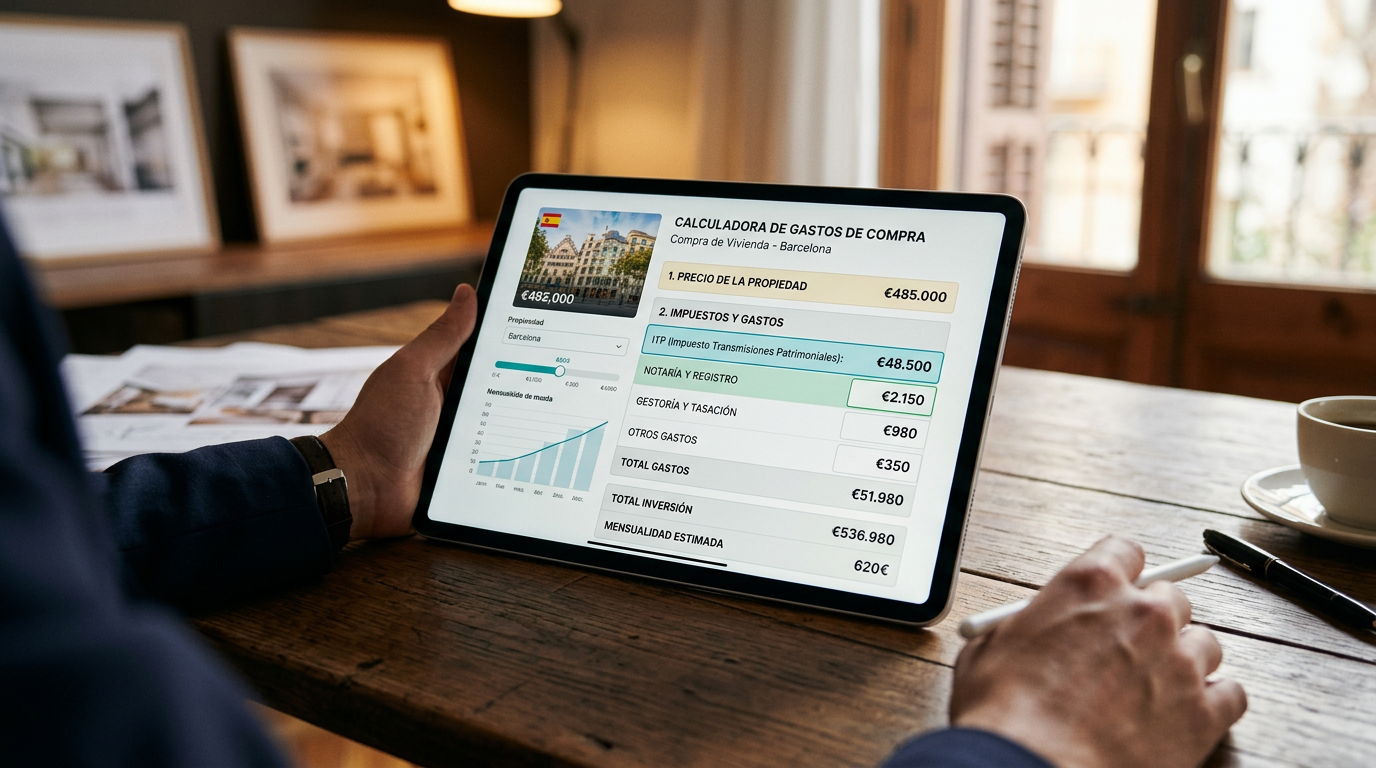
Notary and Property Registry Fees
Formalizing the contract through a public deed of sale and purchase and its subsequent registration are essential steps to secure your property against third parties.
Notary fees are regulated by state tariffs approved by law. Therefore, all notary offices apply the same base rates, although the final invoice amount varies according to the deed value, the document's length, the number of copies issued, and whether annexes such as parking spaces or storage rooms are included. Do not use the simplistic "0.5%" rule for this calculation; it is better to request an estimated quote from the chosen notary office, detailing the characteristics of the property.
Once the deed is signed, you must proceed to register it in the corresponding Property Registry. Registry fees are also progressively fixed by the State. Keep in mind that if the flat, the parking space, and the storage room are recorded as independent registered properties, the registrar must perform separate registrations, which will proportionally increase the final cost.
Valuation and Mortgage: Costs Assumed by the Buyer
If you are going to finance your home with a bank loan, you must be very clear about the rules of the financial game. Since the entry into force of the Ley de Contratos de Crédito Inmobiliario (Real Estate Credit Contracts Act) of 2019, most of the mortgage formalization costs have been assumed by financial institutions. The bank is responsible for paying for the notary, the Property Registry, the administrative agency (gestoría), and the AJD (Stamp Duty) tax of the mortgage.
However, the buyer still has to pay out of pocket for the official valuation of the property. This report must be carried out by an appraisal company approved by the Banco de España and usually costs between 300 and 600 euros, depending on the area of the property. Remember that the appraisal has a legal validity of six months; if it is valid, any bank is obliged to accept it to study your financial viability.
Additionally, you should watch out for whether your financial institution applies an opening commission on the mortgage loan, which will be deducted from the capital granted at the time of signing. Planning these steps well avoids last-minute surprises and prevents the scenario of suffering what happens if you don't secure financing after having committed your savings in a deposit contract (contrato de arras).
The Importance of Verifying the Legal Status of the Flat
In addition to taxes and regulated costs, it is highly recommended to set aside a budget for checking the property before buying. A thorough technical and legal analysis (referred to as due diligence) will protect you against hidden defects, financial encumbrances, or zoning issues.
This professional study checks critical aspects such as:
- Ownership and potential encumbrances through the Land Registry's nota simple (property registry filing).
- The existence of outstanding debts with the community of owners or approved pending special assessments (derramas).
- The Building Technical Inspection (ITE) and the validity of the occupancy certificate (cédula de habitabilidad).
- The consistency between the cadastral value and the property plans.
Gathering and analyzing all documentation before paying the deposit is the best insurance policy for your money. Even if you are an investor or are planning to buy an apartment in Barcelona from abroad, having independent professionals on the ground will guarantee a highly secure purchase.
Comparison table: How much money do you need based on the price of the apartment?
Below, we provide an indicative breakdown of the minimum personal funds you must contribute for three common budgets in Barcelona (Ciudad Condal), assuming a standard bank financing of 80% of the sale price and the application of the general ITP (Property Transfer Tax).
| Purchase price | General ITP (Catalonia) | Required down payment (20%) | Minimum funds needed (Down payment + ITP) |
|---|---|---|---|
| 300,000 € | 30,000 € | 60,000 € | 90,000 € |
| 500,000 € | 50,000 € | 100,000 € | 150,000 € |
| 750,000 € | 76,500 € | 150,000 € | 226,500 € |
Note: To these amounts, you must add an additional reserve of between 1% and 1.5% to cover notary fees, registration, official valuation, and preventive legal advice. The actual financing from the bank may be lower than 80% depending on your profile.
The risk of an appraisal lower than the purchase price
A critical factor that can completely alter your financing plans is that the bank calculates the 80% based on the lower of the two values: the purchase price or the appraised value.
If you sign an earnest money agreement (arras) for an apartment of €500,000 expecting to receive a €400,000 mortgage, but the official appraisal company values the property at €450,000, the bank will only grant you 80% of that appraisal (€360,000). As a result, you will have to contribute €140,000 of your savings for the down payment instead of €100,000, in addition to the €50,000 of ITP and the rest of the management costs.
Common mistakes when budgeting for a purchase in Barcelona
- Believing that a 20% down payment is enough: This is the most common mistake and the reason why many transactions fall through right before reaching the notary.
- Not verifying the cadastral reference value: Filing the self-assessment for the ITP below this value can lead to a tax audit by Hacienda (the Spanish Tax Agency) with penalties and late payment interest.
- Failing to take into account the progressive nature of the ITP: Applying a flat 10% to homes exceeding €600,000 will distort the final budget.
- Calculating the numbers after signing the earnest money agreement (arras): Financial planning must always precede any signing or deposit payment.
Frequently asked questions about purchase expenses
How much money do I need in total for a €500,000 apartment in Barcelona?
If you get 80% financing of the price, you will need to provide a €100,000 down payment and approximately €50,000 to pay the ITP (Property Transfer Tax). Adding notary, registry, and appraisal fees, you should have a minimum of €155,000 to €157,000 of personal capital.
Do the additional expenses always represent 10% of the purchase?
No. The general ITP in Catalonia is 10% for properties up to €600,000, but to this you must add notary, registry, and brokerage costs. For properties exceeding this amount, the progressive scale means that the tax alone represents an effective percentage higher than 10%.
Can the bank finance the taxes and purchasing expenses for me?
As a general rule, no. Financial institutions limit lending to 80% of the property value due to prudence and solvency criteria, meaning the buyer must have their own liquid funds to cover tax and deed registration expenses.

Conclusion
Calculating the real costs of buying an apartment in Barcelona requires going beyond the price you see on the real estate portal. Analyzing in advance the exact ITP that applies to you, the reference cadastral value, and anticipating the associated legal fees will prevent unnecessary financial surprises. Do not leave such an important decision to chance or approximate formulas.
Information updated as of August 2026. This content is for general informational purposes only and does not replace legal, tax, or financial advice tailored to a specific transaction.