
The cadastral value (valor catastral) of a property is an administrative value assigned to each property based on the information held in the Catastro (Cadastre). It is a fundamental piece of data in the Spanish real estate sector, as it serves as the taxable base for calculating various local and state taxes.
However, there is great confusion surrounding it. Many buyers and owners confuse it with the price they would pay on the market or with the new reference value (valor de referencia) of the Dirección General del Catastro (Directorate General for Cadastre). Understanding what it is, how it is calculated, and where to find it will save you from major financial and tax errors.
What is the cadastral value of a property?
The Ley del Catastro Inmobiliario (Real Estate Cadastre Act) defines the cadastral value as the objective determination of the value of a property based on the data contained in the administrative registry of the Catastro. This value is made up of the sum of two clearly differentiated concepts:
- The cadastral land value (valor catastral del suelo): The value attributed to the land on which the building stands.
- The cadastral building value (valor catastral de la construcción): The administrative value of the building itself (materials, age, quality, etc.).
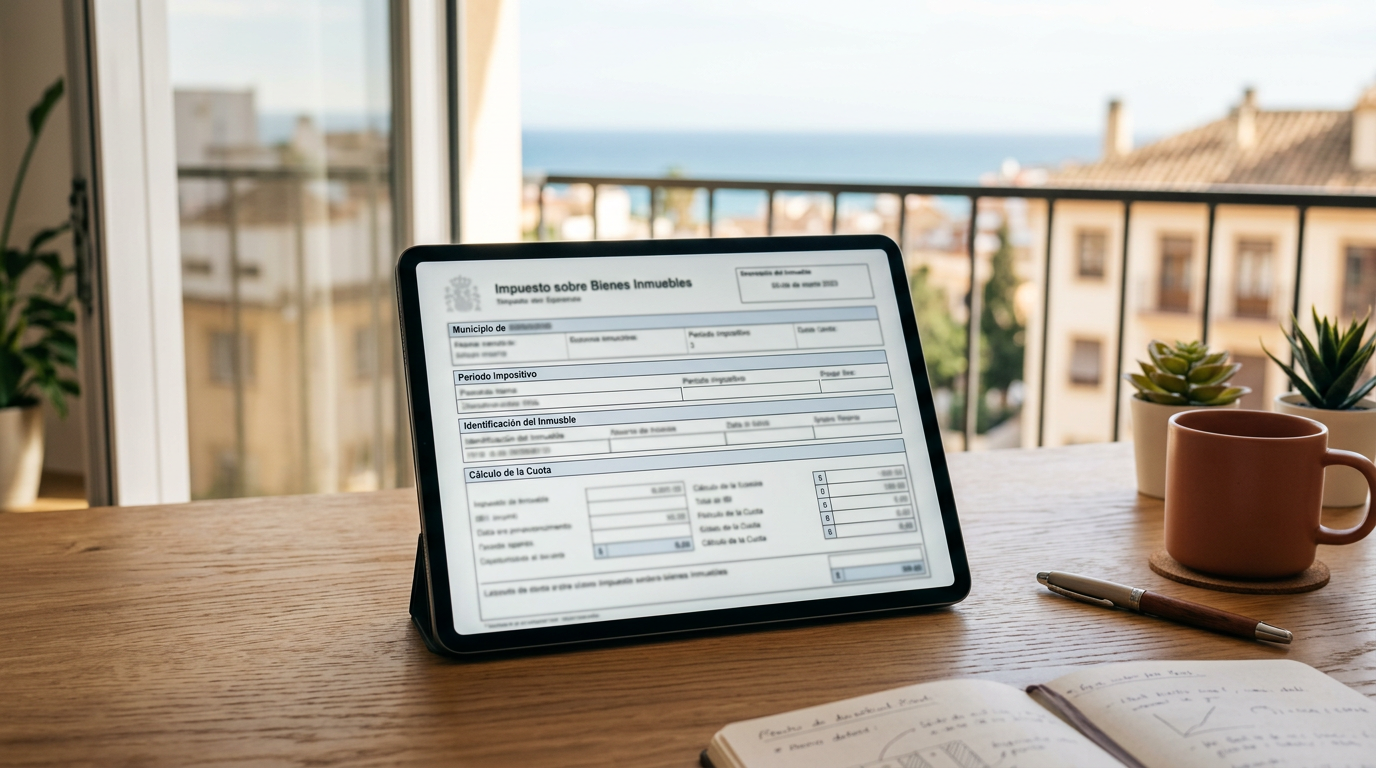
For example, if you review a receipt for the Impuesto sobre Bienes Inmuebles (IBI, municipal property tax), you might find a breakdown similar to this:
- Valor catastral del suelo: 85.000 €
- Valor catastral de la construcción: 115.000 €
- Valor catastral total: 200.000 €
This total of 200.000 € represents the cadastral value of the property. It is important to bear in mind that, as a general rule and by legal mandate, the cadastral value cannot exceed the market value of the property. In fact, it is usually set at around 50% of it.
How is the cadastral value calculated?
The calculation of the cadastral value is not carried out by the owner, but is determined ex officio by the Dirección General del Catastro through the so-called ponencias de valores (valuation reports). To set this figure, specific technical and objective criteria of the municipality where the property is located are applied.
Among the main factors influencing the calculation are:
- Location and urban planning: The location of the property, the urban planning circumstances of the land, and the value of the area.
- Physical characteristics of the property: The construction cost of the building, the use of the property (residential, commercial, etc.), construction quality, age, and state of conservation.
- Market factors: The expenses and profits of the real estate development activity, as well as market studies of actual transactions in the area.
This value is not updated automatically every year according to free market fluctuations. Modifying it usually requires collective valuation procedures, new municipal ponencias de valores, or updates specifically approved in the Presupuestos Generales del Estado (State General Budgets).

Differences between cadastral value, reference value, and market price
It is extremely common to confuse these three terms, but using them interchangeably can lead to significant tax penalties or calculation errors when buying a house.
| Concept | Valor Catastral (Cadastral Value) | Valor de Referencia (Reference Value) | Market Price |
|---|---|---|---|
| Definition | Administrative value calculated based on land and construction. | Value determined annually by the Catastro (Cadastre) based on real transactions. | The price agreed between buyer and seller under free market conditions. |
| Main Use | Calculation of IBI (Property Tax) and imputed income tax in IRPF (Personal Income Tax). | Taxable base for ITP (Property Transfer Tax) and ISD (Inheritance and Gift Tax). | Pricing, mortgage applications, and financial appraisals. |
| Privacy | It is protected data (only accessible to the owner or authorized parties). | It is public data (accessible with the DNI and the cadastral reference). | It is public and negotiable between the parties of the sale. |
| Update | Through collective valuation procedures (intervals of several years). | It is calculated on a massive scale and published on January 1st of each year. | Changes constantly according to market supply and demand. |
⚠️ Important Notice: The valor catastral is not the automatic taxable base for ITP. If you buy a property in Catalonia, for example, the taxable base for the Impuesto sobre Transmisiones Patrimoniales (ITP) is usually calculated using the higher of the cadastral reference value and the deeded purchase price. Do not make the mistake of using the valor catastral for this calculation.
Not sure which value you should use to calculate purchase taxes?
We review the Catastro, the reference value, and the price before you sign the earnest money agreement (arras) to avoid surprises with Hacienda (the tax authority).
Where can I check the valor catastral?
As it is protected data, not just anyone can freely check the valor catastral of someone else's property. However, if you are the owner or have the owner's authorization, you have several ways to consult it:
1. On the IBI receipt
This is the simplest method. The annual receipt issued by your local town hall for the payment of the Impuesto sobre Bienes Inmuebles (IBI) breaks down the cadastral reference, the land value, the construction value, and the total valor catastral, which serves as the taxable base to settle the tax.
2. Sede Electrónica del Catastro
By accessing the official portal of the Sede Electrónica del Catastro and identifying yourself using a digital certificate, electronic DNI, or the Cl@ve system. Under the "Mi Catastro" section, you can check the protected information of all properties under your ownership.
3. Cadastral certificate
You can request a descriptive and graphic cadastral certification. This official document contains all the physical, legal, and economic data of the property, including the areas and the itemized valor catastral.
Can the buyer find out the valor catastral before the purchase?
Not directly, since they are not the owner. However, during the negotiation phase of a sale, it is a recommended practice to ask the seller to provide the latest IBI receipt or a cadastral certification to carry out the appropriate cadastral checks before buying.
For which taxes is the valor catastral used?
This administrative value is the starting point for settling several of the most important taxes in Spain:
- Impuesto sobre Bienes Inmuebles (IBI, Property Tax): It is calculated by applying a coefficient (set by each city council) directly to the cadastral value of the property.
- Plusvalía Municipal (IIVTNU, Municipal Capital Gains Tax): If you choose the objective calculation method to settle the plusvalía after a sale or inheritance, the cadastral value of the land on the transfer date is used as the basis. We recommend learning how to calculate plusvalía using the cadastral value of the land to avoid errors.
- Imputación de rentas en el IRPF (Imputed Income Tax in Personal Income Tax): If you own a second home that is not rented out and is not your primary residence, Hacienda (the Spanish Tax Agency) requires you to declare an imputed income in your IRPF. This income is usually equivalent to 1.1% or 2% of the property's cadastral value.
What happens if the Catastro (Cadastre) data is incorrect?
If the cadastral description of the home (surface area, year of construction, use of the rooms) does not correspond to the physical reality, the resulting cadastral value will be incorrectly calculated, causing you to systematically overpay taxes.
In these cases, it is necessary to initiate a procedure to rectify cadastral discrepancies by submitting the modelo 900D to the Catastro. You should know, however, that modifying the cadastral information does not solve all your problems at once: it is essential to know what to do if the Registro and Catastro do not match, as they are independent organizations and coordinating them requires specific technical procedures.
Before any transaction, we suggest checking the registration status of the property to verify that the nota simple (land registry certificate) from the Registro de la Propiedad (Land Registry), the public deeds, and the cadastral record describe exactly the same home. In this way, you will know how to differentiate cadastral and registration information with total clarity and avoid future audits by Hacienda or urban planning issues.
Frequently asked questions about the cadastral value
Is the cadastral value of a home public?
No. Unlike the referencia catastral (the 20-character alphanumeric identifier, which is publicly accessible), the cadastral value is confidential and can only be consulted by the owner, their heirs, authorized representatives, or public administrations.
What is the referencia catastral of a property?
It is the unique identification code of the property, comparable to the DNI (ID card) of the property. It should not be confused with the cadastral value, which is the economic value assigned to said property.
Does the Catastro prove that I am the actual owner of the property?
No. The Catastro is a registry for tax and administrative purposes. The only institution that provides full legal certainty and public faith regarding property ownership in Spain is the Registro de la Propiedad. Therefore, before buying, you should always check for charges on the property using a nota simple.
Conclusion
The cadastral value is an essential administrative metric that determines how much you will pay annually in property taxes (such as the IBI) and directly affects your income tax return if you own second homes. However, it is not equivalent to the market value of the home nor to the valor de referencia (reference value) used in the payment of ITP (Property Transfer Tax) or inheritance tax.
When facing a real estate transaction, it is a priority to review the cadastral data and verify the Land Registry and Cadastre in a professional manner. This will prevent you from paying undue taxes or inheriting area discrepancies that could complicate a future sale.
At INMODOCS we help you analyze the property before buying, taking care of the entire technical, legal, and cadastral audit of your future home so you can invest with absolute peace of mind.

Before signing the deposit
If you are considering buying in Barcelona, read the full guide: Buying a flat in Barcelona without surprises.