

If you are considering buying a flat in Barcelona to place it on the rental market, the first question you will ask yourself is obvious: what yield will I get? However, in the current regulatory landscape, making the mistake of calculating your return based solely on the prices you see on real estate portals can ruin your investment before you even start.
Barcelona has been declared a zona de mercado residencial tensionado (stressed residential market area). This means that rental prices are not freely governed by supply and demand, but are strictly limited by law. To calculate the real viability of your transaction, it is mandatory to understand how the zona tensionada affects a purchase and to meticulously analyze the legal and administrative history of the property before signing any earnest money contract (contrato de arras).
The danger of calculating yield using the advertised rent
The most common mistake among novice investors is using the average rental price in the area as a reference. Let's imagine you find a flat in the Eixample district for €400,000 and you notice that similar properties are advertised on portals for €1,700 per month.
A quick and incorrect calculation would lead you to think:
- Estimated annual income: €1,700 × 12 = €20,400
- Gross yield: 5.1%
However, if that same property was rented out in the last five years for a rent of €1,250, current legislation will generally force you to maintain that reference price. In that case, the reality of your investment would be:
- Real income: €1,250 × 12 = €15,000
- Real gross yield: 3.75%
This drastic difference demonstrates why you need to calculate the maximum rent permitted by law before committing your funds.

How does the flat's history influence the rent you can charge?
In the zonas tensionadas (stressed areas) of Catalonia, the starting point for setting the price of a new lease agreement is the history of the property. If the property has had a primary residence lease agreement (contrato de alquiler de vivienda habitual) in force during the last five years, the law establishes that the new rent cannot exceed the last updated rent of the previous contract.
To avoid unpleasant surprises, before buying it is essential to request the following documents from the seller:
- The complete previous lease agreement.
- Payment receipts proving the actual rent collected.
- The history of applied rent updates (IPC [Consumer Price Index] or other indices).
- The exact end date of the contract.
Buying the property does not "reset" this history. The new owner inherits the limitations of the previous contract, which can affect the yield for years.
The State Reference Index: the second legal limitation
In addition to the previous rent, the Ministerio de Vivienda y Agenda Urbana (Ministry of Housing and Urban Agenda) has a system for setting reference prices. By entering the cadastral reference or the exact address of the flat in Barcelona, the system provides a price range (a lower and an upper limit) based on the characteristics of the property (surface area, year of construction, elevator, energy certificate, etc.).
This state index acts as a mandatory cap in two key scenarios:
- If the owner is considered a large property holder (gran tenedor).
- If the property has not been rented out as a primary residence in the last five years.
It is vital not to confuse this official index with market price statistics from real estate portals or with the annual CPI (IPC) update. They are completely different tools and concepts.
Large property holder vs. Small landlord: how does your limit change?
The profitability of the same apartment in Barcelona can vary significantly depending on the buyer's profile. The Generalitat de Catalunya defines the conditions to check if you are a large property holder, a status that directly influences rent limits:
- Small landlord: Generally, if they inherit a previous contract from the last five years, their maximum limit will be the previous updated rent (even if this is higher than the state reference index).
- Large property holder: They must compare the previous updated rent with the maximum limit set by the state reference index and must apply the lower of the two.
Let's look at an example of how rent changes depending on the landlord for an apartment with a previous rent of 1.500 € and an index cap of 1.250 €:
| Landlord Type | Applicable Limit | Annual Income | Annual Difference |
|---|---|---|---|
| Small landlord | 1.500 € (Previous rent) | 18.000 € | - |
| Large property holder | 1.250 € (Index Cap) | 15.000 € | -3.000 € |
What happens if the property has never been rented?
If the home you are going to buy has been the primary residence of its previous owner during the last decade, or has simply been vacant with no primary residence lease contracts in the last five years, the limit is simplified but becomes stricter. In this case, the new lease agreement is directly subject to the maximum limit of the state reference system, regardless of whether you are a small landlord or a large property holder.
If you estimated that the apartment would easily rent for 1.800 € due to demand in the area, but the state index shows a cap of 1.400 €, your financial viability calculations must be strictly based on those 1.400 € per month.
Calculate profitability on the total investment, not on the sale price
Another recurring financial mistake is omitting the costs associated with the acquisition. Buying an apartment for 400.000 € in Barcelona requires a much higher real outlay. To obtain a realistic profitability percentage, you must calculate the total acquisition cost by adding:
- Taxes: In Catalonia, the general Property Transfer Tax (ITP, Impuesto sobre Transmisiones Patrimoniales) for second-hand homes is 10%.
- Notary and registration fees: Approximately 1% of the purchase price.
- Financial expenses: Valuation, mortgage setup, and agency fees (gestoría) if you need bank financing.
- Renovations and preparation: Initial investment to paint, furnish, or renovate the property before putting it up for rent.
If additional costs amount to 45.000 €, your real investment is 445.000 €. A maximum rent of 1.300 € per month translates to a gross return on the purchase price of 3,90%, but drops to 3,51% if you calculate it on the total investment.
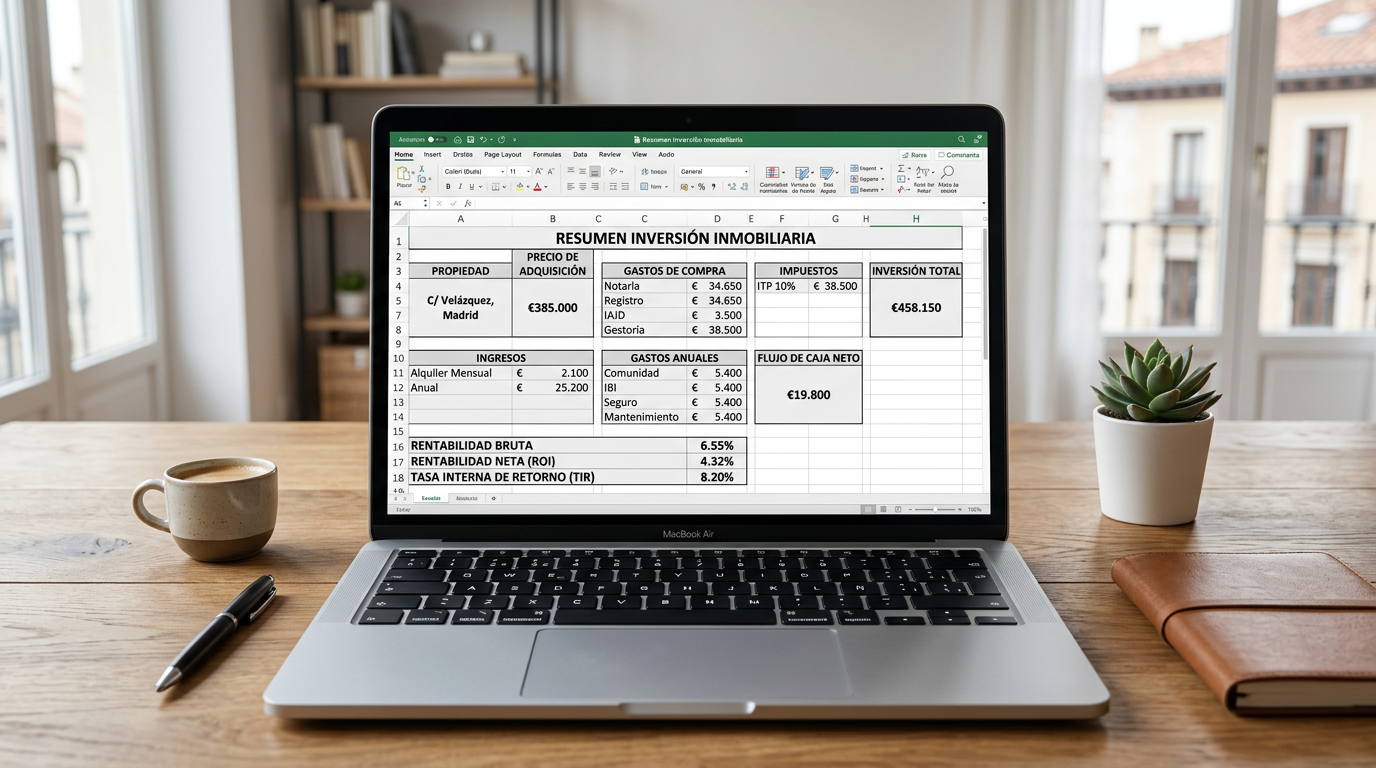
The impact of annual expenses on net yield
To know the real profit, it is essential to subtract the recurring annual expenses that you will assume as a landlord:
- Impuesto sobre Bienes Inmuebles (IBI - Property Tax): Annual municipal tax.
- Community fees: Ordinary monthly fees and potential extraordinary assessments (derramas).
- Insurance: Multi-risk home insurance and, highly recommended, rent default insurance.
- Maintenance and repairs: Boiler, household appliances, plumbing, etc.
- Vacancy periods: Estimation of weeks or months that the apartment may be empty between tenants.
If we subtract these costs (which can easily add up to between €2,000 and €3,000 annually) from your gross income, the final net yield will frequently be one percentage point below the gross yield initially calculated.
Are you going to buy an apartment that already has a tenant?
Acquiring a property with an active lease agreement may seem like an advantage because it generates income from day one. However, it requires an even stricter legal audit.
You must bear in mind that purchasing the property does not terminate the active lease; you subrogate into the position of the former owner, assuming all their rights and obligations. It is imperative to review the agreed conditions in detail, any potential extension agreements, and ensure that the tenant is up to date with payments to avoid buying an apartment that is already rented with hidden legal or delinquency problems.
Renovations and room rentals: myths and regulatory realities
Many buyers trust that carrying out a comprehensive renovation will allow them to bypass rent limitations. Although the Ley de Arrendamientos Urbanos (LAU - Urban Leasing Act) contemplates the possibility of increasing the rent by up to 10% above the limit in specific cases of rehabilitation, energy efficiency improvement, or accessibility, these requirements are very strict and must be perfectly justified and documented. Not just any cosmetic touch-up work entitles you to this increase.
Similarly, renting by rooms has emerged as an alternative to try to maximize yield. However, in Catalonia, regulations actively pursue fraud under the law. If it is proven that splitting the contract is used solely to bypass rent control on primary residences, you expose yourself to serious administrative penalties and the obligation to return any overcharged amounts.
The importance of reviewing the community of owners
Finally, the financial profitability of your apartment in Barcelona can be drastically affected by the building's health. Before signing the earnest money agreement (arras), you must review potential community assessments before buying. Request the certificate of being up to date with payments, the latest minutes of the owners' association meetings, and the Inspección Técnica del Edificio (ITE - Building Technical Inspection) report. An approved community assessment (derrama) of €15,000 to repair the facade or install an elevator just a few months after the purchase can completely neutralize the positive cash flow of your first three years of rent.
Checklist: what to check before signing the earnest money agreement (arras)
To ensure you are making a safe purchase based on real numbers, gather the following information:
- Updated nota simple (land registry extract): To verify liens, ownership, and property description.
- Contract history: Copy of the rental agreements from the last 5 years.
- Cadastral certificate: To query the state reference index.
- Occupancy certificate (cédula de habitabilidad) and Energy Performance Certificate (CEE): Mandatory for renting in Catalonia.
- Community documentation: Minutes of the last 3 owners' meetings and bylaws.

Conclusion: invest with legal certainty
Buying a flat in Barcelona to rent it out remains an attractive option for many investors, but the rules of the game have changed. The success of the operation no longer depends solely on negotiating a good purchase price, but on conducting a rigorous prior legal and regulatory analysis.
At INMODOCS we specialize in reviewing a property before buying in Barcelona. We thoroughly analyze the property's rental history, the limitations of the stressed area, the condition of the community, and the registry documentation to ensure that your investment's return is real, sustainable, and free of legal risks. Do not sign your earnest money agreement (arras) blindly; protect your capital with a comprehensive professional analysis.