

When calculating how much money you need to buy a home, it is not enough to simply add the property price and the mortgage down payment. The taxes associated with the purchase can represent tens of thousands of additional euros.
In Catalonia, real estate taxation depends mainly on whether the property is pre-owned or a brand-new development. In addition, recent tax reforms have introduced a system of progressive brackets and special surcharges that make it essential to crunch the numbers before taking any firm steps.
Therefore, before signing an earnest money contract (contrato de arras), it is advisable to calculate in detail the taxes associated with the chosen property and check if you can benefit from any of the advantages offered by the regional regulations.
What taxes do you pay when buying a home in Catalonia?
The fundamental distinction for the tax authority (Hacienda) lies in the number of transfers the property has undergone:
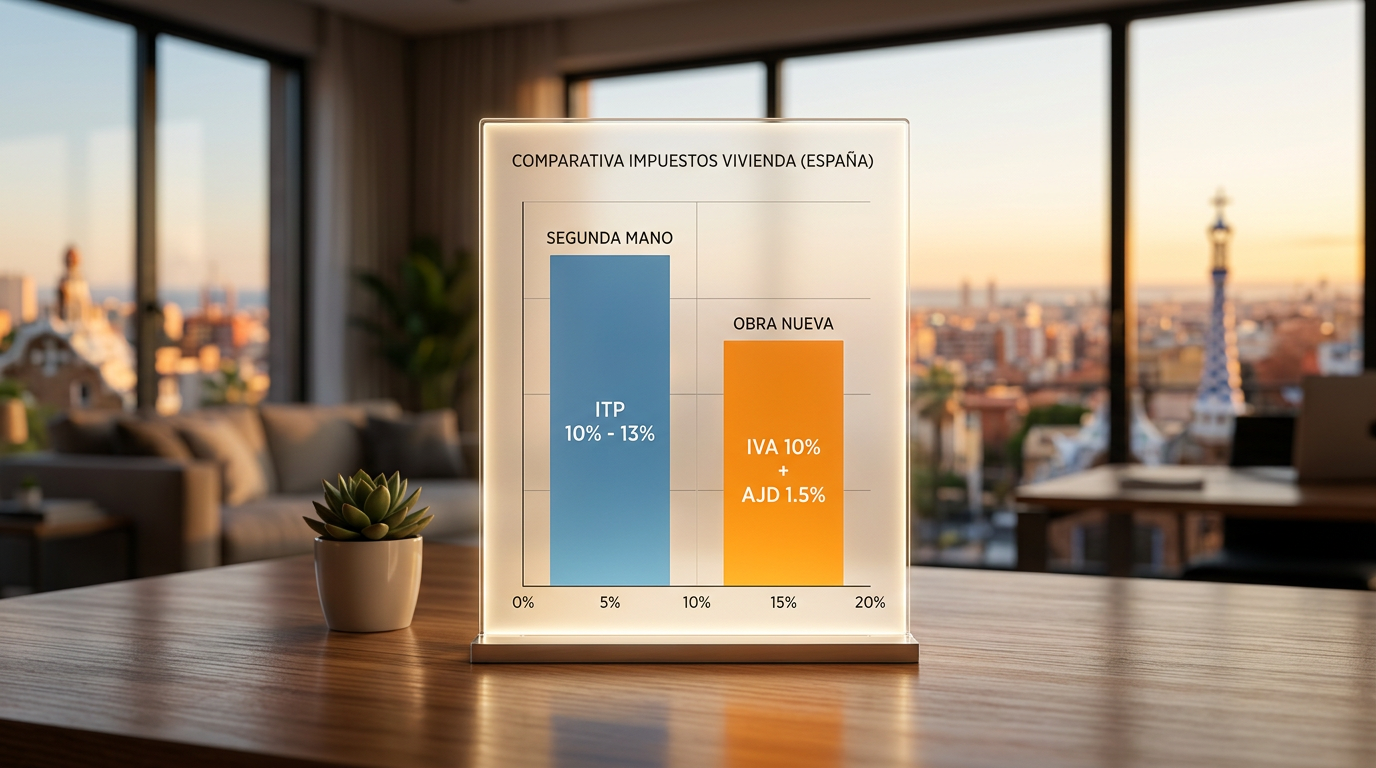
- Pre-owned home (second and subsequent transfers): It is subject to the ITP (Impuesto sobre Transmisiones Patrimoniales / Property Transfer Tax).
- New build home (first transfer by the developer): It is subject to IVA (Impuesto sobre el Valor Añadido / Value Added Tax) and, additionally, to the AJD (Actos Jurídicos Documentados / Stamp Duty) tax.
Both taxes are mutually exclusive for the same residential transfer; in other words, you will never pay IVA and ITP at the same time for the purchase of your home.
| Concept | Pre-owned Home | New Build Home |
|---|---|---|
| Main Tax | ITP (Progressive scale from 10% to 13%) | IVA (10% general rate) |
| Secondary Tax | Not applicable | AJD (1.5% in Catalonia) |
| Tax Base | The higher between price and Reference Value | Actual purchase price |
ITP in Catalonia for pre-owned homes
The ITP (Property Transfer Tax) in Catalonia does not apply a single flat rate. Since the tax reform, the Generalitat establishes a progressive rate by brackets. This means that as the property value increases, the applicable rate goes up.
The current general rates are structured as follows:
- Up to €600,000: 10% is applied.
- From €600,000.01 to €900,000: 11% is applied to this bracket.
- From €900,000.01 to €1,500,000: 12% is applied to this bracket.
- Over €1,500,000: 13% is applied to the excess.
The advantage of this progressive system is that a high marginal rate does not penalize the entire property. Each percentage is settled strictly on the portion of the price that falls within each bracket.
Practical examples of progressive ITP calculation
To understand how this progressive system actually works, let's look at three common scenarios:
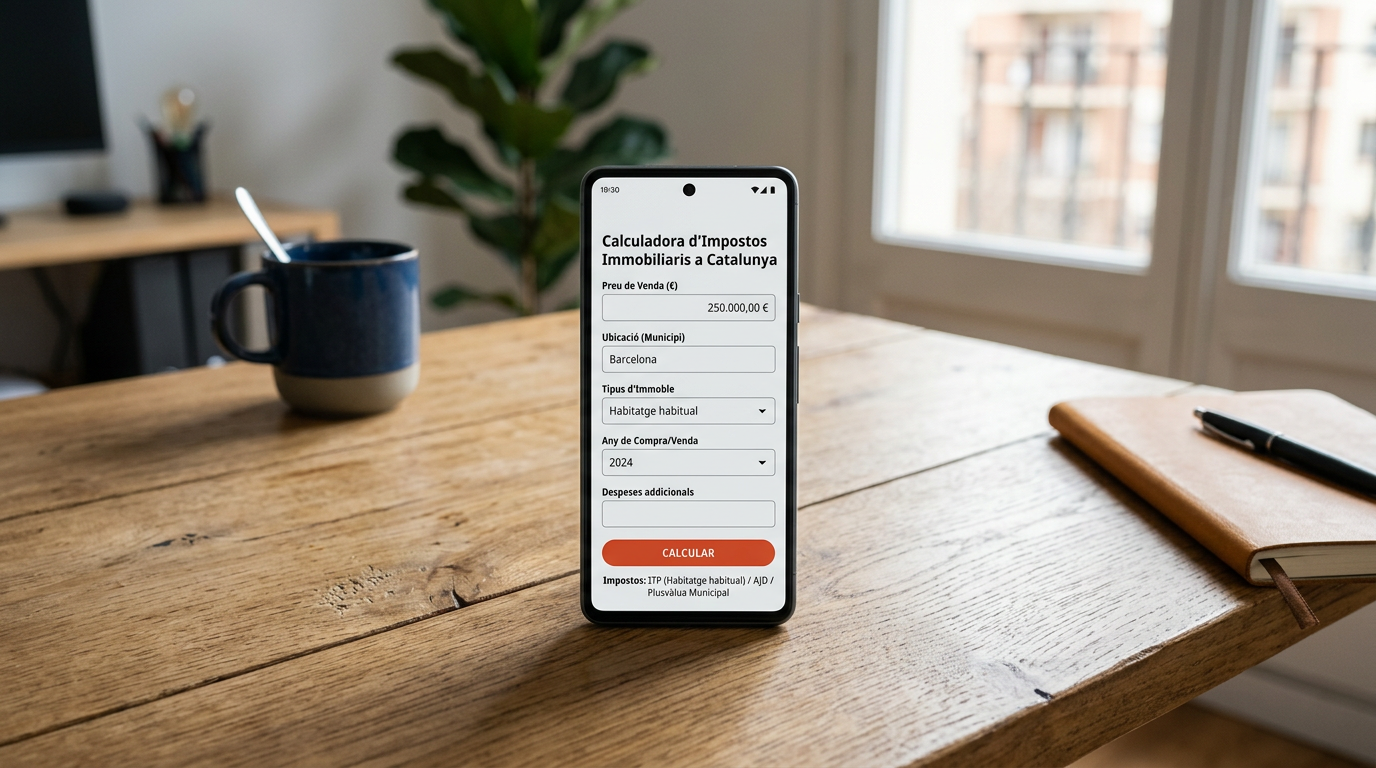
- Purchase of €300,000: As it does not exceed the first limit, the calculation is direct. 10% is applied to the entire price. The resulting tax is €30,000.
- Purchase of €700,000: Here, the first two brackets apply. The first €600,000 is taxed at 10% (€60,000) and the remaining €100,000 at 11% (€11,000). The total ITP amounts to €71,000.
- Purchase of €1,000,000: In this case, three brackets apply. The first €600,000 at 10% (€60,000), the next €300,000 at 11% (€33,000), and the final €100,000 at 12% (€12,000). The total amount payable will be €105,000.
How does the Cadastral Reference Value affect you?
There is a critical and recurring mistake among buyers: thinking that the ITP (Property Transfer Tax) is always calculated on the price agreed in the deed.
Since the entry into force of the Catastro (Cadastral) reference value, the taxable base of the ITP is subject to a strict rule. The tax will be calculated on the highest of the following values:
- The price or consideration agreed by the parties.
- The official reference value determined by the Dirección General del Catastro (Directorate General for Cadastre).
- The value declared by the interested parties themselves.
For example, if you buy an apartment for €280,000 but its cadastral reference value is €310,000, the Agencia Tributaria de Cataluña (Catalan Tax Agency) will require you to settle the ITP on the €310,000. Ignoring this reference value and settling for the purchase price will almost certainly result in a proposal for a provisional assessment with late payment interest.
If you consider that this value does not reflect the reality of the property (for example, if the property needs a comprehensive renovation that reduces its value), you must first file a self-assessment based on the official value and then request the rectification of the self-assessment by providing proof of its actual condition. To avoid these situations, it is essential to carry out an exhaustive tax and legal review of the property before making any down payment.
Reduced ITP rates in Catalonia
The Generalitat de Cataluña provides for various tax reliefs that significantly reduce the ITP bill, provided that the property is used as a primary residence and the buyer meets certain socioeconomic requirements.
Reduced rate of 5% for young people
This is one of the most frequently requested deductions. To benefit from the 5% ITP, the buyer must simultaneously meet the following conditions:
- Be 35 years old or younger on the date of the sale.
- The property must become their primary residence.
- Meet the income limit: the sum of the general and savings taxable bases, minus personal and family minimums in their last IRPF (Personal Income Tax) return, must not exceed €36,000.
This saving is highly significant. For a €250,000 property, the general rate of 10% would mean a payment of €25,000, whereas under the youth rate it is halved: €12,500.
Large families, single-parent families, and disability
There are other groups that can benefit from the reduced 5% rate when purchasing their primary residence:
- Large families: Requires that the sum of the taxable bases of the family unit does not exceed €36,000 (a limit that is increased by €12,000 for each child exceeding the minimum number required to legally qualify as a large family).
- Single-parent families: The same taxable base limit of €36,000 applies.
- Persons with disabilities: This applies when the buyer has a degree of disability equal to or greater than 65%.
Social Housing (VPO) and rural areas
The acquisition of officially protected housing (VPO) subject to ITP is taxed at the reduced rate of 7%. In addition to the tax advantage, purchasing a protected property requires a specific analysis to verify its maximum sale price and the administration's preferential acquisition rights. We advise you to review in detail the taxation and requirements of a VPO before signing.
Furthermore, super-reduced rates of 4% or 3% are applied for purchases in certain low-density rural municipalities or areas requiring special attention, with the aim of promoting population retention.
The special 20% rate for large property holders
With the aim of regulating the market, Catalonia applies an increased ITP (Impuesto sobre Transmisiones Patrimoniales - Property Transfer Tax) rate of 20% in home purchase transactions carried out by large property holders (grandes tenedores), or when entire residential buildings are acquired under certain commercial exploitation circumstances.
If you are an individual or corporate investor with a substantial portfolio, it is a priority to verify whether your profile fits this classification to avoid an unforeseen tax impact of double the general rate.
Taxes on new-build properties in Catalonia
If you are buying a brand-new home directly from the developer, the tax rules change completely.
IVA (Value Added Tax)
The tax rate for new-build homes is 10% at national level. This percentage also applies to a maximum of two parking spaces and annexes (such as storage rooms) that are transferred jointly in the same deed.
AJD (Actos Jurídicos Documentados - Stamp Duty)
In addition to IVA, the execution of the public deed of sale for a new-build property triggers the AJD (Actos Jurídicos Documentados - Stamp Duty) tax. In Catalonia, the general tax rate for these notarial documents is 1.5%.
Adding both taxes together, the indirect tax burden of a new-build property in Catalonia stands at 11.5% of the actual sale price.
Example: For a new apartment of €400,000:
- IVA (10%): €40,000
- AJD (1.5%): €6,000
- Total associated taxes: €46,000
Who pays the AJD on the mortgage?
It is essential not to confuse the AJD on the purchase contract with that of the mortgage loan setup. Following legislative changes in recent years, the AJD on the mortgage is paid entirely by the lending financial institution (the bank), meaning the individual buyer does not have to pay this fee.
Frequently asked questions about real estate taxes in Catalonia
How much time do I have to pay ITP or AJD?
The maximum period to file and pay the tax self-assessment (using Modelo 600) is one month from the date the public deed is signed.
Does a foreign buyer pay more taxes?
Not because of their nationality. Non-residents are taxed at exactly the same scales and percentages of ITP or IVA as Spanish citizens. However, they must pay special attention to the particularities of obtaining financing and verifying the origin of funds. You can consult our guide on taxes for foreign buyers.
What is the difference between the cadastral value and the reference value?
The cadastral value serves as the basis for the annual payment of IBI (Impuesto sobre Bienes Inmuebles - Property Tax), while the Cadastral reference value (valor de referencia) determines the minimum tax base for taxes such as ITP or Inheritance Tax. Knowing the difference between cadastral value and reference value will save you common confusions during the process.
Conclusion: Plan your budget before signing the deposit agreement (arras)
Taxes in Catalonia are complex and represent a very significant portion of the initial outlay when buying a property. Do not leave these calculations to the last minute or blindly rely on generic 10% estimates. It is essential that you know in advance the reference value (valor de referencia) of the property, whether you meet the conditions for reduced tax rates, and what the actual global expenses are.
To guarantee a secure transaction without financial surprises, it is recommended to gather all the documentation before committing with a deposit. At INMODOCS, we help you audit the tax and legal status of the property so that your only concern is enjoying your new home.

Before signing the deposit
If you are considering buying in Barcelona, read the full guide: Buying a flat in Barcelona without surprises.