
Buying a new-build property is an exciting project that conveys a great sense of security. The property is brand new, the installations are modern, the design is contemporary, and, generally, there are attractive renderings and a highly advanced quality specification.
However, buying a property under construction or off-plan also entails specific risks that should be identified in time. The construction may suffer significant delays, the final result may differ from the virtual recreations, the distribution of the area may undergo changes, or the developer might request financial payments without providing the guarantees required by law. For this reason, carrying out the due checks before buying a property is absolutely essential.
Before signing any reservation, private contract, or paying any amount, we explain in detail what to check when buying a new-build property to secure your investment from start to finish.
Before signing the arras agreement
If you are considering a purchase in Barcelona, check the complete guide: Buying a flat in Barcelona without surprises.
1. Check the solvency and identity of the developer
The first essential step is to precisely identify the developer entity with which you are going to sign the contract. It is very common that the commercial brand advertising the homes, the real estate agency in charge of the sale, or the construction company physically executing the structure do not match the commercial company that owns the development.
To certify the reliability of the seller, you must request and verify the following information:
- The full corporate name, NIF, and registered office of the developer. With this data, you can check in the Registro Mercantil if it is an active, solvent company with no legal incidents.
- The identity of the legal representative who will sign the contracts and the validity of their power of attorney to act on behalf of the company.
- The track record and experience of the developer. Researching previous projects by the same company will give you an idea of their quality standards and their history of meeting deadlines.
Remember that the bank account where you make the payments must belong to the developer signing the contract and never to intermediaries or third parties without a transparent legal justification.
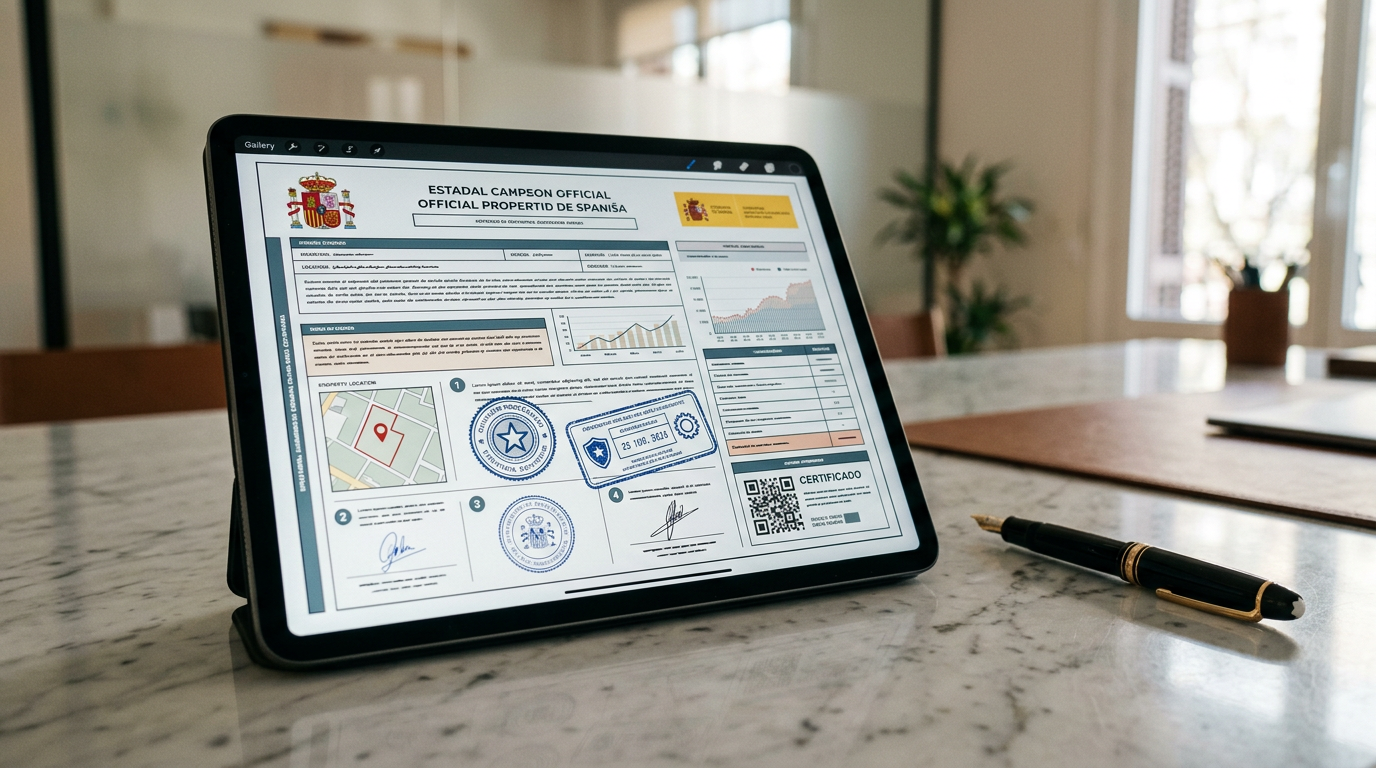
2. Review the registration status of the plot and the development
Even before the first brick is laid, the land on which the building will be located must be in order in the Registro de la Propiedad. Since the property under construction does not yet have an independent registered property sheet, a Nota Simple of the parent property (the original plot) must be requested. To do this, it is highly useful to know how to check property charges on the land.
When examining the registry, you must verify:
- Ownership of the land: The land must belong to the developer or, at least, they must prove a legal and sufficient right to build and sell.
- Registration of the new-build: Check if the declaration of new-build under construction (declaración de obra nueva en construcción) and the horizontal division (división horizontal) that individualizes each flat, parking space, and storage room have already been registered.
- Existing charges: Identify if there are any foreclosures, easements, or prior mortgages on the plot.
The developer's mortgage and subrogation conditions
It is extremely common for the developer to have financed the construction through a mortgage loan that encumbers the entire plot. The purchase agreement must clearly specify how the proportional part of that mortgage corresponding to your home will be canceled or if you have the option to subrogate into it.
Remember that, by law, the buyer is not obliged to subrogate into the developer's mortgage. You are completely free to arrange your own financing with any financial institution, and the seller cannot impose any penalty on you or charge you the costs of the registration cancellation of their loan.
3. Confirm that a building license exists
Every residential development requires the corresponding town hall to have granted the appropriate building license (licencia de edificación). Under no circumstances should money be handed over if the project lacks this municipal approval.
Obtaining a copy of the license will allow you to check the date it was granted, the number of floors and authorized homes, and the deadlines for the start and development of the works. In complex developments consisting of multiple construction phases, it is critical to ensure that the specific phase where your home is located already has its respective individual building authorization, and not just the general project.

4. Protect all advance payments: The bank guarantee
One of the essential legal pillars in acquiring off-plan properties is the protection of the money paid in advance before receiving the keys to the house.
In accordance with current legislation in Spain, regulated in the first additional provision of the Ley de Ordenación de la Edificación, once the building license has been obtained, the developer is required by law to guarantee the refund of all advanced amounts (plus the corresponding taxes and the legal interest on money) in the event that construction does not start or is not completed within the agreed deadlines.
What guarantees must advance payments have?
The developer must implement this protection through a surety insurance (seguro de caución) contracted with an insurance company or through a joint and several bank guarantee (aval bancario) provided by an authorized financial institution. For this protection to be effective, you must demand:
- The deposit of your funds into a special and restricted account, owned by the developer in a banking institution, destined exclusively for the payment of construction costs.
- The immediate delivery of an individualized guarantee certificate or individual insurance policy in your name specifying your details, those of the property in question, and the exact amounts contributed.
Do not let them convince you with the claim that there is a global policy for the entire development: you need a nominative and individualized guarantee so that your money is legally safe in the event of a bankruptcy or stoppage of the construction company.
5. Analyze the purchase agreement and its clauses
Until the formalization of the public deed before a notary, the private purchase agreement is the document that governs the contractual relationship. It is essential to perform a thorough real estate due diligence on this document to avoid the unconscious acceptance of abusive clauses.
Pay special attention to ensuring that the clauses transparently reflect:
- The precise identification of the property: The address, floor, door number, usable area, boundaries, and whether the annexes (garages and storage rooms) are independent or administratively linked.
- The agreed price and taxes: The cost of the property, the Impuesto sobre el Valor Añadido (IVA in the common territory or IGIC in the Canary Islands), and the exact payment schedule must be clearly broken down.
- Reciprocal penalty: If you default on a payment, the contract usually stipulates the loss of the amounts paid. However, this clause must be reciprocal and penalize the developer in equal proportion if they decide to withdraw or breach their obligations.
- Unilateral modification clauses: Strictly avoid clauses that give the developer the possibility to arbitrarily alter the design, common areas, or dimensions of the properties during the course of the construction.
To provide maximum security to the transaction, it is highly recommended to have a documentation review before signing service to check the legality of the contract.
6. Study the property plans and the quality specifications
Commercial brochures and promotional videos are not strictly contractual, but the detailed plans and the quality specifications (memoria de calidades) are legally part of the purchase agreement.
According to consumer information from public administrations, such as the Agencia Catalana del Consumo, the buyer has the right to possess:
- A to-scale plan of the property layout indicating usable and built areas, location of water inlets, sockets, air conditioning, radiators, or boilers.
- A detailed quality specification (memoria de calidades) listing the materials used, acoustic treatments, insulation, claddings, exterior and interior carpentry, and household appliances.
Avoid ambiguous expressions in the specifications such as "materials of equivalent quality" or "similar finishes". If you decide to contract customization options for the property design, demand that a written annex be drafted, signed by both parties, stating the variations in materials and their possible impact on the budget.
7. Properly regulate the delivery timeframe and potential delays
One of the greatest sources of conflict in the new-build sector stems from the delay in the delivery of a property. For this reason, the private contract must never reflect an excessively generic or indicative completion date.
The document must contain:
- An exact date or a very well-defined quarter for the completion of the construction.
- Un explicit schedule for processing licenses and the subsequent signing of the deed.
- The consequences and daily financial penalties for the developer if they do not deliver possession within the agreed timeframe.
- The clear definition of exceptional circumstances or force majeure that would justify an extension of the construction, protecting you against unfounded delays due to a lack of logistical foresight by the builder.
8. Demand all documentation before signing the deed
The physical completion of the construction works does not automatically enable the legal delivery of the flat. Prior to formalizing the sale before the notary, you have the right to demand a series of critical documents from the developer, also detailed by bodies such as the Agencia de la Vivienda de Cataluña:
- Certificado Final de Obra (CFO): Signed by the project's construction management, certifying that the works have been completed according to the plans.
- Licencia de Primera Ocupación (LPO) or equivalent urban planning responsible declaration: Essential to legalize residential use before the town hall.
- Cédula de Habitabilidad: Indispensable in autonomous communities like Catalonia to be able to register basic utilities.
- Certificado de Eficiencia Energética (CEE).
- Libro del Edificio: Contains the essential instructions for use, maintenance, and technical incidents of the property.
The seguro decenal and the cédula de habitabilidad
In newly built buildings in Spain, it is mandatory for the developer to have contracted a seguro decenal policy. This guarantee covers, for a period of ten years starting from the Acta de Recepción of the building, any direct damage caused to the property that originates in or directly affects the foundations, beams, load-bearing walls, or other structural elements, severely compromising the stability of the building.

9. Carry out the courtesy visit or defect inspection
Before signing before the notary and receiving your keys, you will have the right to carry out a verification visit of the property to confirm that everything has been built according to what was agreed.
Thoroughly checking a new home involves:
- Turning on all taps, flushing toilets, and ensuring there are no leaks or pressure issues.
- Turning all switches and sockets on and off, and checking the heating or air conditioning systems.
- Checking the tightness of double-glazed windows, the proper closing of interior doors, built-in wardrobes, and blinds.
- Meticulously examining the correct placement of tiling, potential cracks or poor joints in plaster, and paint imperfections.
Any detected deficiency must be chronologically recorded in a snagging list (acta de desperfectos), which will be signed jointly by the buyer and a technical representative of the developer, setting a tight deadline for its immediate repair.
10. Know the legal guarantees for construction defects
Even after carrying out a meticulous pre-sale inspection, it is common for what are commonly called "hidden defects" (vicios ocultos) to appear once settled in the property. The LOE establishes three time periods to demand liability from the agents involved in the construction, counted in all cases from the date of the handover deed (acta de recepción) of the construction:
| Period | Coverage of Damages and Defects |
|---|---|
| 1 Year | Material execution damages that directly affect the finishing elements (e.g., paint, flooring, door handles, plaster finishes). |
| 3 Years | Construction defects or installation failures that prevent or violate the objective conditions of habitability, health, or water tightness of the interior (e.g., dampness due to filtration, thermal or acoustic structural failures). |
| 10 Years | Material damages to the building caused by defects affecting the foundations of the structure, risking the integrity, stability, and structural suitability of the housing block. |
If you find yourself in this situation after the purchase, it is crucial to properly document the incident in writing in a technical and reliable manner, for which you should understand the protocols to claim for new-build defects.
Warning signs to halt a new-build purchase
At the slightest suspicion, it is advisable to postpone the delivery of monetary deposits or the signing of the contract when you perceive the following irregularities:
- The developer repeatedly refuses to provide you with their Número de Identificación Fiscal (NIF), the ownership of the land, or the details relating to the marketed municipal building license (Licencia de Obra).
- They intend to collect the reservation money or monthly installments in a standard current bank account, without immediately granting an individualized guarantee or surety policy.
- The contractual clauses stipulate only unilateral penalties for the buyer, leaving it to the sole discretion of the seller to vary the final price, substitute material brands, or delay delivery without any compensation.
- They impose the express subrogation of the mortgage contracted by the developer, preventing you from applying for financial options tailored to your credit profile with other institutions.
Interactive checklist of verifications
For your maximum convenience, you can use the following quick checklist to assess whether everything is compliant before purchasing your off-plan property:
- The plot on which the building is constructed is registered in the name of the developer in the Registro de la Propiedad.
- The development has an approved and valid building license from the corresponding town hall.
- You have a detailed floor plan of the property (broken down into usable and built area).
- The contract has a payment schedule with exact dates and an associated special account.
- Each advance payment is guaranteed to you through a nominative bank guarantee or an individualized insurance policy.
- You have received and formally accepted the detailed technical quality specifications of the interior finishes.
- The contract stipulates a fixed maximum delivery date with penalties for unjustified delays.
- The mandatory Seguro Decenal has been contracted for the residential real estate development.
- A prior inspection or finish control visit is carried out and a compliance report (acta de conformidad) is generated.
Frequently Asked Questions (FAQ)
Is it safe to buy an off-plan property in Spain today?
Yes, it is a highly regulated process with full guarantees, as long as the corresponding technical and legal checks are carried out regarding the developer, licenses, registration status, and payment guarantees.
What happens if the developer goes bankrupt and cannot finish the property?
If you have systematically demanded the individualized guarantee certificates or surety insurance corresponding to each of your advance deposits, you can enforce the guarantee to fully recover the amount paid to date, increased by the stipulated legal interest.
Can I select materials or change the original layout?
Many of today's developments offer very specific customization catalogs. However, any change or improvement in finishes over the parent project must be agreed in writing through a properly budgeted annex to avoid future discrepancies.
To whom should I address a claim for subsequent defects in the property?
The claim for rectification must be formally and reliably addressed (via burofax, for example) to the developer, who holds direct responsibility to the buyer, without prejudice to the individual responsibilities corresponding to the project's architect, surveyor, or contractor according to the LOE.
Conclusion
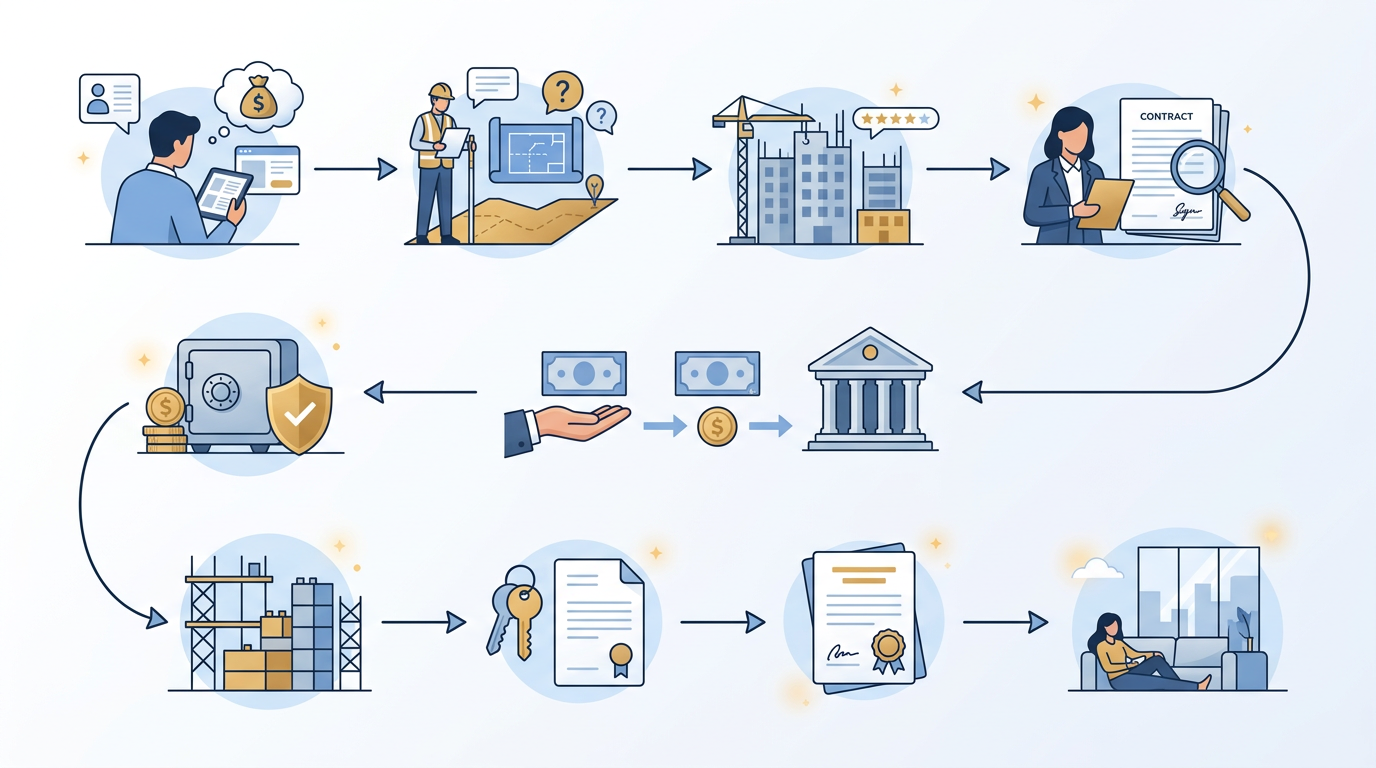
Determining what to check when buying a new-build property is the best defensive tool available to any buyer to safeguard their assets. When purchasing a home, the excitement of moving into a brand-new place should never detract from being rigorous and interested in analyzing the contractual foundations, technical licenses, and extensive financial guarantees on advanced money.
At INMODOCS, we exhaustively and professionally analyze all the legal documentation of the development, audit your purchase agreement, and verify the guarantee policies before you commit your savings. Safety in your off-plan purchase begins long before the doors of your new home open.
Note: This content is strictly for general informational purposes and in no case constitutes a binding legal analysis for a specific real estate transaction.