
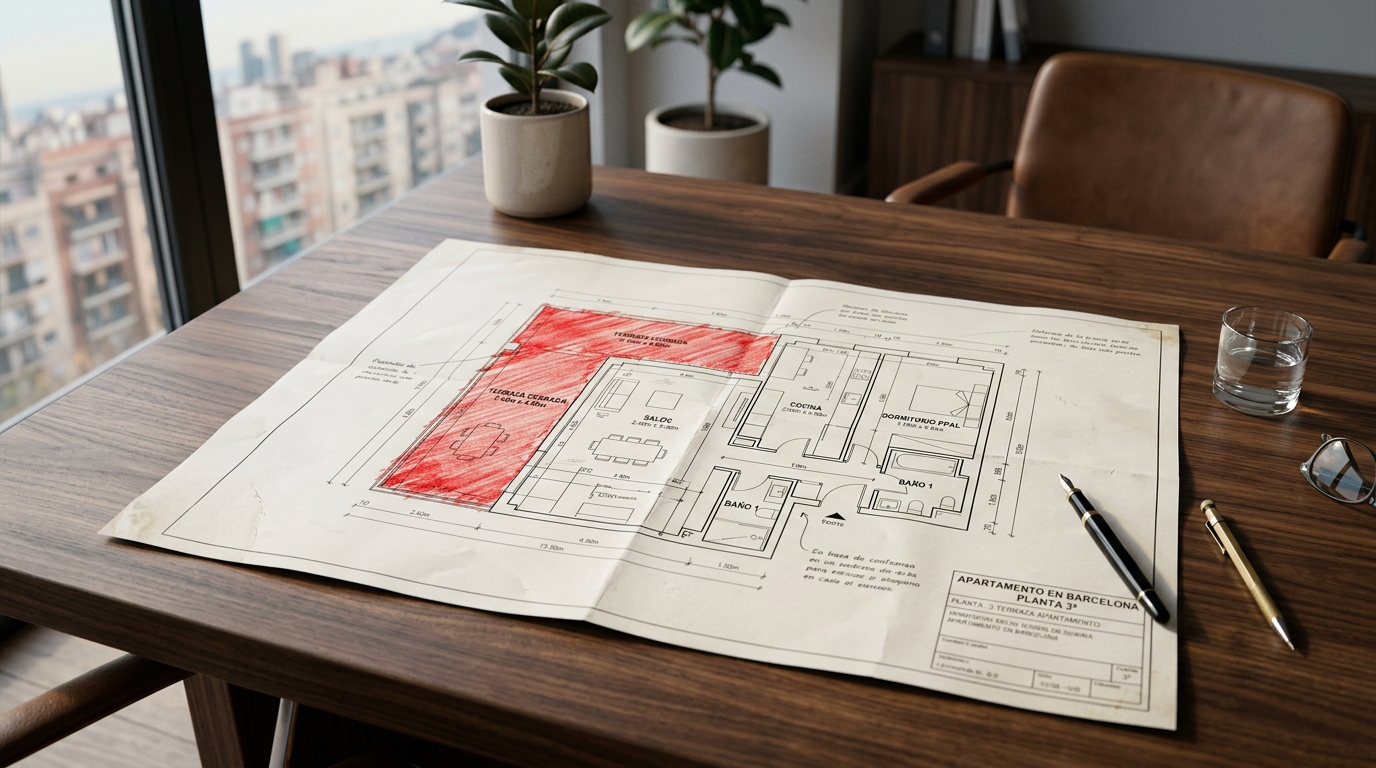
A property may seem like your dream home: renovated, with a spacious living room extended onto the terrace, a practical loft in the bedroom, or a modern open-plan design. However, in the Spanish real estate market, it is extremely common to find that these physical improvements are not recorded on any official document.
Buying a flat with unlegalised building work does not necessarily mean you should rule out the transaction immediately, but it does require you to tread very carefully. Before signing any document or paying a deposit, it is essential to determine precisely what was done, when it was done, what licences it required, and whether there is a risk of a fine or demolition.
In this article, we explain in detail everything you need to analyse so as not to put your savings at risk when acquiring a property with renovations that are out of planning conformity (fuera de ordenación).
What does it mean for building work to be unlegalised?
When we talk about an unlegalised renovation in a property, we refer to any modification of the layout, structure, use, or volume of the property that has been carried out outside of planning or community regulations.
In practice, building work can be in very diverse situations:
- Without any licence: It was carried out clandestinely without requesting permits from the local town hall (ayuntamiento).
- Breach of the granted licence: A permit was requested for one type of work (for example, minor interior renovations) but something entirely different ended up being executed (such as altering the structure or expanding the volume).
- Lack of technical documentation: The approved technical project and the certificate of end of works (certificado de final de obra) were never submitted.
- Without community authorisation: A common element (facades, downpipes, floor slabs) was modified without the necessary quorum of the co-owners' association (comunidad de propietarios).
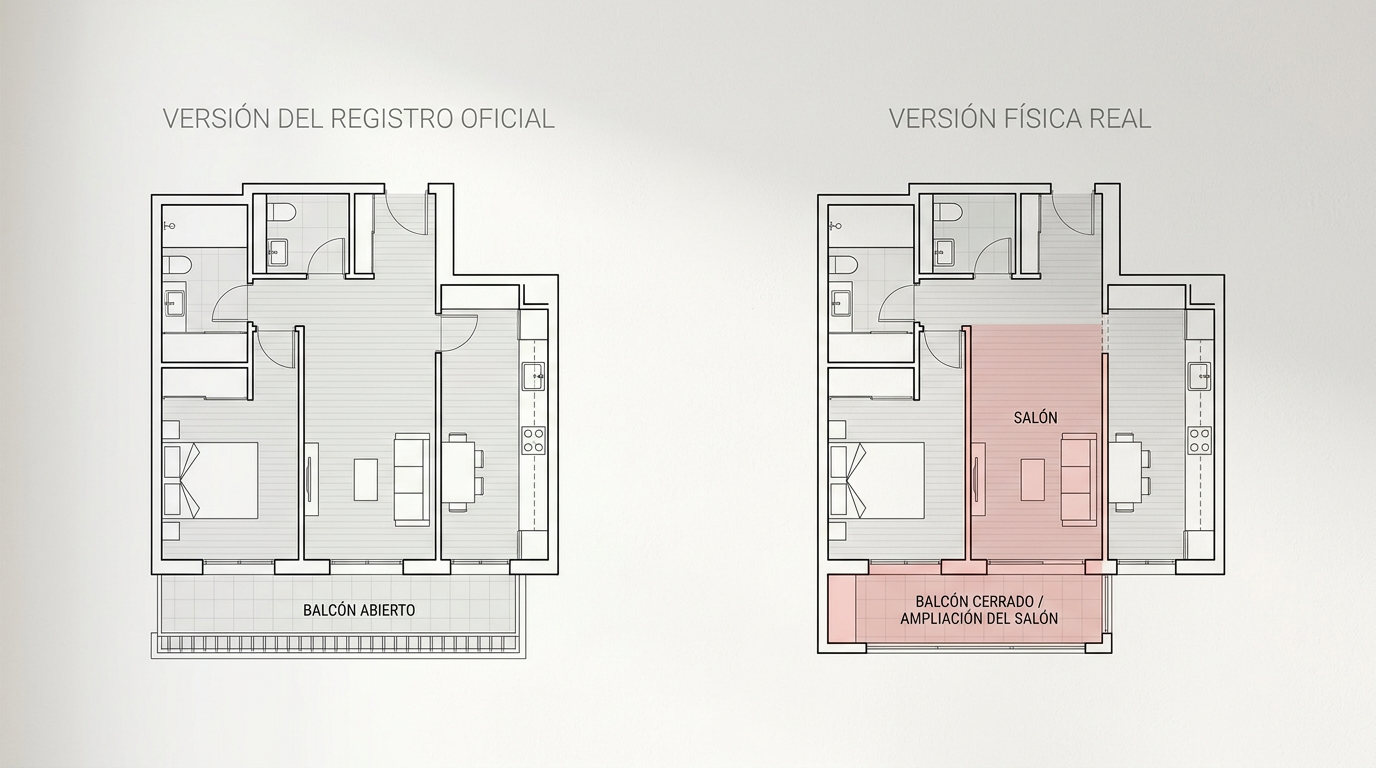
- Registry discrepancy: The extension physically exists but has not been registered in the Registro de la Propiedad (Property Registry) nor does it appear in the Catastro (Cadastre).
For example, if you are looking to purchase a property and need to comprobar las diferencias entre Registro y Catastro, you will see that many discrepancies stem from old renovations that were never declared. In cities like Barcelona, the Ayuntamiento (Town Hall) has a prior consultation system to determine what type of administrative procedure (major building licence (licencia de obra mayor), immediate notification (comunicado inmediato), etc.) each action required. Therefore, not all "unpermitted works" have the same level of severity.
Common building works that require reviewing the documentation
Not all unlicensed renovations carry the same level of risk. Changing bathroom tiles is not the same as incorporating a terrace into the living room or building a structural loft. If you are in the process of buying, pay special attention to these typical cases:
Enclosure of terraces or balconies
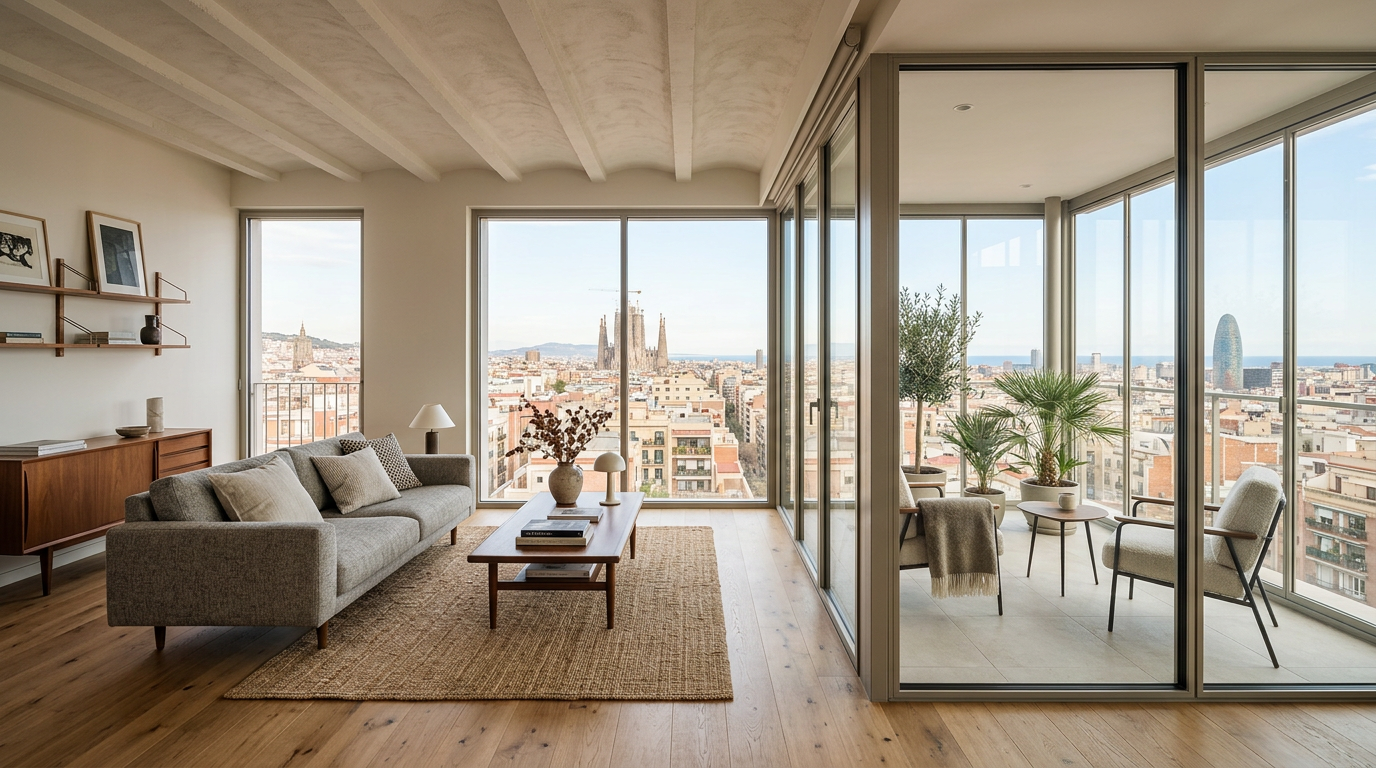
This is perhaps the most common case in Spain. Many owners decide to enclose the balcony with aluminium frames to gain usable square metres. However, buying a flat with an enclosed terrace without the proper municipal licence or the unanimous approval of the homeowners' association meeting (junta de propietarios) can lead to problems. In Catalonia, any modification that alters the exterior configuration or affects common elements strictly requires the agreement of the community.
Mezzanines and floor area extensions
An unlegalized mezzanine is often presented as an attraction of "additional square meters", but you must tread carefully. You should verify whether the clear height is sufficient to be considered habitable, whether the structure safely supports the load, and whether this surface area counts for zoning purposes. Do not make the mistake of financially valuing these meters at the same price as the rest of the registered surface area.
Courtyards and terraces for exclusive use
The "exclusive use" of a communal courtyard is often confused with its ownership. If the previous owner roofed over or built a permanent structure in a lightwell or communal terrace without permission from the community of owners and the town hall, you would be taking over a space that violates planning regulations, which the neighbors could demand you demolish.
Change of use from commercial premises to residential
Using former commercial premises as a residence without having processed the change of use license is a critical risk. In Catalonia, this process is strictly regulated and requires compliance with very precise technical and habitability guidelines. Before taking any steps, it is mandatory to check the occupancy certificate (cédula de habitabilidad) and confirm that the town hall has granted the corresponding license.
How to check if a renovation is legalized
To find out if the property you are interested in has had any irregular renovations, relying on the word of the seller or the real estate agency will not be enough. It is essential to actively cross-reference information through various channels, a key step in what needs to be checked before buying a home.
1. Public deed and Nota Simple
The first filter is to compare the physical reality of the property with what is described in the Property Registry (Registro de la Propiedad). If the apartment you are visiting has 110 m² built with three bedrooms and a large covered terrace, but the Nota Simple (land registry extract) indicates that it has 80 m², two bedrooms, and an open terrace, you are facing an unregistered extension.
2. Sede Electrónica del Catastro
The database of the Catastro (Cadastre) will provide us with information about the year of construction, the graphic surface area, and the layout on record with the tax authority (Hacienda). However, you must be very clear about one thing: the fact that a work is reflected in the Catastro does not mean it is legally compliant with town planning regulations. The Catastro is solely for fiscal and cadastral purposes; registering the square meters there does not remedy the lack of a municipal license.
3. Municipal planning file
To definitively rule out any contingency, it is highly recommended to request the property's building works file (expediente de obras) from the town hall. This will allow you to review the original plans, the licenses granted, the building notifications, and check if there are any active planning enforcement proceedings against the property.
4. Minutes of the Community of Owners
Reviewing the minute book and speaking with the property manager (administrador de fincas) will help you find out if the renovations that affected common elements (such as enclosures or merging apartments) had the express authorization of the community at the time or if, on the contrary, there are outstanding complaints or ongoing litigation.

Is it possible to legalize work done without a permit?
The short answer is: yes, but not always. The possibility of regularising building works depends exclusively on the renovation strictly complying with the local zoning regulations (planeamiento urbanístico) in force in the municipality at the time of requesting the legalisation (not when the work was done).
To legalise works in Catalonia, for example, a legalisation project signed by a competent technician (architect or technical architect) must be submitted to the town hall, paying the corresponding fees and construction tax (ICIO). If the works violate basic parameters such as the maximum buildability of the area, permitted heights, or habitability regulations, the town hall will deny the legalisation, which would leave you with a property in a "fuera de ordenación" (non-conforming status) situation or, in the worst-case scenario, with a demolition order.
Limitation periods: What happens if the works were done many years ago?
A very common sales argument from sellers is to claim that "since the works were done more than ten years ago, they have already prescribed and are completely legal". This is a half-truth that creates huge legal confusion.
In Catalonia, the Administration's action to demand the restoration of the altered physical reality (i.e., forcing the demolition or reversal of the works) is generally barred by the statute of limitations (six years after the complete completion of the works) provided that no disciplinary proceedings have been initiated. However, there are important exceptions where the restoration action never expires, such as works carried out in green areas, open spaces, public roads, or protected rustic land (suelo rústico protegido).
But the most important thing to understand is that the prescription of the sanction or demolition order is not equivalent to the legalisation of the works. The property will remain in a de facto "fuera de ordenación" legal status, which will significantly limit your options for future consolidation renovations, and could prevent you from obtaining activity licenses or renewed certificates of occupancy (cédulas de habitabilidad).
The impact on the appraisal and the mortgage
Buying a property with unpermitted works also has a direct impact on your pocket when applying for financing. When the bank's appraiser comes to value the property to grant the mortgage, they will compare the physical reality with the property registry records (registro de la propiedad).
If significant discrepancies are detected, the appraiser will apply warnings or conditions to their valuation report. In most cases, any square meters that are not properly registered or legalised will be valued at construction cost or, directly, excluded from the appraisal. This translates into a lower-than-expected total property valuation, and we already know how a discrepancy can affect the appraisal, forcing you to contribute a larger amount of your own funds to cover the difference that the bank will not finance.
How to protect yourself in the earnest money contract (contrato de arras)
If, after assessing the risks, you decide to proceed with the purchase of the flat, it is crucial to explicitly state this circumstance in the earnest money contract (contrato de arras). Do not limit yourself to signing a standard document. This is the time to protect the regularisation in the earnest money contract using specific clauses:
- Suspensive condition of legalisation: You can agree that the sale and purchase is subject to the seller obtaining and providing the corresponding legalisation licence before the signing of the public deed.
- Assumption of costs: If you decide to take charge of the legalisation yourself after the purchase, the estimated cost of the technicians, fees, and taxes must be deducted directly from the final sale price.
- Liability for defects and penalties: The contract must clearly specify that any penalty, fine, or administrative proceeding arising from works carried out prior to signing shall be the sole responsibility of the seller.
Avoid signing generic clauses where you declare that you "buy the property 'a cuerpo cierto'" (as a certain body/as is) or that you "know and accept the current physical and planning status of the property", as you would be releasing the seller from any future claims under these concepts. Make sure to demand all the documentation you must request before signing to draft the contract with full knowledge of the facts.
Conclusion
Buying a flat with unlegalised works does not have to be a bad decision if managed with the right information. However, it requires a thorough technical and legal analysis to avoid unpleasant surprises in the future in the form of fines, mortgage denials, or costly demolition processes.
Before taking any firm step, it is highly recommended to conduct due diligence before buying. At INMODOCS, we analyse in detail the land registry, cadastral, and planning situation of the property so that you sign your deposit agreement (contrato de arras) with absolute legal certainty. Do not pay for square metres or renovations that do not legally exist; protect yourself and secure your investment from start to finish.

Before signing the deposit
If you are considering buying in Barcelona, read the full guide: Buying a flat in Barcelona without surprises.