
Since June 27, 2025, the tax landscape for real estate investors and buyers in Catalonia has changed radically. The purchase of a pre-owned home, subject to the Impuesto sobre Transmisiones Patrimoniales Onerosas (TPO), can be taxed at a tax rate of 20% ITP if the buyer is tax-classified as a large property holder.
This measure, designed to discourage the accumulation of housing by certain profiles, can double the tax cost of a transaction. If you are considering buying a flat in Barcelona or in any other Catalan town, it is vital to understand how this regulation affects you to avoid an unforeseen financial impact.
In an average transaction, failing to perform this preliminary analysis can result in the loss of tens of thousands of euros. Therefore, knowing the taxes when buying a home in detail is mandatory before committing to an earnest money agreement (contrato de arras).
Which purchase transactions does the 20% rate apply to?
This specific 20% tax is aimed exclusively at transfers of real estate taxed under the Transmisiones Patrimoniales Onerosas (TPO) modality of the ITP. This means it directly affects pre-owned or second-hand homes.
New-build homes are excluded from this tax, as they are subject to Impuesto sobre el Valor Añadido (IVA) and Actos Jurídicos Documentados (AJD), since these taxes follow their own state and regional regulatory channels.
It is important to note that, for the purposes of calculating the taxable base and applying this tax rate, the regulations treat a storage room and up to a maximum of two parking spaces as part of the home, provided they are transferred together and located in the same building.

When is the status of large property holder acquired for ITP purposes?
For the Agencia Tributaria de Cataluña (ATC) to apply the special 20% rate (technically known as the TGT rate), the acquirer (whether an individual or a legal entity) must hold the status of a large property holder. The regulations provide three different ways to acquire this tax status:
1. Owners of more than 10 residential properties
Any person or entity holding more than 10 residential-use properties located in Catalonia is considered a large property holder. Under this general assumption, the numerical limit is triggered starting from the eleventh residential property.
2. Exceeding 1,500 m² of residential surface area
Even if the figure of 11 properties is not reached, a person will be considered a large property holder if the sum of the built surface area of all their residential-use properties in Catalonia exceeds 1,500 square meters. For this calculation, the built surface area recorded in the Catastro (Cadastral Registry) is taken as a reference, expressly excluding garages and storage rooms.
3. The critical threshold: five or more homes in stressed areas
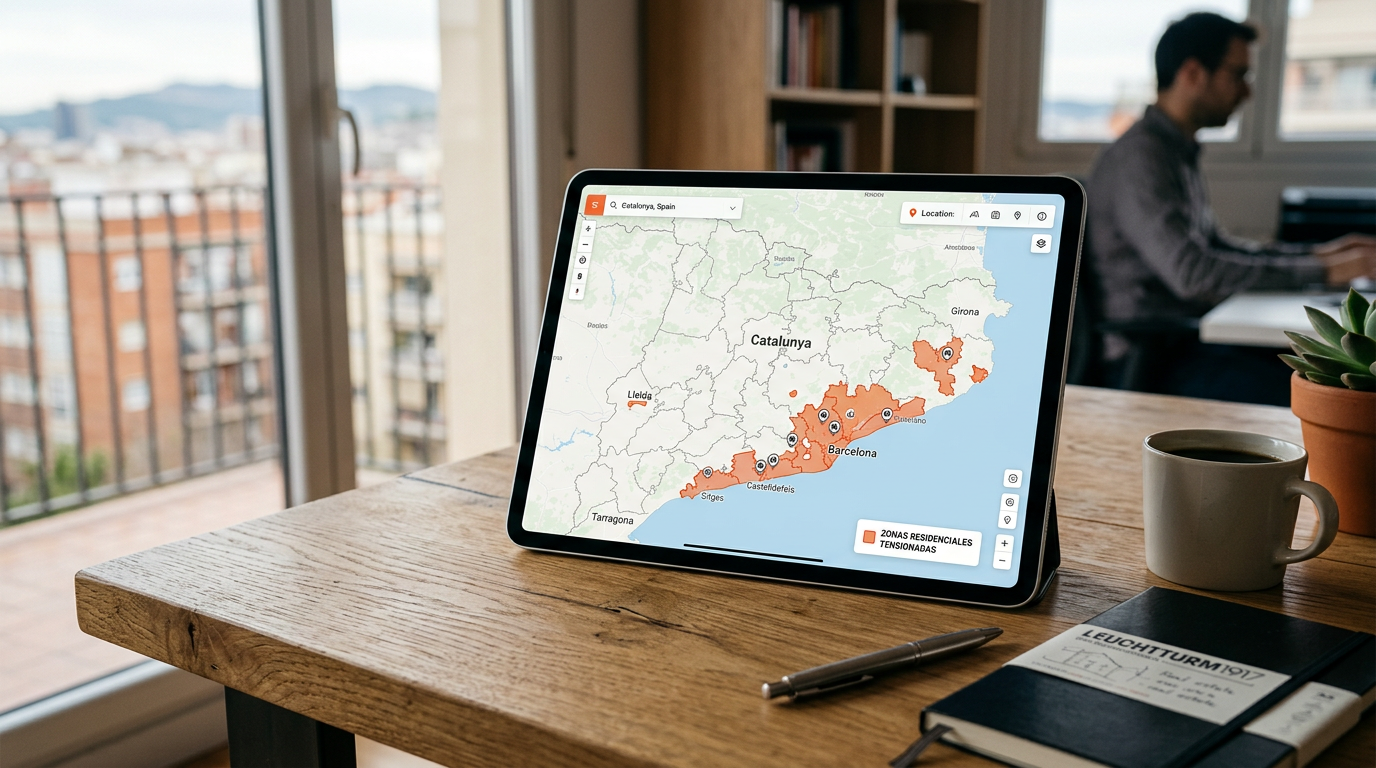
This is the most sensitive point for medium-sized investors. Large property holder status is acquired if you own five or more urban residential-use properties located in municipalities officially declared as stressed residential market areas (zona de mercado residencial tensionado).
Since Barcelona and a large part of its metropolitan area are classified under this label, it is extremely easy to fall into this category without owning a vast real estate empire. Therefore, it is essential to determine beforehand which municipalities are stressed areas before making a new purchase offer.
The key change from July 2026
At the beginning of this measure's implementation, for the five-property limit to count, the ATC (Catalan Tax Agency) required all of them to be located within the same stressed area declared jointly by the Generalitat.
Sin embargo, desde el 14 de julio de 2026, the criteria have become significantly stricter. Now, to reach the five-property threshold, properties located in any of the stressed municipalities of Catalonia are added together, even if they belong to different declarations or geographical areas.
- Example: If you own two properties in Barcelona, two in Badalona, and one in Sant Cugat, for tax purposes you already meet the requirement of having five properties in stressed areas and, therefore, you will be treated as a large property holder (gran tenedor) in your next residential acquisition.
To delve deeper into the calculation of your properties and confirm your profile, we advise you to read our guide on how to know if you are a large property holder.
Essential exceptions: primary residence and co-ownership
Not all acquisitions made by a large property holder are automatically subject to the 20% rate. There are highly relevant exceptions that should be analyzed in detail:
Does your primary residence count in the calculation?
The regulations of the ATC establish two important safeguards for individuals:
- Exclusion from the calculation: The property that constitutes the taxpayer's primary residence is not counted when determining whether the ownership limits are exceeded (whether 5 or 10 properties).
- Exclusion from the purchase: If the pre-owned property being acquired is to become the buyer's primary residence, the transaction is excluded from the 20% tax rate, applying instead the general ITP (Property Transfer Tax) rate or the reduced rates applicable to specific groups (young people, large families, etc.).
How are co-ownerships and inheritances taxed?
When you own a percentage of a property (due to shared inheritances or joint investments with partners or spouses), the calculation is not straightforward. The ATC usually performs an apportionment of the ownership percentages.
For example, holding 50% ownership of two properties is equivalent to one full property (100%) for the purpose of the total calculation of your real estate assets. It is advisable to thoroughly analyze each deeded percentage to avoid unintentionally falling into the category of a large property holder.
Bare ownership versus usufruct
Unlike what happens under the regulations of the LAU (Urban Leasing Act), where the usufructuary usually assumes the status of main landlord, for the purposes of ITP in Catalonia, both the person holding full ownership (pleno dominio) and the person holding bare ownership (nuda propiedad) of the property are counted as owners. A usufructuary without bare ownership does not add the property to this tax calculation.
The temporal factor: does the property you are buying count?
One of the most frequent doubts among buyers is whether the property being purchased is added to the total to determine if one is considered a large property owner (gran tenedor) prior to payment.
The position of the ATC (Catalan Tax Agency) is clear: the status of large property owner is assessed immediately prior to the tax accrual (which coincides with the moment of signing the deed of sale). The property being acquired in that act does not count towards determining whether you were already a large property owner before purchasing it.
- Practical case: If you own four properties in a stressed area (zona tensionada) and purchase two more properties simultaneously in the same deed, at the time of tax accrual you started with four properties. Therefore, neither of the two new acquisitions will be taxed at 20% for this reason. However, for your next purchase, you will start with a portfolio of six properties, meaning the seventh will indeed be penalized.
Practical examples: the real impact on your pocket
To understand the scale of this tax measure, let's analyze two scenarios of second-hand home sales in Barcelona.
Case A: Purchase of a €500,000 property
- Ordinary buyer: Applies the general rate of 10%. Pays €50,000 in ITP (Property Transfer Tax).
- Large property owner: Applies the TGT rate of 20%. Pays €100,000 in ITP.
- Cost difference: An additional €50,000 due to the buyer's status.
Case B: Purchase of an €800,000 property
For a standard buyer, Catalonia applies a progressive rate (10% up to €600,000 and 11% on the excess).
- Ordinary buyer: (€600,000 × 10%) + (€200,000 × 11%) = €82,000 in ITP.
- Large property owner: €800,000 × 20% = €160,000 in ITP.
- Cost difference: €78,000 in tax overcost.
In addition to the purchase price, it is essential to check the taxable base on which the ITP is calculated. If the Cadastral Reference Value (Valor de Referencia de Catastro) is higher than the agreed price, the 20% will be applied to that cadastral value, further increasing the tax bill.
Collective purchases: the 20% rate on entire buildings
There is another scenario set out in Catalan law where the 20% ITP rate can apply without the buyer needing to be a pre-existing large property owner. We refer to the acquisition of an entire residential building (TEH rate).
A residential building is understood as any property consisting of two or more residential units, with or without horizontal division. If a buyer acquires the building in its entirety under the TPO modality, the 20% rate will be applied to the total taxable base, regardless of their previous assets.
This measure seeks to limit bulk acquisitions by investors and requires a detailed analysis if the property has commercial premises, which are taxed under their own general rates.
What you must check before signing the earnest money contract
If you have an active real estate portfolio in Catalonia, before making any deposit or signing an earnest money contract (arras), you must compile a file with the following information:
- Inventory of residential properties in Catalonia.
- Exact location of each to check if they are in a stressed zone (zona tensionada).
- Built area according to the Catastro (Cadastre, excluding annexes).
- Exact ownership percentage and type of right (full ownership/pleno dominio, bare ownership/nuda propiedad).
- Use of each property (clearly identifying your primary residence).
- Reference value of the new property you wish to buy to calculate the complete cost of the purchase.
It is also essential to verify whether the transaction is subject to other preferential rights of the administration, such as the right of first refusal and retraction (tanteo y retracto) in transactions linked to large property holders, which could delay or frustrate the acquisition.

Conclusion
The application of the 20% ITP (Property Transfer Tax) for large property holders (grandes tenedores) in Catalonia is no longer a remote risk, but has become a fiscal reality with an enormous financial cost. An error in interpreting your properties or in calculating stressed zones can transform an excellent investment into a serious financial problem.
Prevention is the best tool. Analyzing your asset profile and the nature of the property prior to signing the earnest money agreement (arras) will guarantee legal certainty and economic viability in your real estate transactions.