
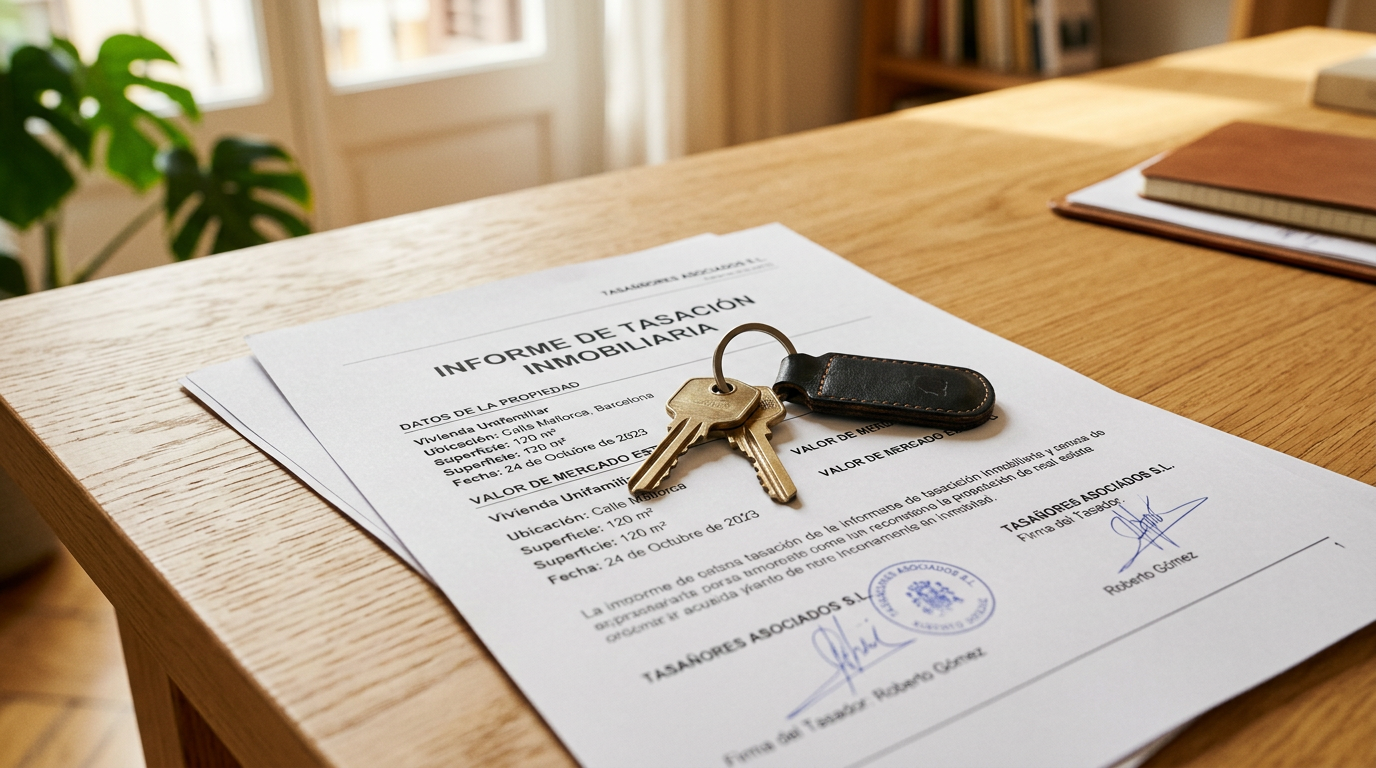
You have agreed to buy a flat for 500,000 euros, but the mortgage appraisal values it at 450,000 euros. At that moment, doubts arise: is the transaction cancelled? Is the seller obliged to lower the price? Will I lose the money already paid?
The reality is that an appraisal lower than the purchase price does not automatically cancel the sale, but it does create a significant gap in the financial viability of the transaction. The main obstacle lies in the fact that banks use the appraisal value as the basis for calculating the financing percentage. If the property is worth less to the appraisal company, the bank will lend you less money, forcing you to provide additional savings that you might not have budgeted for.
To avoid last-minute surprises and plan your finances realistically, it is essential to know how much money you need to buy and understand how the relationship between appraisal, mortgage, and earnest money (arras) works.
The major problem of an appraisal lower than the purchase price
When you apply for a mortgage, the bank needs to assess the real collateral backing that loan. According to the financial prudence guidelines of the Banco de España (Bank of Spain), credit institutions generally grant up to 80% of the appraisal value for the acquisition of a primary residence, although this percentage can vary depending on the client's profile.
The problem arises because many buyers mistakenly assume that this 80% will be calculated on the agreed purchase price. If the appraisal is lower than that price, the financial institution will apply the financing percentage to the appraisal figure (the lower of the two).
This creates a direct financial gap that the buyer must cover out of their own pocket using personal funds, in addition to the corresponding taxes and expenses associated with signing the deed.

What is the mortgage appraisal actually for?
The appraisal is not a mere bureaucratic formality or a price suggestion for the market. It is a technical valuation with legal validity. The Ley 5/2019 de contratos de crédito inmobiliario (Real Estate Credit Agreements Act) requires all properties offered as mortgage collateral to undergo an adequate appraisal before the loan is formalized.
This valuation must be carried out by an approved and independent appraisal company, using standardized methods for market comparison, state of conservation, and urban planning parameters.
However, a high appraisal is not synonymous with automatic mortgage approval. The bank will use this report as the maximum collateral limit, but will simultaneously analyze other crucial buyer factors:
- Job stability and net income level.
- Debt capacity (ensuring the monthly installment does not exceed 30-35% of income).
- Credit history and the absence of unpaid debts.
- Previous savings contributed to the transaction.
Therefore, a low appraisal makes it difficult to secure the requested amount, while a high appraisal simply validates the collateral but does not exempt the buyer from meeting solvency requirements.
The financing myth: Does the bank always lend 80%?
There is no legal regulation that obliges a banking institution to grant exactly 80% of the valuation of a property. This percentage is an industry standard conditioned by risk control policies.
In fact, depending on the applicant's solvency, the bank may choose to:
- Finance a lower percentage (e.g., 60% or 70%) if it perceives a medium risk in the client's profile.
- Finance 80% of the lower value between the purchase price and the appraisal value (the most common practice today).
- Offer financing higher than 80% in very exceptional cases, such as the purchase of the bank's own real estate assets or specific solvent profiles with additional guarantees.
Before committing to payments on account, make sure you know what to check before signing to avoid finding yourself without the financing you took for granted.

Practical example: The real impact on your savings
To clearly visualize how a low appraisal impacts your pocket, let's analyze the following practical scenario:
- Agreed purchase price: 500.000 €
- Mortgage appraisal obtained: 450.000 €
- Maximum bank financing: 80%
Scenario A: If the appraisal had matched the purchase price (500.000 €)
- The bank lends you: 400.000 € (80% of 500.000 €).
- Your own funds required for the price: 100.000 €.
Scenario B: With the actual appraisal of 450.000 €
- The bank lends you: 360.000 € (80% of 450.000 €).
- Your own funds required to complete the price: 140.000 €.
As can be observed, a 10% drop in the appraisal value compared to the agreed price translates into the obligation to immediately contribute an additional 40.000 euros as own funds. To this amount must be added, of course, notary, registry, agency fees, and purchase taxes (ITP [Property Transfer Tax] or IVA [VAT]).
Why can a property be appraised below its price?
It is common for buyers to wonder why a professional appraiser values a home below the price the market seems to accept. Discrepancies are usually due to regulated technical criteria versus speculation or buyer urgency:
- Evolution of the local market: The transaction price may be inflated by a high specific demand in a particular area, while the appraiser analyzes real transactions already registered in the Registro de la Propiedad (Land Registry) in recent months.
- Condition of the property: Issues such as the lack of an elevator, a poor interior layout, the need for structural renovations, or low energy efficiency penalize the technical valuation.
- Discrepancies in surface area: It is not uncommon to find differences between the actual built square meters, those listed in the Catastro (Cadastre) and those registered in the Registro de la Propiedad.
Practical solutions: What can you do if the appraisal comes in low?
If you find yourself in this situation, all is not lost. There are several courses of action to try to save the sale:
- Request a second appraisal: If you believe the initial report has errors or does not reflect the real value, you can independently hire another appraisal company approved by the Banco de España (Bank of Spain). The law requires banks to accept any appraisal provided by the client as long as it is valid (they are valid for 6 months) and issued by a certified entity.
- Review the appraisal report for errors: Meticulously check that the calculated square meters, annexes (such as garage or storage room), state of conservation, or the building floor are correct. A material error can be claimed to the appraisal company so they rectify the value.
- Provide more guarantees or other properties: If you have another property free of charges (or with a small mortgage), you can propose it to the bank as a double guarantee to compensate for the financing deficit.
- Negotiate the price with the seller: Presenting the official appraisal report to the seller is a very solid negotiation tool. If the market values the property at less, other buyers will likely face the same financing issue.
What happens to the earnest money contract (contrato de arras) if the appraisal is low?
This is the biggest source of legal conflicts in home sales. If you have signed an earnest money contract (contrato de arras) and the appraisal is so low that you cannot obtain the necessary money to buy, can you get your money back?
The answer depends entirely on the wording of the contract:
- If you included a termination clause due to mortgage denial: You might be protected. However, a low appraisal is not exactly the same as a loan denial. If the bank offers you the mortgage but for a lower amount, the seller could argue that financing has indeed been granted to you and refuse to return the earnest money (arras) if you decide not to buy.
- Specific regulation in Catalonia: Article 621-49 of the Civil Code of Catalonia (Código Civil de Cataluña) offers special protection to the buyer, allowing them to withdraw from the contract if the planned financing is not obtained, provided it is documentarily justified and there is no negligence. Even so, to avoid disputes, the ideal approach is to specifically detail in the contract what happens if the appraisal does not reach a minimum threshold.
If you are in a negotiation process, we recommend looking at how to regulate financing in the earnest money agreement to avoid legal loopholes that put your savings at risk. If the situation becomes complicated and the entity ultimately rejects the transaction, you can consult our article on what happens if the bank denies the mortgage to know the steps to follow.
Mortgage appraisal vs. Fiscal reference value (Valor de referencia fiscal)
A very common mistake is to confuse the appraisal value with the reference value of the Dirección General del Catastro (General Directorate of Cadastre). It is key to understand the [difference between appraisal and reference value]:
- The appraisal determines the limit of the mortgage loan that the bank will grant you.
- The fiscal reference value (valor de referencia fiscal) is the minimum value for which you must pay the purchase and sale taxes (such as the Property Transfer Tax - ITP, Impuesto de Transmisiones Patrimoniales).
If you buy for €500,000, the property is appraised at €450,000, and the fiscal reference value (valor de referencia) is €520,000, you will suffer a double negative impact: the bank will lend you less money based on the low appraisal, but your regional tax authority (Hacienda) will require you to pay taxes based on the €520,000 of the fiscal reference value.
Common mistakes you should avoid as a buyer
To navigate this process safely, avoid making the following typical mistakes:
- Signing the earnest money contract (contrato de arras) before having a viable feasibility study of your financial profile.
- Assuming that the bank will finance based on the purchase price.
- Not establishing a sufficiently long earnest money (arras) period to react if the first appraisal comes back low and you need to look for another alternative.
- Overlooking the associated expenses (approximately an additional 10-12% on top of the purchase price) when calculating your actual capacity to contribute personal funds.
The best strategy always involves analyzing the property before buying with professionals who can detect registry, zoning, or cadastral issues before you hand over a single euro as a deposit.
Conclusion: Protect your money before signing
An appraisal lower than the purchase price of a home can completely destabilize your financial planning. However, having the right legal and technical advice makes the difference between losing your savings in a poorly drafted earnest money contract (contrato de arras) or successfully saving the transaction.
At INMODOCS, we analyze the legal viability, the property documentation, and draft earnest money contracts (contratos de arras) that effectively protect you against any setbacks with the appraisal or the mortgage. Do not leave the most important investment of your life to chance.

Before signing the deposit
If you are considering buying in Barcelona, read the full guide: Buying a flat in Barcelona without surprises.