
Buying a property from an inheritance is not, in itself, a problem or a high-risk transaction. However, the scenario changes completely if the registered owner has passed away but the succession is not yet fully documented, there are multiple co-owners, an active usufruct exists, or some tax and registry procedures remain pending.
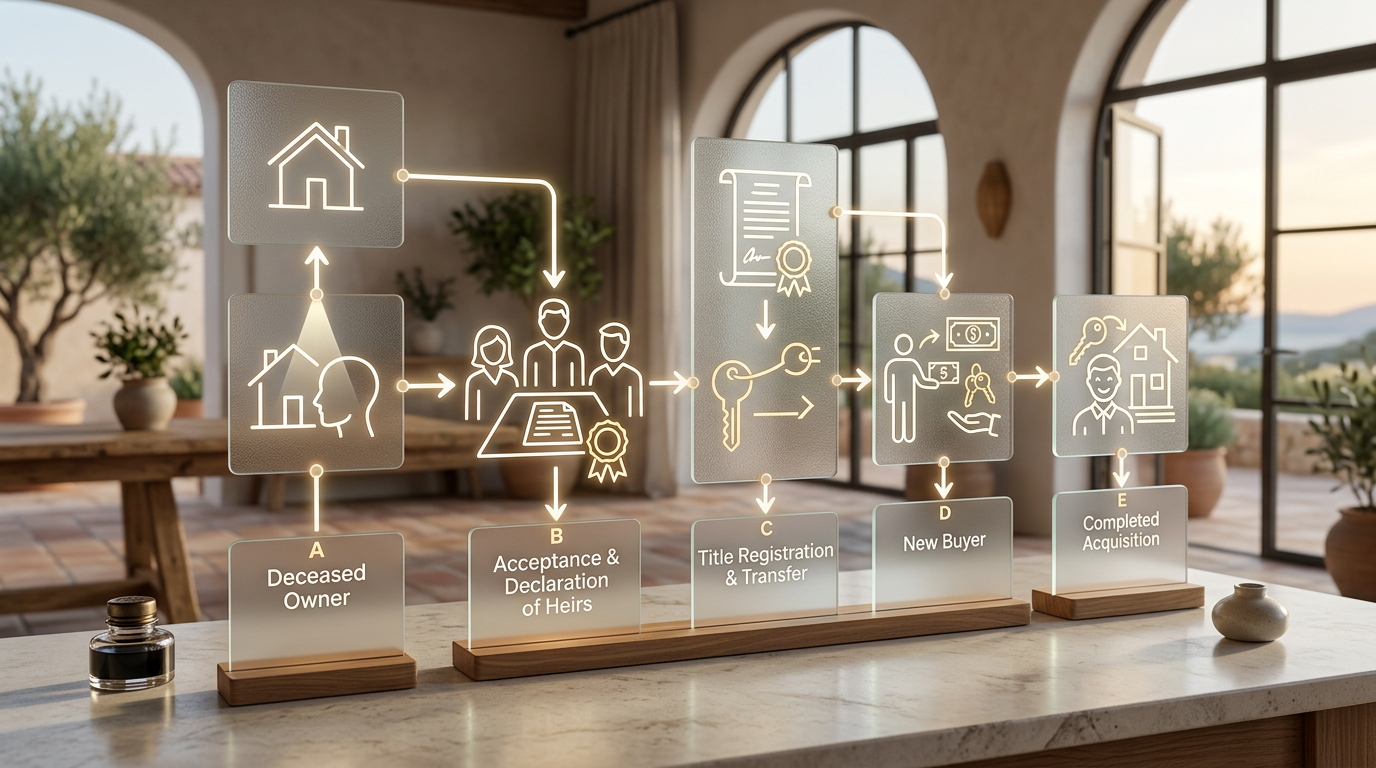
In regions like Catalonia, the heir acquires the inheritance upon acceptance, the effects of which retroact to the time of death. This acceptance can be express or occur tacitly through actions that only an heir could perform. But for you, as a buyer, the key question is much more direct and practical: can the people selling to you actually transfer 100% of the property legally and have it registered in your name without any setbacks?
To answer this with certainty, it is essential to carry out a series of checks before handing over any deposit or signing an earnest money agreement (contrato de arras).
1. Check who appears on the nota simple
The first essential step is to request and analyze an informative nota simple (property registry filing) from the Colegio de Registradores. This document will give you the current legal snapshot of the property. When checking who is listed as the owner in the document, you may find yourself with several scenarios:
- The seller themselves already appears as the sole owner.
- All heirs appear with their respective percentages.
- The owner is still the deceased person.
- One heir appears with bare ownership (nuda propiedad) and another person with the usufruct (usufructo).
If the property is still registered in the name of the deceased, it does not mean you should rule out the transaction. However, it does indicate that there is a succession chain (tracto sucesorio) pending documentation and registration. This inheritance pending registration in the Property Registry (Registro de la Propiedad) must be properly resolved and coordinated before formalizing the sale.

2. Has the inheritance already been accepted?
It is vital to distinguish between being called to inherit (being a legitimate or testamentary heir) and having formally accepted the inheritance. According to the Código Civil de Cataluña (Catalan Civil Code) and the common Código Civil (Spanish Civil Code), acquiring assets requires express or tacit acceptance by the beneficiaries.
If you are considering buying a flat from an unaccepted inheritance, you should know that the sale cannot be executed in a public deed (escritura pública). Before committing, you must demand to know exactly:
- Who the formal heirs are.
- Whether they have already executed the deed of acceptance (escritura de aceptación).
- How the property has been allocated and what percentage of ownership each one has.
- Whether there are specific legacies or usufructs affecting the property.
Do not rely solely on the word of the sellers when they claim they are "the only heirs." Legal documentation is the only real guarantee.
3. What inheritance documents should you request?
To carry out a risk analysis or a comprehensive property due diligence, it is necessary to collect and review the following succession documentation:
- Death certificate (certificado de defunción): Officially certifies the death.
- Certificate of last will and testament (certificado de últimas voluntades): Confirms whether the deceased made a will and before which notary.
- Will or declaration of heirs (testamento o declaración de herederos): The document designating the new owners (in the absence of a will, the deed of intestate declaration [acta de declaración abintestato] is required).
- Deed of acceptance and allocation of inheritance (escritura de aceptación y adjudicación de herencia): Where the distribution of the assets is formalized.
- Self-assessment of the taxes on the inherited home (Sucesiones [Inheritance Tax] and Plusvalía Municipal [Municipal Capital Gains Tax]).
Each file is unique. Negotiating with a sole heir is not the same as dealing with a sale involving several siblings or where a right of usufruct (usufructo) exists.
4. Can you buy an inherited home that is not registered?
It is possible that you may be offered an inherited home not registered in the name of the current heirs. In Spain, registration in the Land Registry (Registro de la Propiedad) is not mandatory (except in cases such as mortgages), but it is what provides legal certainty against third parties.
Buying a property in this situation implies that the notary will require the principle of consecutive tract (tracto sucesivo) in order to register your purchase. This means that, obligatorily, either in the same act or prior to it, the sellers' deed of acceptance of inheritance must be presented and registered. If you intend to finance the purchase, banks will rarely grant a mortgage on a property with a pending inheritance in the Land Registry (Registro de la Propiedad), so resolving this procedure is a priority.
5. Buying a house from several heirs: must they all sign?
This is one of the most common conflict points when buying a house from several heirs. If, after the allocation of the inheritance, the property belongs to three siblings in equal shares, a community of assets (proindiviso) is created.
For the sale to be fully valid and for you to acquire 100% of the ownership, each and every one of the co-owners must intervene and sign the deed of sale, or a legal representative who holds a sufficient power of attorney granted by them.
It is not enough for the sibling who manages the sale or the one who has the keys to sign the earnest money contract (contrato de arras) on behalf of everyone, unless they have express and documented representation. If a single heir opposes the sale, the transaction can stall indefinitely.
6. Beware of the usufruct on the inherited home
A very common provision in wills in Spain (and under the forced share [legítima] of the surviving spouse in Catalonia) is the division of the property right:
- Bare ownership (nuda propiedad): It is transferred to the children.
- Life usufruct (usufructo vitalicio): It is granted to the surviving spouse to secure their right to use the home.
If there is a usufruct (usufructo) on the inherited home, the bare owners (the children) cannot sell the full ownership on their own. In order for you to acquire the home free of this encumbrance, the usufructuary must intervene in the sale to transfer or waive their right, or its extinction must be proven (for example, through the death certificate of the usufructuary if they have passed away).
7. Check the property's prior liens and encumbrances
The fact that the property comes from an inheritance does not clear the property's history of debts. The heir acquires the assets, but also the obligations and encumbrances associated with them.
Therefore, it is vital to check the charges on the property to rule out the presence of active mortgages, judicial liens, tax liabilities, or easements. All these charges must be financially and registry-cancelled before or at the exact moment of signing your deed of sale.
8. Taxes on inherited property: Inheritance and Plusvalía
For the transfer of the property to be registered in the Land Registry, it is mandatory to prove the payment or filing of the taxes on the inherited property. The two key taxes that heirs must settle are:
- Impuesto sobre Sucesiones y Donaciones (ISD - Inheritance and Gift Tax): In Catalonia, the deadline to file it is six months from the date of death, extendable for another six. You can check the details at the Agencia Tributaria de Cataluña.
- Plusvalía Municipal (IIVTNU - Municipal Capital Gains Tax): It taxes the increase in the value of the land, and the taxpayer is the heir. The filing period is also six months from the date of death.
As a buyer, you are not responsible for paying these taxes of the seller, but you must ensure they have been filed. If they are not settled, the Land Registry (Registro de la Propiedad) will suspend the registration of your sale due to the registry closure for tax reasons.
9. Do you have to wait two years to buy an inherited property?
There is a widespread myth stating that you cannot buy an inherited property until two years have passed since the death of the deceased. This belief was based on the old Article 28 of the Ley Hipotecaria (Mortgage Law), which protected a potential real heir who might appear by surprise against non-forced heirs.
However, this article was definitively repealed in 2021. As explained by the Consejo General del Notariado, this two-year time limit no longer exists today. An inherited property can be sold and bought immediately after processing the inheritance, and banks grant mortgages on these properties without applying delay clauses.
10. Deposit agreements (arras) in an inherited property
If you have decided to move forward, the deposit agreement (contrato de arras) must be drafted with extreme care. Do not use a generic internet template. It is crucial to adapt the deposit agreement (arras) to the seller's situation and clearly reflect the status of the inheritance.
The contract for an inherited property under a deposit agreement (arras) must include specific clauses that condition the sale on the seller formalizing the acceptance of the inheritance, settling the corresponding taxes, gathering the signatures of all heirs, and resolving any registry charges before the deadline for signing the deed.
Likewise, before signing, remember to carry out the usual checks: request the certificate of outstanding debts from the homeowners' association, verify the payment of the IBI (Real Estate Tax) and review the technical state of the building (ITE - Building Technical Inspection), for which it will be useful to check community and IBI with actual documents in hand.
Conclusion
Purchasing an inherited property can be an excellent real estate opportunity, but it requires a rigorous analysis of the inheritance documentation to avoid inheriting someone else's problems. Before handing over funds as a reservation or earnest money deposit (arras), make sure to have specialized advice to validate the chain of title (tracto sucesivo), tax viability, and the legal capacity of the signatories.
At INMODOCS we analyze the inheritance documentation, the property registry report (nota simple), and the Cadastre (Catastro) to guarantee that your transaction is 100% secure and free of registry surprises.
Before signing the deposit
If you are considering buying in Barcelona, read the full guide: Buying a flat in Barcelona without surprises.